


Dear readers,
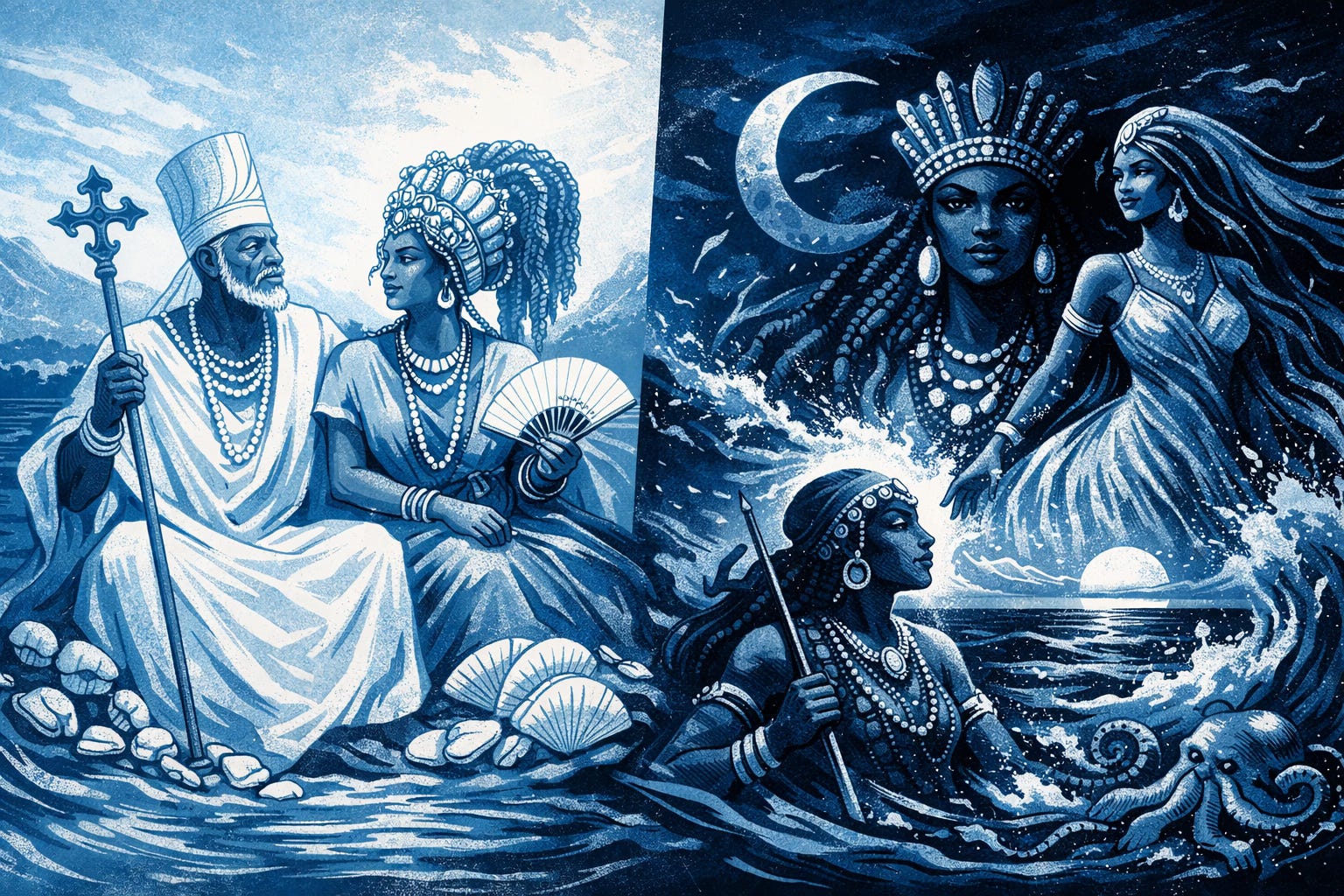
Among the better-known Òrìṣà, names such as Ọbàtálá, Yemọja, Ọ̀ṣun, Ṣàngó, Ògún, and Ọ̀rúnmìlà circulate widely. Yet beneath that familiar layer lies a quieter and older sacred grammar—one preserved in Ifẹ̀-centered memory, local shrines, oral theology, and house lineages rather than in the simplified lists that often dominate popular summaries. It is within that deeper current that Yemòwó appears: white-clad, maternal, and profoundly dignified, the consort of Ọbàtálá, an elder among water powers, and one of the most refined images of gestational protection in the Yorùbá sacred imagination. In the most accessible scholarly overview now available, Yemòwó is described as the most superior female deity, the wife of Ọbàtálá, a general water goddess not tied to one specific river, Ìyá-Ayé (“Mother of the World”), Olórí-Bìrìn (“Head of Women”), and a power especially revered by women seeking children.
That description matters because it places Yemòwó far above the category of a “minor” or merely domestic goddess. She belongs to the theology of origin, protection, and continuity. If Ọbàtálá gives shape, coolness, composure, and the white architecture of life, Yemòwó is the maternal water that makes life inhabitable before it enters the public world. She is not simply “water” in the broad sense. She is enclosing water—the kind that protects before emergence, sustains before naming, and surrounds the unborn with sacred continuity. That logic is entirely consistent with the older Ifẹ̀-centered memory in which her role survives most clearly. Both lexicographic and summary sources note that her worship became increasingly localized in Ifẹ̀, even while the cult of Ọbàtálá remained widespread.
The name itself is also worth handling carefully. Modern devotional interpretation often hears in Yemòwó an association with maternal abundance and wealth. But the accessible lexicographic evidence does not support the simplistic reduction of the name to “mother + money” in a literal modern sense. Rather, the strongest public lexical note glosses the name as deriving from ìyá / iye + mòwó, and explicitly marks Yemòwó / Yémòwó as an Ifẹ̀-centered theonym. That means the richer theological reading is preferable to a crude literal one: Yemòwó is not “money” as cash, but maternal abundance, the blessing that makes continuity possible—fertility, children, shelter, viability, and the wealth of survival itself.
Yemòwó and Ọbàtálá: the marriage of form and enclosure
In Yorùbá theology, Ọbàtálá stands for whiteness, clarity, coolness, moral composure, sacred seniority, and the shaping dimension of creation. He is associated with the ordered, refined, cooling aspect of existence—the principle that prevents life from collapsing into frenzy or disorder. In the public record, Yemòwó is specifically identified as his consort. In fact, even brief summary entries preserve that pairing as central: Yemòwó is a water-and-creation deity whose spouse is Ọbàtálá.
The spiritual brilliance of this union is easy to miss if it is read only as mythic marriage. It is far more than that. It expresses a metaphysical law: life requires both form and shelter. Form without shelter fractures. Shelter without form remains undifferentiated. Ọbàtálá shapes. Yemòwó preserves. Ọbàtálá cools and orders. Yemòwó encloses and nourishes. The old saying preserved in a recent scholarly summary of the Ọbàtálá festival in Ilé-Ifẹ̀—“Òrìṣà-Nlá saw the possibility of marrying 200 wives yet cleaved to Yemoo”—is therefore not trivial romance but a statement of theological compatibility. Among many possibilities, divine form cleaves most deeply to the force that can hold life gently.
This is precisely why Yemòwó should not be flattened into a generic maternal category. She is the inner sanctuary of creation. She is the watery hush before biography begins.
Why Yemòwó is not simply another name for Yemọja
Because both are maternal water powers, modern retellings often collapse Yemòwó into Yemọja. That is too simple. Yemọja is a major and widely loved mother-Òrìṣà, but in strict Yorùbá theology she is, above all, a river deity, especially associated with the Odò Ògùn (Ogun River) and other inland waters. Crucially, in Yorùbáland it is Olókun, not Yemọja, who fills the role of the sea deity. Only in the Atlantic diaspora—especially Brazil and Cuba—does Yemọja / Yemanjá / Yemayá become primarily identified with the ocean.
That distinction clarifies Yemòwó’s place. Yemọja is maternal flow in an expansive, public, moving sense—riverine continuity, nourishment, motherhood that travels, the broad current of life. Yemòwó belongs to a more intimate and interior register: not the public river, but the protective water of gestation, enclosure, and first viability. In other words, Yemọja is often the great moving mother, while Yemòwó is the holding mother. The two overlap, and later lineages sometimes fold one into the other, but their emphases are not identical. The historical reduction of Yemòwó’s cult to Ifẹ̀, combined with the far wider diffusion of Yemọja, helps explain why later traditions often remember Yemòwó through Yemọja rather than alongside her.
Yemòwó in Ifẹ̀: a localized memory, not a marginal one
The fact that Yemòwó is less publicly visible today should not be mistaken for insignificance. Several sources point in the same direction: her cult became especially localized in Ifẹ̀, the ritual and historical heartland of Yorùbá civilization. Even outside direct theology, this survives in the sacred topography of the city itself. Ita Yemoo remains one of the best-known archaeological place names in Ilé-Ifẹ̀, associated with major excavations and important art-historical finds. Older art-historical scholarship also notes that Yemo / Yemoo had shrines at Ifẹ̀ alongside the cultic presence of related primordial figures. (journals.openedition.org)
This should be read correctly: Yemòwó is not “obscure because unimportant.” She is esoteric because localized, and localized because Ifẹ̀ retained older layers of divine memory that later public religion often redistributed among more widely diffused mother deities.
Olókun: depth, sovereignty, and the waters beneath all waters
No serious treatment of Yemòwó can stop at her alone. The wider water theology around her opens naturally into the mystery of Olókun. In public summaries, Olókun is the deity of the bottom of the ocean, ruler of all waters, and the source of wealth, health, and prosperity. Just as importantly, communities across West Africa and the diaspora understand Olókun as female, male, or androgynous, depending on place, lineage, and ritual framework. One concise reference captures the core distinction well: in coastal West African settings Olókun often appears in a male form, while in inland or hinterland settings Olókun is more often remembered as female; in broader Yorùbá thought, Olókun is marked by a kind of gender duality or balance rather than a single fixed sex.
That fluidity is not confusion. It is theology. Olókun is depth—the hidden, pressurized, treasure-bearing, dangerous, healing, and immeasurable side of reality. Depth does not fit cleanly into ordinary social categories. The deep sea nourishes and terrifies; it conceals riches and swallows ships; it hides both memory and force. This is why Olókun is linked not only to water, but to hidden wealth, serious healing, majesty, secrecy, and the part of life that the visible surface cannot explain. Public summaries consistently preserve this: Olókun is associated with the bottom of the ocean, the authority over other water deities, and the power to grant great wealth. Olókun is also widely remembered as the parent of Ajé, the power of wealth.
This is also where the comparison between Africa and the diaspora becomes especially important. In Yorùbáland, Olókun remains the deep-water sovereign. In Brazilian Candomblé, Olókun is recognized as a divinity of great African importance but historically occupies a much less public place than orixás such as Iemanjá or Oxalá; available summaries note that Olókun is recognized in terreiros, often understood as the mother of Yemoja and owner of the sea, but traditionally has no major public xirê cycle of her own. In Santería, by contrast, Olokún remains highly significant and is often treated explicitly as an androgynous or dual-gender orisha, with different ritual expressions in Ifá and Ocha.
The “nine daughters” of Olókun: fixed canon, regional memory, and house theology
The so-called “nine daughters” must be approached with both reverence and precision. There is no single universally fixed pan-Yorùbá list, publicly attested in the same way as the great major Òrìṣà. What exists instead is a layered structure:
First, there is the broad and well-attested theology of female water powers in Yorùbá religion, with Yemòwó, Yemọja, Ọ̀ṣun, and related figures holding major places. Second, there are older regional traditions, especially coastal and lagoon-centered ones, that preserve distinct aquatic beings such as Olóṣà. Third, there are house-preserved and diaspora lineages, especially in Brazilian and Cuban circles, where some names survive as independent powers, some as “roads” or manifestations of other goddesses, and some as retinues or grouped assistants. Even the number nine itself is not always organized identically: in some Afro-Cuban houses, for example, the number nine appears not as nine universally named daughters, but as a cluster of Olosá attendants in nine covered vessels serving the Olókun current. (Springer)
So the deepest and most accurate reading is this: the “nine daughters” are best understood as a sacred hydrology—a way of differentiating the powers of water—rather than as a universally standardized genealogical chart.