


Dear seekers of wisdom,
“The river does not shout that it is deep;
it is the careless one who discovers it with both feet.”
There are truths in life that do not need noise. They move quietly, but they shape entire destinies. They form families, vows, bodies, wounds, blessings, and generations.
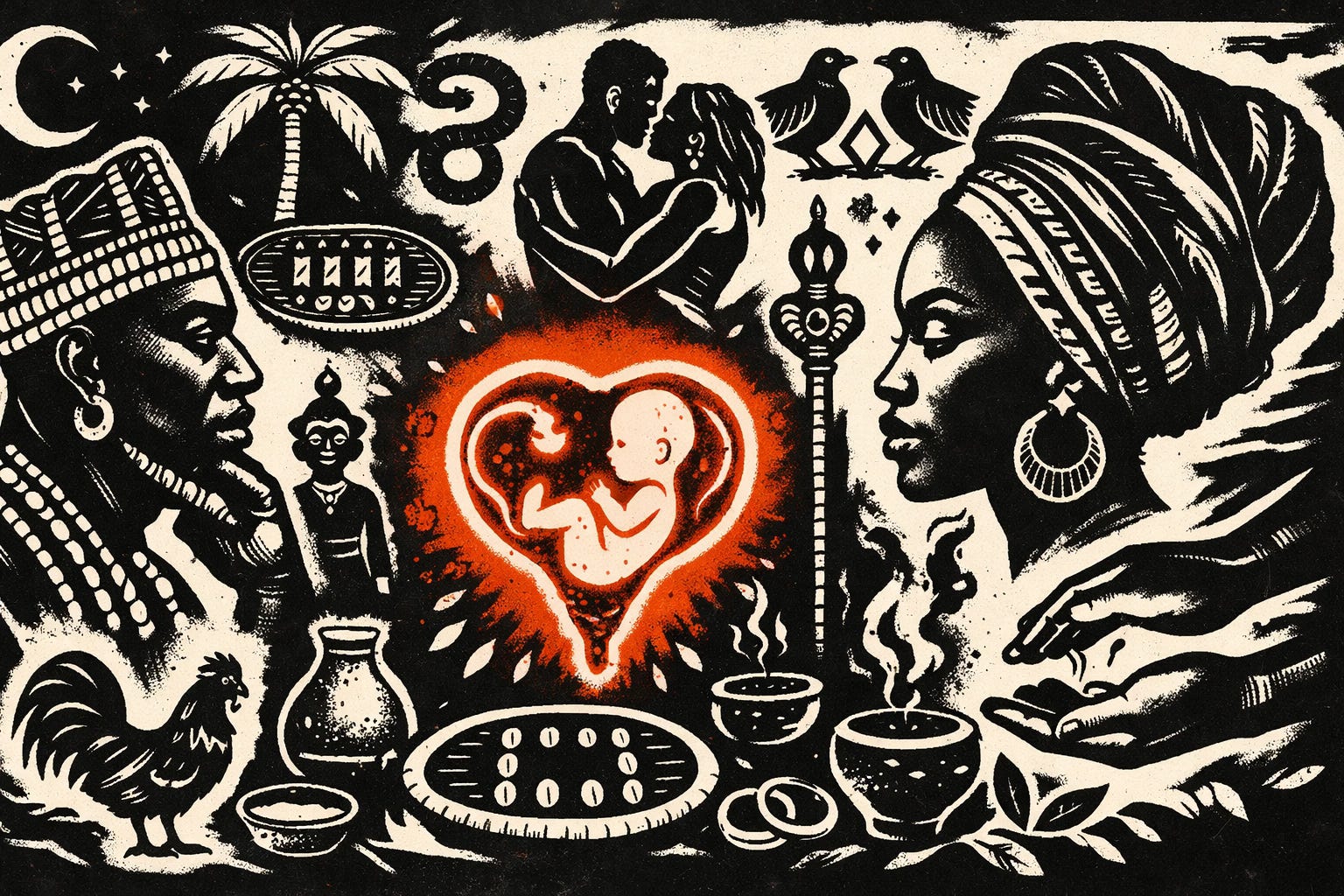
This is one of the reasons many readers, after years of studying the Odu Ifá, begin to notice something curious. The texts speak often about marriage, fertility, menstruation, childbearing, jealousy, adultery, health, covenant, and taboo. Yet they seem to speak less often in the blunt, modern language of “sex” and “sexuality.”
At first, that silence can look like absence. But it is not absence. It is method.
Why Does Ifá Rarely Speak of Sex Directly?
This week we sit with a subtle question: why do the Odu so rarely sound explicit about sex, even though bodily union is one of the great engines of earthly life?
The answer, as I hear it through Òdí Méjì and its echoes in related Odu, is that Ifá is not uninterested in sexuality. Ifá is deeply interested in it. But it refuses to reduce sexuality to spectacle.
It does not speak of desire merely to entertain curiosity. It speaks of desire as power. It speaks of the body as covenant. It speaks of union as consequence.
It speaks of blood, seed, womb, lineage, timing, and character.
This is why so many verses and stories in the corpus do not isolate sex as a separate topic. Instead, they place it inside larger spiritual realities: fertility, family, jealousy, procreation, illness, order, taboo, blessing, or misfortune. That pattern is visible across all odùs, especially in the ways menstruation, semen, conception, and promiscuity are handled.
Sex in Ifá Is Usually Hidden Inside Consequence
This is where many modern readers misunderstand the silence of sacred texts. They assume that if something is not described bluntly, it must have been ignored. But sacred traditions often hide powerful truths in veils, not because those truths are unreal, but because they are too potent to be treated casually.
Fire is not handled carelessly because it is weak. Fire is handled carefully because it is real.
So it is with sexuality in Ifá.
Again and again, the Odu bring us back not to spectacle, but to consequence. Desire can lead to tenderness, children, continuity, and joy. But it can also lead to jealousy, betrayal, spiritual entanglement, disease, distraction, and the breaking of peace.
In one strand of your corpus, Òdí Méjì links semen and menstruation with the mystery of human procreation itself. In another, Ogbè-Dí tells of a woman whose monthly flow would not stop until divination and ritual restored the path toward conception. In Ìrètè, warnings appear against promiscuity and adultery, not as empty moralism, but as practical spiritual caution tied to suffering and imbalance.
So the question is not whether Ifá speaks about sex. It does. The deeper truth is that Ifá usually speaks about sex through what sex creates, disturbs, blesses, binds, or endangers.
What Òdí Méjì Reveals About Desire and Creation

This is why Òdí Méjì is such a powerful doorway into this conversation. Òdí carries the feeling of enclosure, gestation, hidden process, and inner formation. It points us toward the mysteries that develop in silence before they become visible in the world. That alone already tells us something important: not everything sacred is meant to be displayed.
When Òdí speaks of reproductive fluids and the process of human creation, it is not descending into vulgarity. It is revealing that life is made through hidden agreements between body and destiny.
The womb does not publish its work. Blood does not ask permission to be holy. Seed does not announce the future before its time. And yet all of these belong to the architecture of existence.
This is why Ifá’s handling of sexuality often feels more mature than modern discourse. The modern world is very comfortable describing desire, but not always wise in interpreting it. We can say everything and still understand very little.
Ifá chooses another path. It asks what desire is serving. Does it serve life? Does it serve peace? Does it serve lineage? Does it serve health? Does it serve Ori? Or does it simply obey appetite?
That is the sharper question.
Silence, Reverence, and the Sacred Body
In some of the more contemporary interpretive layers found in ancient library, especially around Ìwòrì, the language becomes more direct. There we begin to see explicit references to sexual appetite, pregnancy, orientation, and bodily conduct in a tone that feels closer to modern commentary than to old ritual verse. That difference is important. It reminds us that not every voice inside an Odu book belongs to the same historical moment or the same literary style.
Older ritual-poetic language often protects intimacy with symbol. Later interpreters may choose to explain more openly. Both have value, but they should not be confused.
And this gives us a wiser conclusion. Ifá is not prudish. Ifá is consequential.
It is less interested in erotic display than in the architecture of life that sexuality creates. Does your desire build a peaceful home or a storm? Does your intimacy brighten your Ori or burden it? Does your union ripen into covenant, healing, and fruitfulness, or scatter itself into regret?
These are Ifá’s questions. And they remain urgent today.
Closing insight
Perhaps the reason Ifá does not always speak of sex in blunt language is that it is trying to protect us from becoming shallow in the presence of power.
The modern world often asks, “How far can desire go?” Ifá asks, “What does desire answer to?” That is the wiser question.
The river does not need to announce its depth. It only asks whether you will enter with reverence.
Stay blessed, and may your Ori choose sweetness with wisdom, intimacy with dignity, and desire with destiny.
Babá Tilo de Àjàgùnnà
DAILY IFÁ ACADEMY
For supporting subscribers
In the deeper section of this newsletter, we go further into what this teaching means for spiritual development, health, love and family, and wealth. We will also look at when this Odu becomes especially relevant, the difference between its Ire and Osogbo expressions, and a simple home practice to cool restless desire and restore dignity to the body.