


Seekers of wisdom,
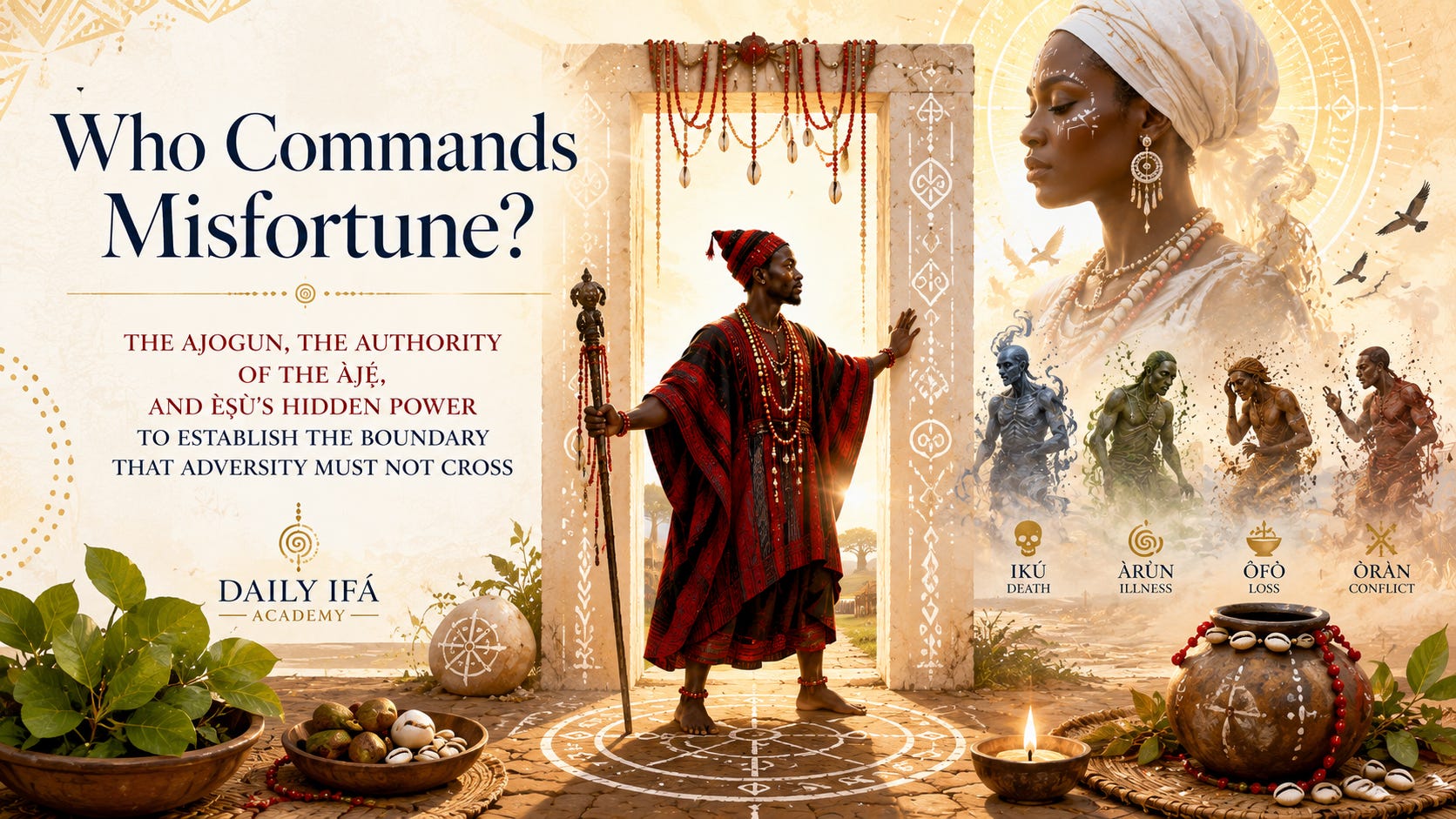
adversity rarely enters a life with a trumpet. It comes first as an opening left unguarded: a promise broken, a body overworked, a quarrel fed too long, a blessing pushed out of balance. In Ifá, these forces are known as the Ajogun—the powers through which death, illness, conflict and loss take visible form. To understand them, we must look not only at what they do, but also at the deeper powers that release them, restrain them, and mark the boundary they must not cross.
Four Visitors Entered Ilé-Ifẹ̀ Without Knocking
Four visitors entered Ilé-Ifẹ̀.
They did not arrive with drums, greetings or gifts. They did not ask permission from the elders. They crossed into the city like a dark wind and refused to leave.
Their names were Ikú, Death; Àrùn, Illness and Affliction; Ẹjọ́, Conflict and Dispute; and Òfò, Loss.
The inhabitants of Ilé-Ifẹ̀ tried to drive them away. Nothing worked. Finally, they approached Òrúnmìlà, confident that the witness of destiny would know how to remove them.
But even Òrúnmìlà struggled.
He applied the knowledge he possessed, yet the four forces remained. The pressure became so severe that Òrúnmìlà considered abandoning the city altogether. On the road, however, he encountered two of his former students, Amosù and Amórè. They reminded their teacher of a principle that even the wisest person must not forget:
When knowledge has reached its limit, one must return to divination.
Òrúnmìlà agreed. Ifá was consulted, and Èjìogbè appeared. The prescribed response was carried out, and the Ajogun were confronted at a place where four roads met.
What happened next reveals that Ifá does not understand adversity through a childish battle between “good spirits” and “evil spirits.”
When Ikú was driven away, wealth appeared in its place. When Àrùn was displaced, companionship appeared. When Ẹjọ́ departed, children and continuity appeared. When Òfò withdrew, longevity was revealed.
The students explained the mystery to Òrúnmìlà. The pursuit of wealth without wisdom can bring a person close to premature death. Intimate relationships carry the possibility of emotional pain and responsibility. Children bring joy, but also obligations, disagreements and concern. A long life brings wisdom, but no one reaches old age without experiencing loss.
The Ajogun were therefore not simply destroyed. Their relationship with human blessings was exposed.
This is our first principle:
The Ajogun often move in the shadow of something human beings desire.
Wealth may carry exhaustion. Love may expose vulnerability. Success may awaken hostility. Longevity may include grief. Authority may invite conflict.
The task of Ifá is not to make us afraid of life. It is to reveal where a blessing has become unbalanced and where an open road has become an entrance for adversity.
What Are the Ajogun?
The Yorùbá word Ajogun refers to forces that fight against human well-being, order, health and fulfilment.
The term is often translated as “malevolent spirits,” “warriors against humanity” or “forces of adversity.” Yet none of these translations carries the full meaning.
Ajogun are not merely frightening invisible beings waiting in the darkness. They are also the spiritual patterns through which ibi (osogbo), adverse manifestation, becomes concrete.
A person may encounter Ajogun through recurring illness, premature endings, constant conflict, unexplained loss, broken agreements, destructive habits, hostile social conditions or opportunities that collapse just before completion.
This does not mean that every illness, financial difficulty or argument is caused by a supernatural attack. Ifá does not excuse human irresponsibility. Poor decisions have consequences. Bodies require medical care. Relationships require communication. Businesses require planning. Legal problems require qualified advice.
Spiritual interpretation becomes dangerous when it replaces reality. Instead, Ifá asks a deeper question:
Why has this pattern become established, and what must be corrected so that it does not continue?
The Ajogun teach us that adversity has movement. It enters through neglected boundaries, unresolved conflict, broken promises, reckless ambition, destructive speech, ignored warnings or spiritual imbalance.
Sometimes the doorway is visible. Sometimes it is hidden.
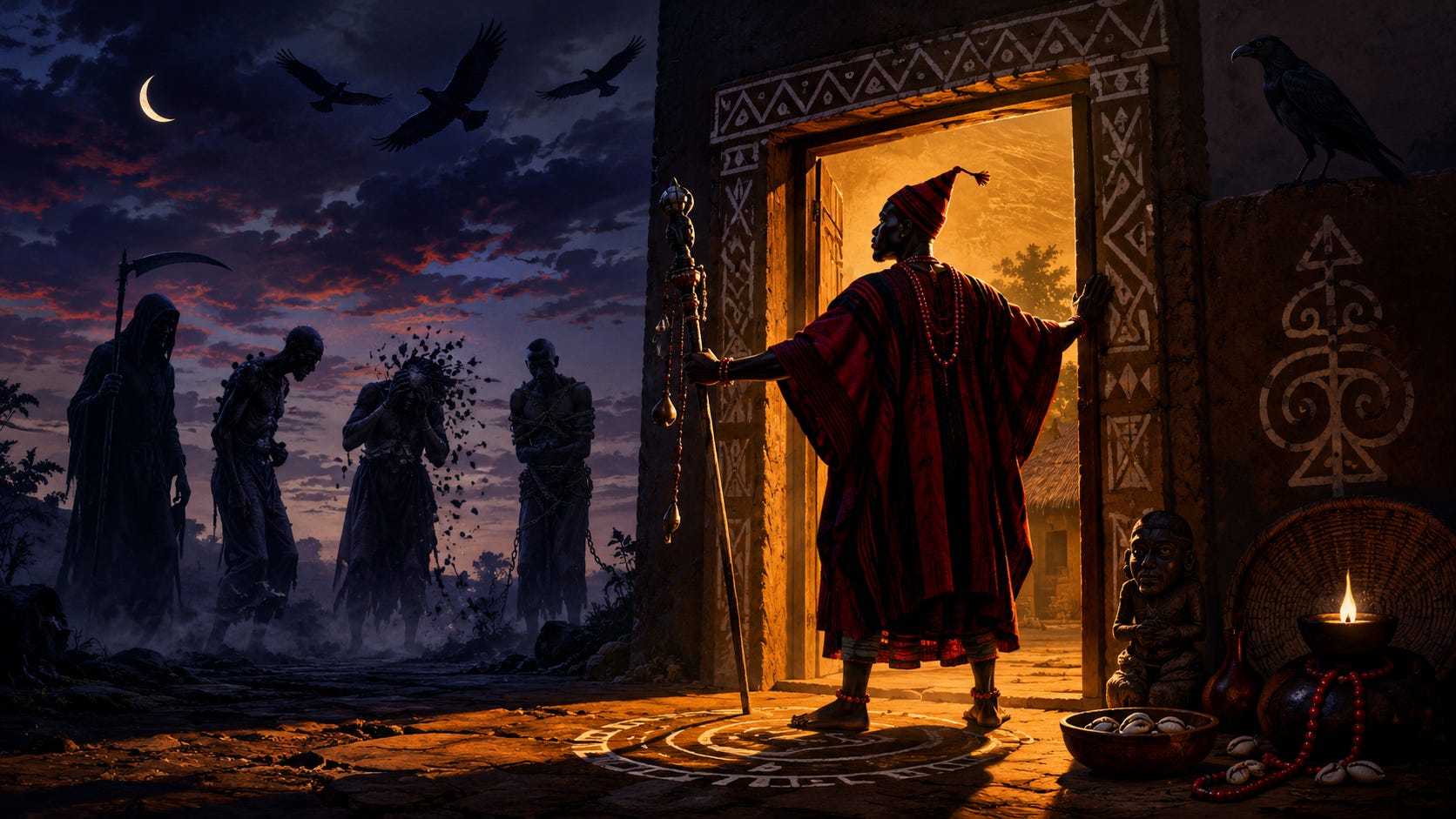
The Four Ajogun at the Center of This Teaching
Although the traditions speak of many Ajogun, four appear together with particular clarity in the verses examined here.
Ikú — Death and Premature Ending
Ikú is death, but the principle of Ikú is broader than physical death alone.
Ikú can appear wherever something is cut off before its proper time. A calling may die before it is developed. A relationship may collapse without truthful conversation. A business may be destroyed by exhaustion, impatience or uncontrolled ambition. Hope itself may begin to disappear.
This does not mean that every ending is evil. Some endings are necessary. The question is whether an ending arrives in alignment with destiny or whether something valuable is being consumed prematurely.
Ikú therefore teaches reverence for time.
Ikú asks: What are you treating as inexhaustible? Your body? Your relationships? Your reputation? Your spiritual strength?
Àrùn — Illness and Affliction
Àrùn is illness, weakness and affliction.
Its presence reminds us that the body is not separate from destiny. Neglected health, chronic stress, destructive environments and spiritual exhaustion can reinforce one another.
Yet spiritual teaching must remain responsible. A person who is ill should seek appropriate medical care. Prayer and ritual may support the mind, Orí and spiritual resilience, but they do not replace diagnosis or treatment.
Àrùn asks: Where has pain become normal because you have lived with it for too long?
The answer may involve the body, but it may also involve a harmful relationship, an unhealthy workplace or an inherited pattern of silence.
Òfò — Loss
Òfò is the force of loss.
Money disappears. Support is withdrawn. An opportunity is missed. A trusted person leaves. Status is damaged. Something carefully built begins to unravel.
Òfò is especially dangerous when loss produces panic. In panic, people often make the very decisions that deepen their instability.
Ifá teaches that loss must first be named correctly. Was something stolen? Neglected? Sacrificed for a greater purpose? Released because its time had ended? Or consumed by a pattern that has not yet been corrected?
Òfò asks: What continues to leak from your life because no boundary has been established around it?
Òràn and Ẹjọ́ — Serious Trouble, Conflict and Litigation
Òràn is serious trouble, entanglement or a situation that grows beyond ordinary disagreement. Ẹjọ́ refers more specifically to dispute, accusation, litigation or a matter requiring judgment.
These forces can arise in families, businesses, religious communities, public institutions and courts.
An unresolved disagreement becomes a campaign of hostility. Careless words become evidence. Pride prevents reconciliation. A private matter becomes public. A person finds themselves surrounded by accusation and no longer knows how the conflict began.
Òràn asks: Which problem are you feeding every time you try to prove that you are right?
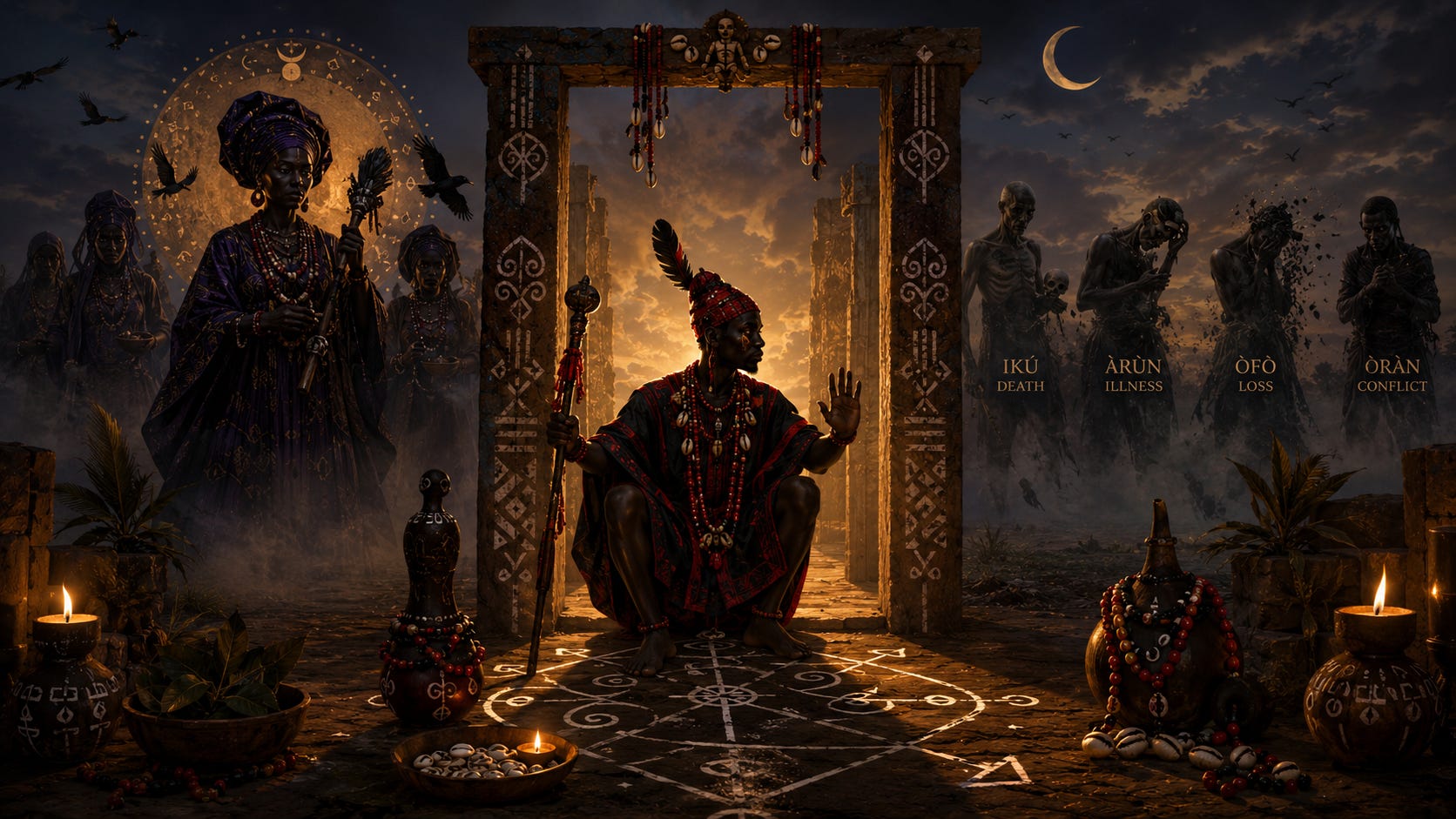
The Ajogun Are Not Always Autonomous
Here the teaching becomes more complex.
If the Ajogun are forces that bring death, illness, conflict and loss into visible human experience, do they act entirely on their own?
In many Ifá-oriented traditions, the Ajogun are understood as moving beneath the authority or direction of greater spiritual powers. Among the most important of these powers are the Àjẹ́, the mysterious Mothers often called Ìyámi Òṣòròngà, “my Mothers, the owners of Òṣòròngà.”
The word Àjẹ́ is frequently translated as “witch,” but the English word is inadequate and often misleading. The Àjẹ́ are not simply evil women or enemies of society. They represent ancient female authority, hidden judgment, gestational power, the ability to nurture life and the capacity to withdraw support from life when balance is violated.
They are associated with birds, night, assemblies, secrecy, blood, fertility, protection and consequence.
In Òsá Méjì, the Mothers appear as a collective court. In the narrative known as “The Witches Discover the Truth,” they uncover a deception involving Òsáméjì and Èṣù. After deliberation, they pronounce that Òsáméjì must die before the end of the year.
The text does not say in one simple sentence, “The Àjẹ́ command every Ajogun.” What it does show is equally significant: the Mothers possess the authority to investigate, judge and release a sentence of death into motion.
This is why many traditions speak of the Àjẹ́ as leaders or directors of destructive forces. Their power is not merely the ability to attack. It is the authority to determine that a correction, punishment or withdrawal of protection will take place.
But the myth also refuses to end in fatalism.
Òsáméjì consults Ifá again. What had been declared as unavoidable death is transformed through a correctly prescribed response. His life is not only preserved; his household receives pregnancy, prosperity, a new home and renewed social standing.
The teaching is subtle: A spiritual sentence may be severe, but Ifá searches for the road by which destiny may still be repaired.
The Mothers are not mocked. Their authority is not denied. Yet consequence can be transformed when the human being accepts correction, restores neglected relationships and fulfils spiritual obligations.
But Who Carries the Sentence?
Here we reach the question that opens the deeper mystery:
If the Mothers represent hidden authority and judgment, who carries power from the invisible assembly into the visible world?
Who negotiates with the Ajogun?
Who knows their appetite?
Who determines where they may enter—and where they must stop?
Most people expect the answer to be Òrúnmìlà, because Òrúnmìlà reveals the remedy.
But one verse gives a far more surprising answer. It says:
Èṣù is the father of the Ajogun. He is the one who gives them instructions.
This does not mean that Èṣù is the creator of all evil. It means that Èṣù knows the roads of consequence. He knows how a force is received, how its portion is distributed and how an agreement becomes binding.
And this is precisely why Èṣù is also connected to protection.
Protection is not created only by pushing danger away. Protection appears when a boundary becomes spiritually recognised: this is outside, this is inside; this road is open, that road is closed; this portion has been received, therefore no further claim may cross the threshold.
Èṣù does not merely open roads. He opens the possibility of a protected space by establishing the limit that adversity must respect.
May the Mothers look upon your destiny with balance. May your Orí remain cool enough to recognise danger before it becomes a visitor. May Èṣù close every unlawful entrance and open only the roads that carry you toward ire.
Stay blessed—kí ọ̀nà rẹ̀ ṣí sí ire, kí ibi má wọ ilé rẹ.
Babá Tilo de Àjàgùnnà
DAILY IFÁ
To understand the relation of Ajogun and Elenini I recommend a Blog I wrote some time about about it.
Supporting Subscribers: Beyond the Threshold
In the deeper section, we will examine why Òyèkú Òtúrúpọn calls Èṣù the father of the Ajogun, how Òsá Méjì shows cooperation and tension between Èṣù and the Mothers, and why the power that carries adversity can also establish the line that protects a home.
You will also receive concrete guidance for health, family, business, conflict and spiritual development, followed by a devotional threshold ritual and cleansing bath.
Èṣù, the Father of the Ajogun
The decisive verse is preserved in Òyèkú Òtúrúpọn.