


Dear readers;
When someone first sees an Odù written on the divining tray, the question often comes quickly: Why four marks on one side and four on the other? Why should a few strokes carry counsel about a marriage, a journey, an illness, or the obligations we have neglected? And if similar arrangements of marks appear in other parts of the world, where did the signs of Ifá actually come from?
I take that question seriously as a Babalawo. It asks about history, certainly. It also asks how a visible mark becomes knowledge. Those questions belong together, although they cannot be answered in exactly the same way. A drawing can tell us how an Odù is identified. It cannot, by itself, recite the ẹsẹ̀ Ifá that gives a consultation depth.
Today I want to show you how I approach that difference. We will begin with two columns in Ifá, look at the disputed historical relationship with ʿilm al-raml, the Islamic science of sand divination, and then follow a question across other African and diasporic traditions: What does the shape reveal, and what must we learn from the people who use it?
The first lesson: an Odù is an address into a body of knowledge
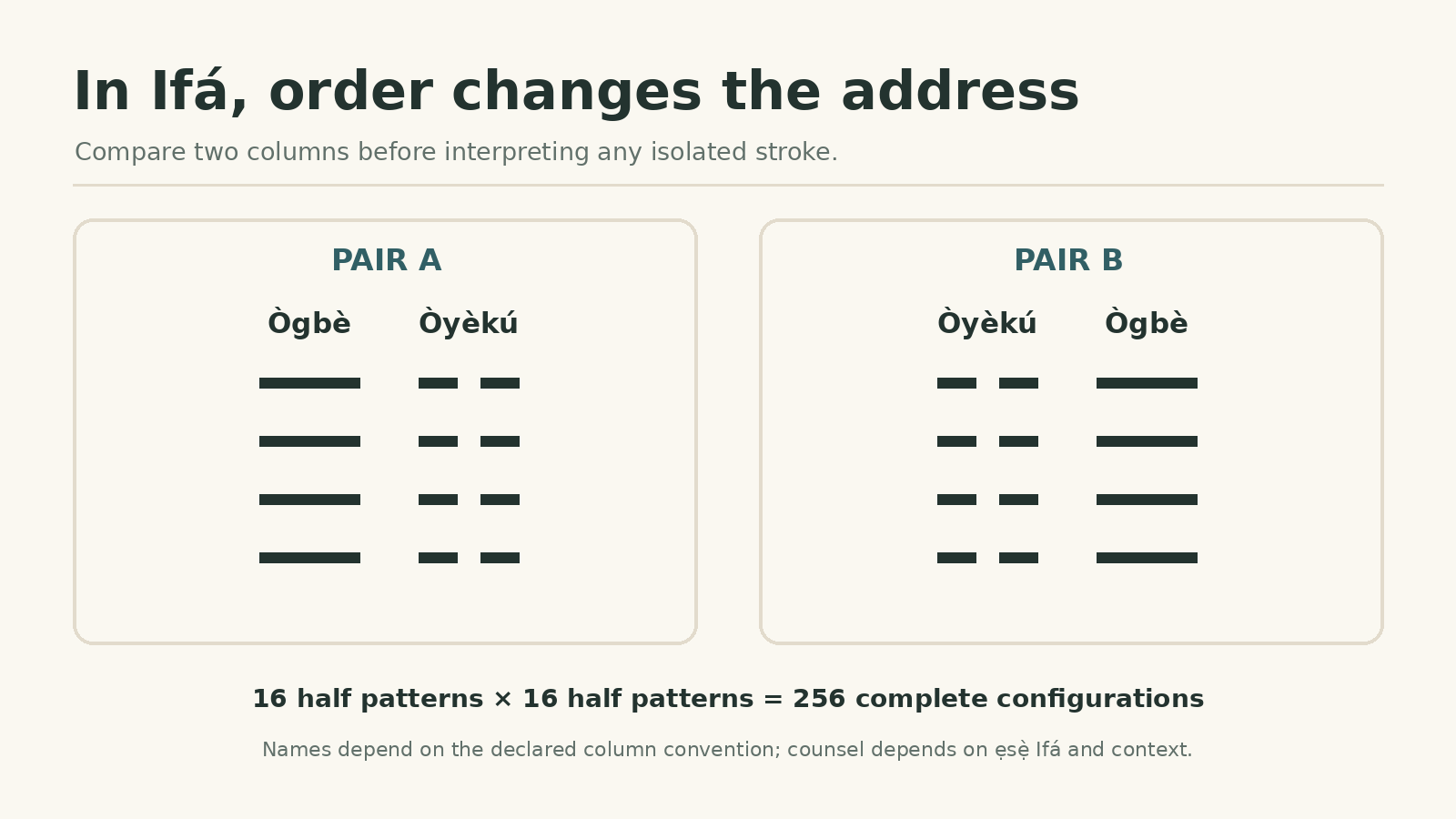
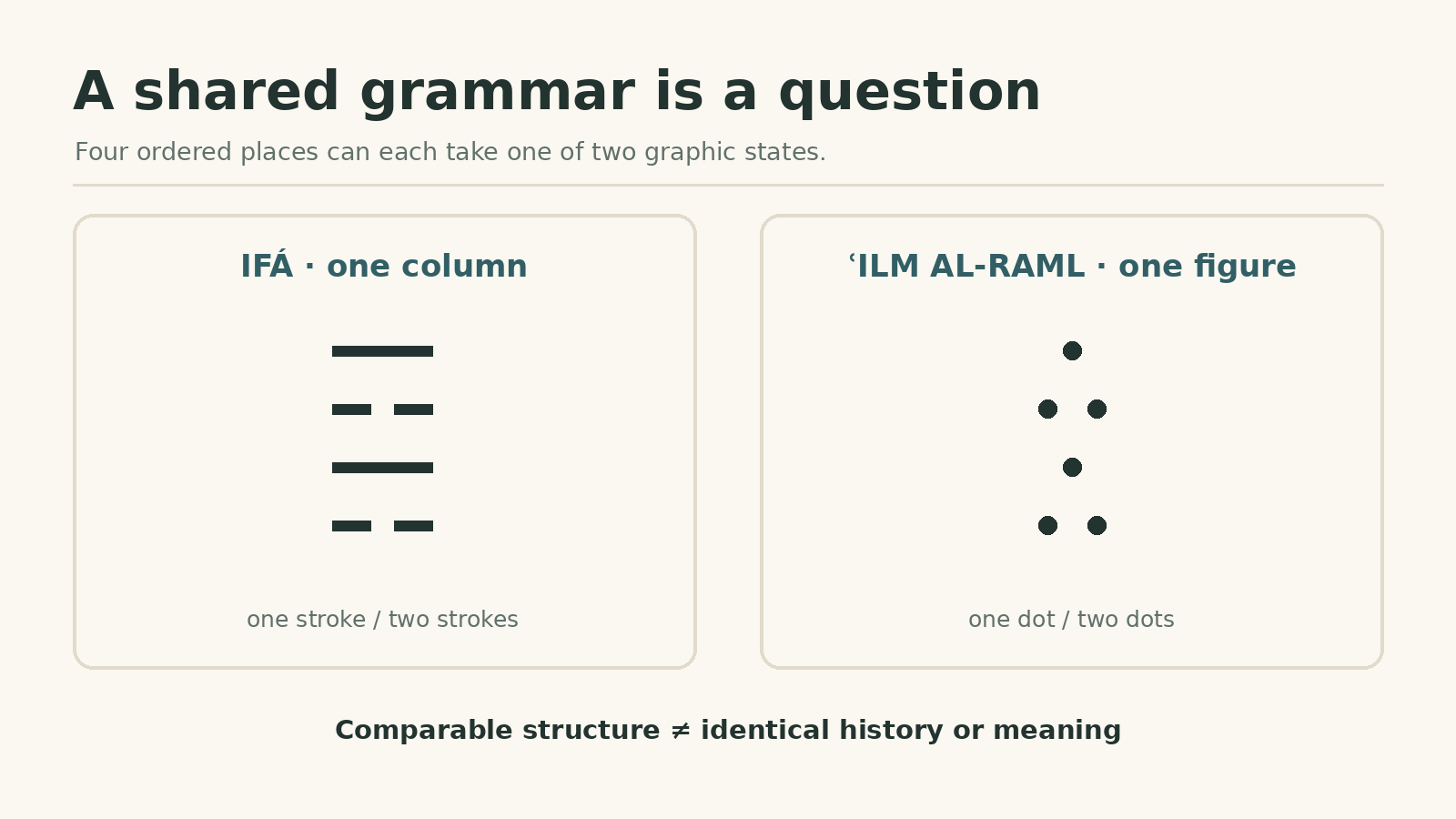
An Ifá configuration has two columns. Each column has four ordered positions; each position appears in one of two graphic states, commonly shown as one stroke or two. Four positions allow sixteen different columns. Pair one column with another and there are 16 × 16, or 256, possible complete configurations.
That arithmetic is useful, but it is only the entrance. Take the column conventionally represented by four single strokes, Ògbè, and the one represented by four doubled strokes, Òyèkú. When they stand together, the two columns identify one ordered pair. Exchange their positions and you have another ordered pair. Even though neither column has changed internally, their relationship has. Traditions and printed tables differ on which side is named first, so a reader should establish the convention before speaking an Odù’s full name.
Now imagine two people consult on different days and the same Odù appears. One is deciding whether to leave home for work; the other is trying to repair a broken relationship. The graphic address can be the same, while the question and the appropriate remembered verses differ. A Babalawo does not extract a fixed sentence from an isolated bar of ink. The sign opens a recognized field of stories, praise, warnings, precedents, and counsel. The consultation calls for judgment about which of those inherited voices speaks to this person, now.
Here is the first useful distinction: the marks identify; the verses and the encounter interpret. An Odù is therefore neither an abstract bit of mathematics nor a picture of an Òrìṣà. It belongs to a cultivated relationship among sign, corpus, diviner, and the person seeking guidance. For readers of DAILY IFÁ who already know a few Odù names, that shift in attention can transform how an illustrated table looks. The table is a map of addresses. It is not the conversation itself.
Did Ifá’s signs come from al-raml?
This is the historical question behind the visual comparison. In ʿilm al-raml, figures are formed from four ordered rows, each with one or two points. Sixteen such figures are possible. Across large parts of Africa, sand divination traveled through trade, scholarship, healing, and exchange; in several places it encountered systems of divination with their own established specialists and stories. The formal resemblance between an al-raml figure and one column of an Ifá sign deserves examination.
Some scholars have proposed that elements of geomantic notation or organization entered Ifá through contact with Islamic geomancy. Ayodeji Ogunnaike suggests a more precise possibility: Yorùbá specialists may have incorporated the useful structure and figures of geomancy into an existing divinatory tradition. Amidu Sanni documents the long conversation between Muslim and non-Muslim forms of divination in Yorùbá settings and reports the arguments for influence in forms and procedures. Their work does not give us a dated eyewitness account of the first transmission or settle every direction of influence.
So when someone says, “Ifá comes from al-raml,” I ask: Which part of Ifá do they mean? The use of four positions? A method of generating figures? The names of the Odù? The ẹsẹ̀ Ifá? The sacred standing of Ọ̀rúnmìlà? A proposed history of the graphic framework is not a documented origin for all those things. The very possibility of adaptation points to the skill of the people who received, reshaped, named, and taught what they used.
Nor does this historical inquiry force a practitioner to set aside the accounts through which Ifá understands its own sacred authority. The historian investigates contacts and dates; the devotee speaks of Ọ̀rúnmìlà, revelation, inheritance, and obligation. We learn more when we state clearly which question we are asking. For me, the most fruitful historical claim is a modest one: al-raml and Ifá have comparable graphic architecture, and their relationship is a serious subject of research. The story of the whole tradition is larger than the resemblance between their marks.
That is an important lesson for anyone searching for ancestral roots. African religious knowledge developed amid movement and encounter. An influence, where it can be demonstrated, tells us something about African intellectual choice and creativity. It cannot by itself measure the spiritual authority or depth of the tradition that made the borrowed or shared form its own.
A Kongo example: the line you cross matters
Let us leave the columns of Ifá for a moment and consider the Kongo Dikenga, often drawn as a circle intersected by a cross. In the account given by Kimbwandende Kia Bunseki Fu-Kiau, the four positions accompany the sun through rising, maturity, setting, and the unseen beginning of another cycle. Kala, Tukula, Luvemba, and Musoni name moments in that movement. The horizontal Kalûnga line distinguishes the visible world of the living from the ancestral dimension.
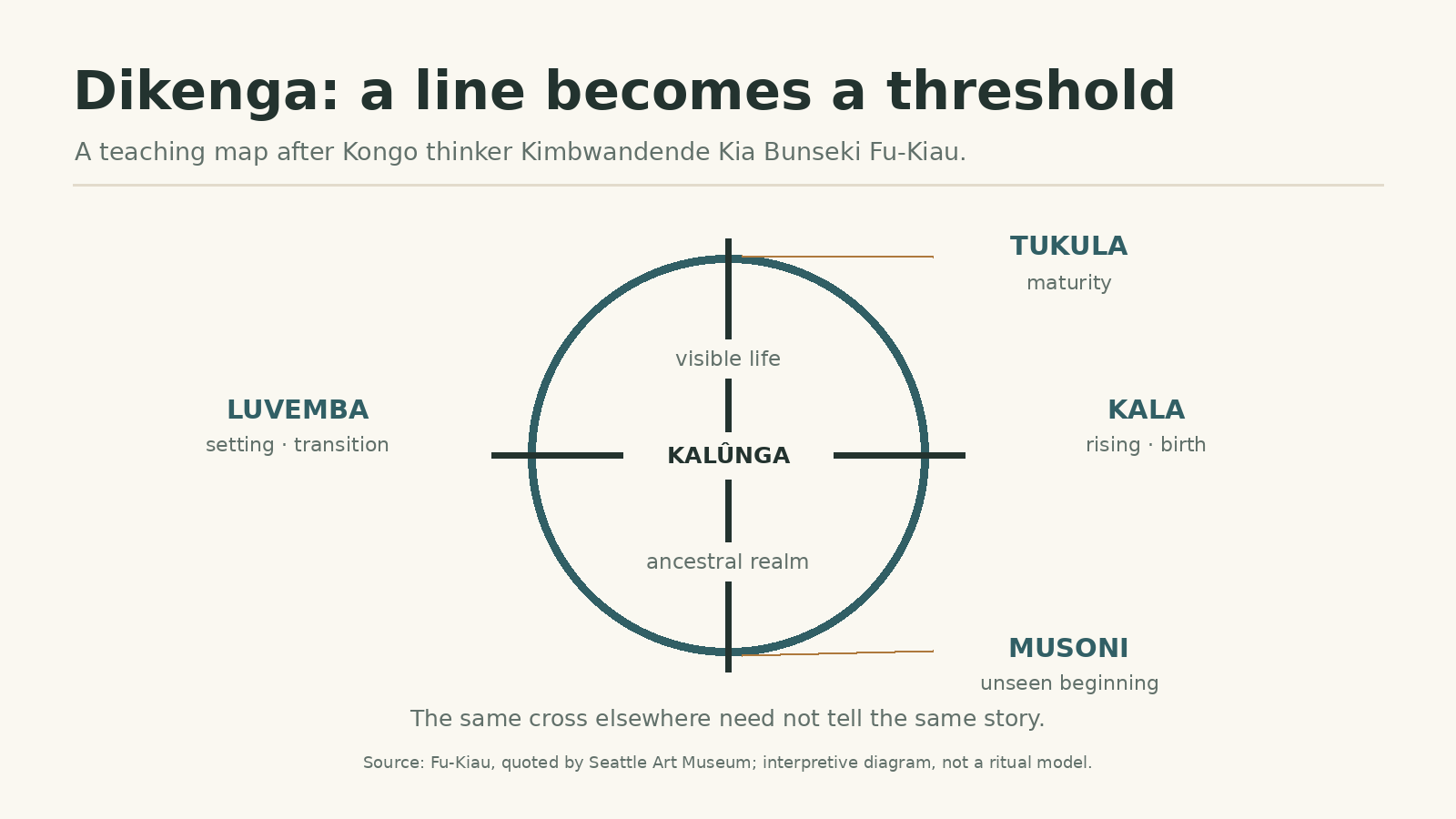
Now look at the horizontal stroke again. Its meaning is not supplied by the fact that it is horizontal. It gains force because it is a threshold in a named account of life, death, ancestry, and return. Rising and setting have different positions in this cycle; crossing the horizon changes the relation between realms. If you rotated the teaching diagram and still called the right-hand point “rising” without explanation, you would have changed the map while pretending it stayed the same.
This is a second lesson: position can carry a worldview. Ifá’s two columns distinguish ordered Odù configurations; the Dikenga’s horizon gives us a way to think about passage between dimensions of life. Both reward close attention to relationships among marks. They do different spiritual and intellectual work. A cross seen in a Cuban firma or a Brazilian ponto riscado does not become a Kongo cosmogram merely because we can draw a circle around it. A documented chain of people, teaching, and use would be needed to make a historical connection.
An archive example: a curve cannot tell the whole story
Nsibidi brings a different kind of difficulty. Within the Cross River region and its connected communities, graphic forms have been used in social, artistic, and restricted contexts. In the numbered archive reproduced in my book, one bowed figure, number 01, is accompanied by a caption about a woman walking with a man following her. Number 02 shows opposed bowed figures; its recorded caption describes a man and a woman turned away after a quarrel. A further figure, number 07, adds crossings and a short horizontal tie. The original maker and occasion of these particular copies are not recorded.
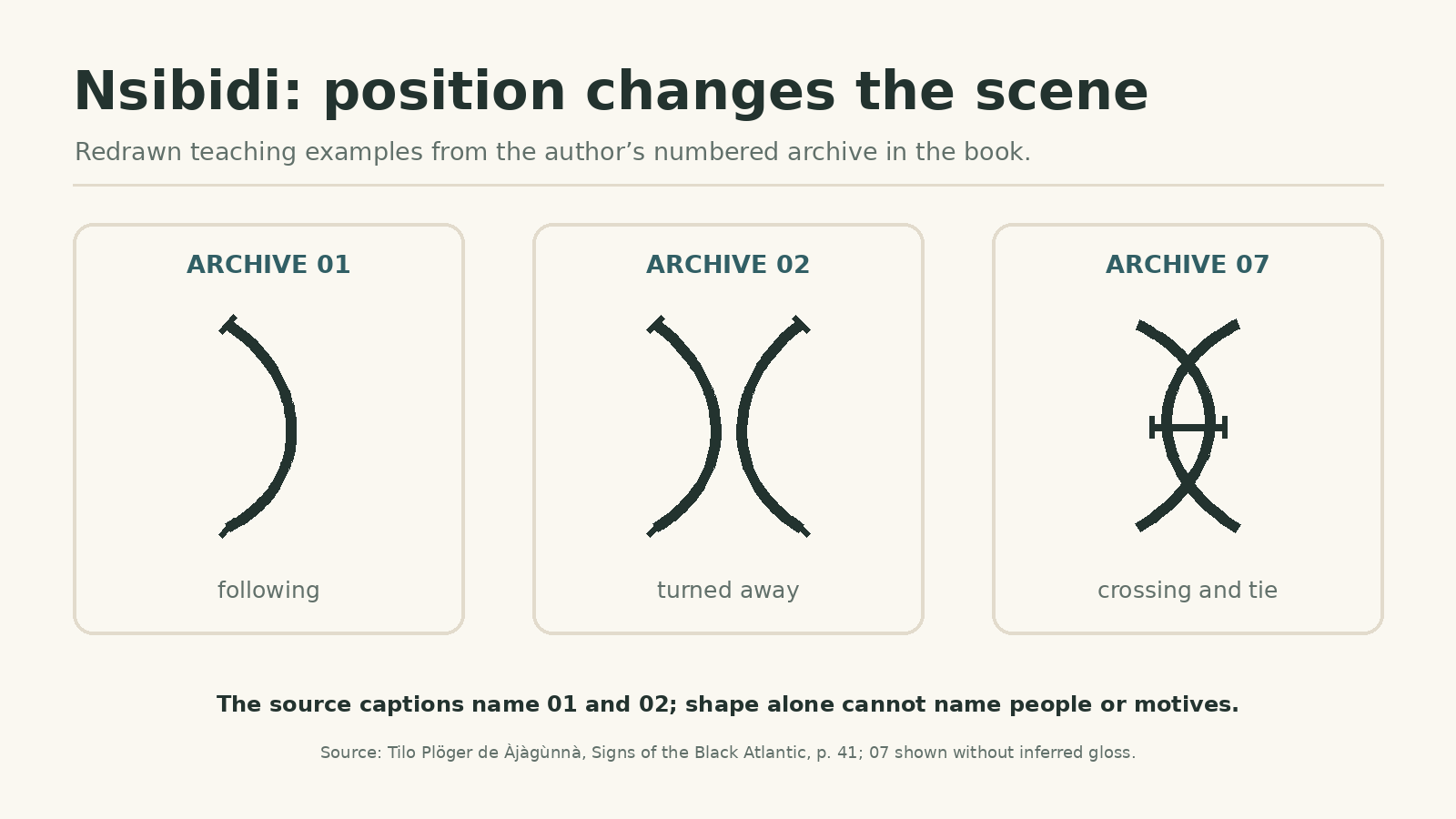
We can make a real observation before reading any caption: one curve has become two opposed curves, and then a different arrangement introduces crossing. We can describe that change with confidence. We cannot infer from the shape alone that every bowed line everywhere means “woman,” or that a crossing always means reconciliation. The captions tell us what one compiled source said about particular figures. Their value lies in the connection between a recorded form and a recorded reading.
I find this especially helpful when viewing images shared online without an archive number, a maker, or a source. A confident translation may be more attractive than a careful one, but the form cannot restore a missing speaker. Learn what the diagram actually shows; then seek the context that lets someone say more.
From Haiti to Cuba and Brazil: who speaks through a drawn sign?
Consider now three practices readers may know from the Black Atlantic: the Haitian Vodou vèvè, the firma of Cuban Palo, and the ponto riscado of Brazilian Umbanda. Their histories differ. Each can be flattened when a photograph turns a mark made in a particular place and moment into a free-floating “symbol” with a one-line meaning.
A vèvè associated with a lwa may be drawn on the ground in a ceremonial setting. A printed image can preserve a design, but the ground, materials, songs, people, and moment of its making matter to the event. In Palo, a firma belongs to a different field of relationships, offices, and obligations. Seeing a cross in both does not entitle us to name the same spirit or reconstruct the same ceremony. In Umbanda, a medium may draw a ponto riscado with pemba in connection with an entidade and the understanding of a particular house. Familiar components include stars, arrows, circles, crosses, crescent forms, and straight or curved forks; their assembly, placement, and interpretation are not fixed across all houses. Some Brazilian repertoires also draw upon European esoteric and alchemical graphic conventions while developing their own doutrinas and hierarchies.
Here is a concrete way to examine an unfamiliar Umbanda drawing without pretending to decode it. Suppose an arrow ends at a circle. First record the relation: a directed line meets an enclosed form. Compare a second drawing in which the arrow points away from the circle. The composition has changed from approach to departure as a description of geometry. Whether either image concerns a path, a person, a spirit, protection, or something else requires the name of the entidade, the house’s teaching, and the circumstances in which the mark appeared. Even an apparently familiar fork cannot supply that missing information by itself.
When people tell me that a vèvè, a firma, and a ponto “all mean the crossroads,” I ask them to show where that meaning was taught and by whom. Crossroads can matter powerfully in more than one tradition. Shared concerns such as passage, protection, ancestors, and spiritual presence do not dissolve the distinct histories that give a drawn sign its life.
Three questions to take into your next encounter with a sign
What changes if I change one relation? In Ifá, reverse two columns and identify the new ordered address under an explicit convention. In an archived Nsibidi drawing, notice whether figures face, turn away, or cross. Describe the visible difference before naming its lesson.
What world does the diagram presume? A line in the Dikenga can name the Kalûnga threshold within a cycle of living and ancestral being. The one-or-two-dot row of al-raml belongs to a different method and interpretive history. Geometry tells us where to begin asking; it does not answer for every community.
Who has the standing to explain it here? Ask for a named source, a transmitted verse, a house, a lineage, or an archive caption. In a consultation or ceremony, attend to the people and the moment. Even when a sign is publicly pictured, its full use may belong to those who have learned its responsibilities.
These questions are available whether you are an initiated practitioner, a descendant trying to reconnect with family memory, or an interested reader entering from another diaspora tradition. They also help us recognize when a resemblance is a promising historical clue, when it is simply a resemblance, and when we have reached the edge of what a photograph can teach.
Why I wrote Signs of the Black Atlantic
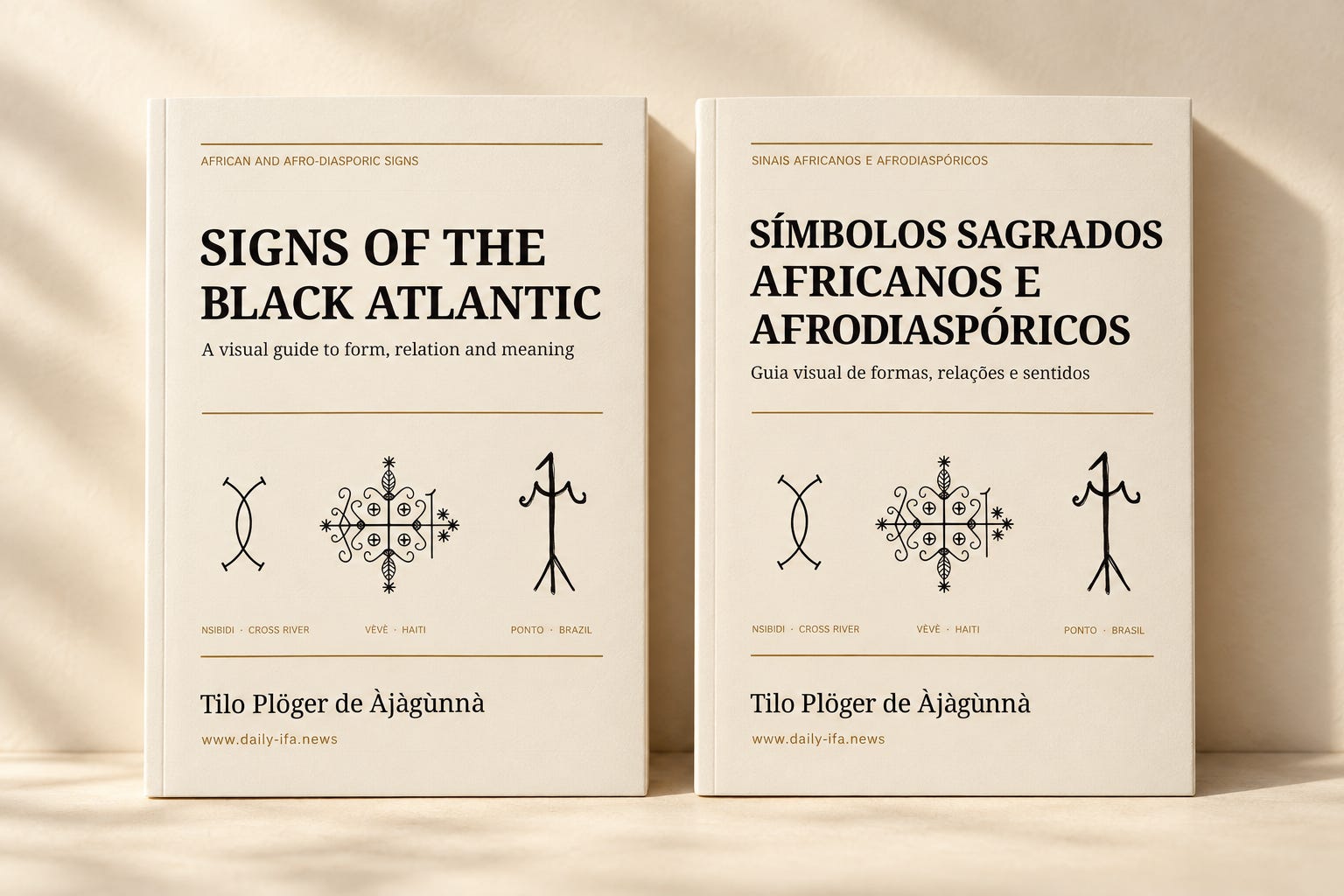
In Signs of the Black Atlantic, I follow these questions through Ifá and Fá, Kongo worlds, Nsibidi, Haitian Vodou, Cuban Palo, Candomblé, Umbanda, and neighboring traditions. The book includes many illustrated examples and attends to how signs are constructed, transmitted, and read in their own settings. Its Brazilian edition, Símbolos Sagrados Africanos e Afrodiaspóricos, brings the conversation to Portuguese-speaking readers. I wrote it from years of Ifá and Òrìṣà practice and from work across related traditions, knowing that even a substantial book cannot replace a living teacher, an elder, or the knowledge of a particular house.
If you have ever searched for the meaning of a sign and found only an isolated image with an absolute translation, this book offers a deeper route. It gives you actual forms to examine, questions worth carrying, and historical connections to investigate. It is written for those who want to understand their roots more fully, including devotees, Babalawos, Babalorisas, and readers from neighboring traditions who care about the integrity of each one.
The English edition is here: Signs of the Black Atlantic on Amazon. You can continue the conversation with me through DAILY IFÁ. If this essay brought a particular sign or family teaching to mind, I would be glad to hear which question it raised for you.
Babá Tilo Plöger de Àjàgùnnà
DAILY IFÁ
Sources for the historical and Kongo examples
Ayodeji Ogunnaike, “The Dynamic Spread of Geomancy in Africa”; Amidu Sanni, “Muslim-Yoruba Rosary Divination and Geomancy”; Kimbwandende Kia Bunseki Fu-Kiau, statement reproduced by the Seattle Art Museum.