


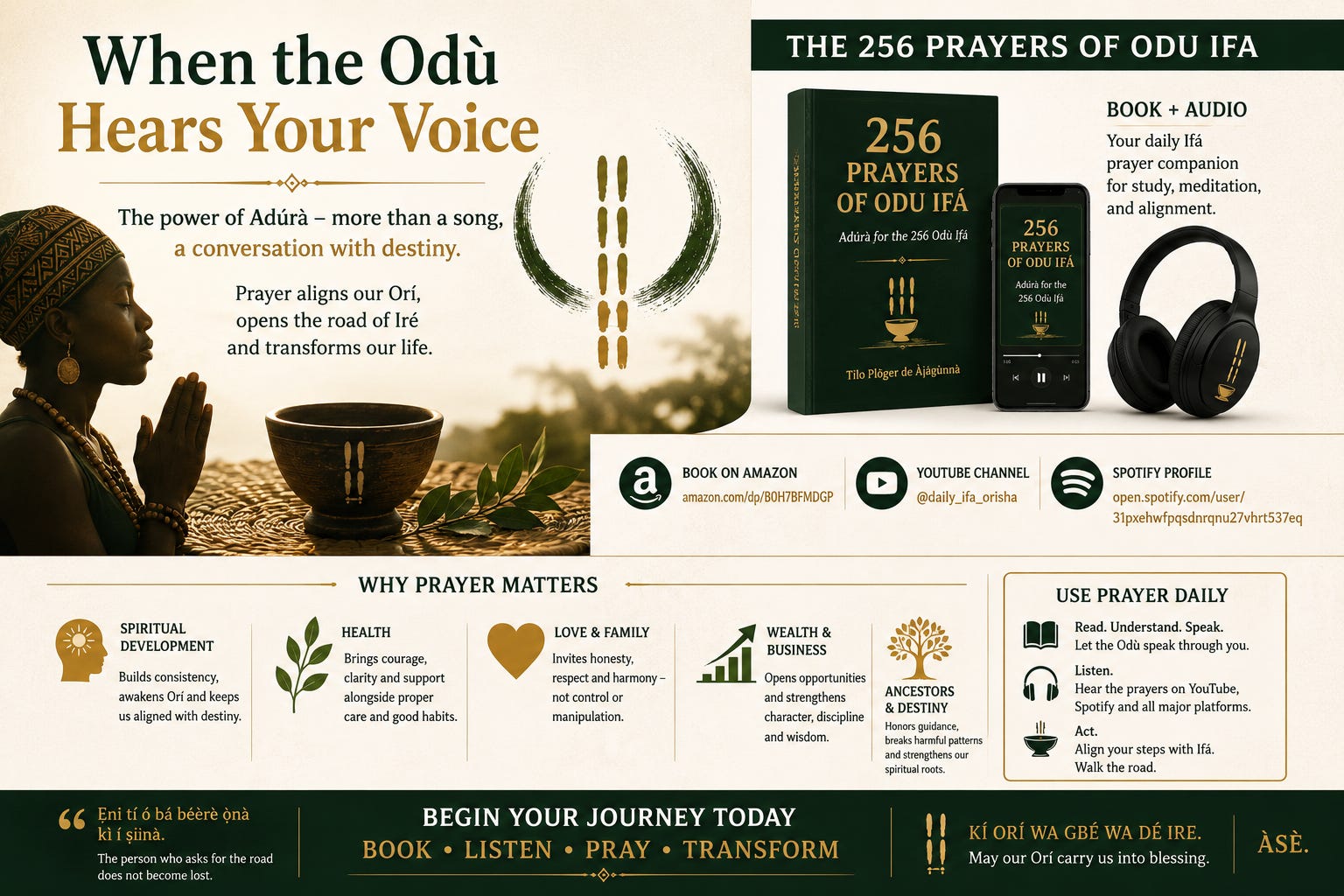
Dear seekers of wisdom,
“Ẹni tí ó bá béèrè ọ̀nà kì í ṣìnà.”
The person who asks for the road does not become lost.
There are many ways to ask for the road.
We ask through divination. We ask through silence. We ask through dreams, offerings, study, and the patient observation of our own character. But one of the oldest and most intimate ways of asking is through the human voice.
We pray.
This is the purpose behind my new devotional series, 256 Prayers of Odu Ifa: Adúrà for the 256 Odù Ifá—a complete journey through the prayers of all 256 Odù, created so that the wisdom of Ifá can not only be studied, but also spoken, heard, and integrated into daily life.
The book presents the prayers with Yorùbá texts, close English translations, and devotional interpretations. The musical prayer series allows you to hear and accompany these Adúrà through YouTube, Spotify, and other major music platforms.
You can begin exploring the project here:
You do not need to begin with all 256 prayers at once. You may start with one Odù, one recording, or one line that speaks directly to the condition of your life. The purpose is not to collect sacred words. The purpose is to enter into relationship with them.
About Adúrà in Ifá
But before using these prayers, we must understand what an Adúrà truly is.
The mouth speaks, the ear listens, the heart becomes attentive, and Orí—the inner spiritual head that carries our destiny—is reminded that it did not come into this world without direction.
Yet prayer within Ifá is often misunderstood. Some people hear a Yorùbá chorus accompanied by drums and immediately call it a prayer. Others assume that every sacred song is an Adúrà. Some approach prayer as though it were a magical command through which spiritual powers must obey human wishes.
None of these understandings is complete.
Prayer is not simply sacred-sounding music. It is not spiritual decoration. It is not an attempt to control heaven. Adúrà is the disciplined act of turning toward divine order and asking to be brought into right relationship with it.
The difference is important.
Where Prayer Enters the Odù
The 256 Odù Ifá are not merely categories to memorize. They are houses of memory, patterns of destiny, containers of revelation, and living spiritual roads through which Ifá continues to speak.
We may study an Odù intellectually. We can examine its proverbs, stories, taboos, medicines, associated Òrìṣà, warnings, and promises. This is necessary work. Study gives us language, orientation, and context.
But prayer does something different. Commentary speaks about an Odù. Adúrà turns toward the Odù.
When we pray, we are no longer standing outside the sign and analyzing it from a distance. We stand before it. We greet it. We acknowledge the powers moving within it. We ask that its blessings become established and that its difficult manifestations be transformed through wisdom, discipline, and good character.
Knowledge becomes relationship. Meaning becomes invocation.
The voice becomes a vessel through which the person seeks alignment with Àṣẹ—the living spiritual authority through which existence becomes effective. This understanding is at the heart of my book and audio project, 256 Prayers of Odu Ifa: Adúrà for the 256 Odù Ifá, in which every Odù receives a dedicated prayer, a literal translation, and a devotional rendering.
A Prayer Is Not Simply a Festival Song
Sacred songs have great importance. They preserve language, praise the Òrìṣà, transmit memory, coordinate movement, gather the community, and establish the spiritual atmosphere of a ceremony.
An orin, meaning a song, may praise an Òrìṣà, narrate a sacred quality, accompany dancing, welcome a spiritual force, or carry the congregation through a festival. A súyèrè or ritual chant may use rhythm, repetition, and call-and-response to intensify attention and invite participation.
These forms must not be dismissed as “mere songs.” Sacred music can contain history, theology, invocation, and tremendous ritual power.
Nevertheless, not every festival song is a prayer. The central distinction lies not in whether drums are present, whether the words rhyme, or whether the text is sung instead of spoken. The distinction lies in the direction and purpose of the words.
A song may describe the greatness of Òṣun: Òṣun is beautiful. Òṣun owns the river. Òṣun carries sweetness.
A prayer turns toward her: Òṣun, bring sweetness into my character. Wash bitterness from my heart. Let love enter my home without deception.
A song may celebrate Ọ̀gún as the owner of iron and the opener of the forest.
A prayer addresses him: Ọ̀gún, remove the obstruction before me. Give me disciplined hands. Do not let my determination become violence.
A song may remember what an Òrìṣà has done. A prayer asks how the devotee must now stand in relation to that power.
The two forms can overlap. A festival song may contain a direct petition and therefore become prayerful. An Adúrà may contain a repeated refrain and may be sung communally. Melody does not cancel prayer, and spoken words are not automatically more sacred than sung ones.
The question is: Are we only singing about sacred power, or are we consciously addressing it and asking to be aligned with it?
Prayer, Ẹsẹ̀ Ifá, and Sacred Song
Another distinction must be made between Adúrà and Ẹsẹ̀ Ifá, the verses of the Ifá corpus.
An Ẹsẹ̀ Ifá may recount a divination, name the Awó who cast Ifá, describe a crisis, present an instruction, reveal whether the instruction was followed, and tell us what happened afterward. It can contain praise names, invocations, proverbs, petitions, and ritual language.
But the complete verse is not necessarily a personal prayer. The verse reveals the architecture of a spiritual situation. The prayer responds to that revelation.
The verse may tell us how pride destroyed a person’s opportunity. The Adúrà asks that pride be removed from our character.
The verse may show how patience protected a traveler. The Adúrà asks that patience remain beside us when the road becomes difficult.
The verse carries revelation. The prayer turns revelation into devotional speech.
The Typical Structure of an Odù Prayer
There is no single formula imposed identically by every lineage, house, or region. Yorùbá, Lucumí, Candomblé, and other diasporic traditions preserve distinct vocabularies, melodies, ritual permissions, and modes of address.
Nevertheless, a well-formed devotional prayer commonly moves through several recognizable stages.
First comes greeting and permission. The devotee does not burst into sacred space making demands. We salute Olódùmarè, Orí, Ifá, the relevant Odù, the Òrìṣà, the ancestors, or the spiritual powers connected to the prayer. Greeting establishes humility. It tells the unseen world that we understand ourselves to be entering a relationship, not issuing an order.
Then comes identification. The prayer names the Odù being addressed. This is essential because the combinations are not interchangeable. The first name is the leading or base Odù—the “left leg” in the organizational structure used throughout my work. Therefore, Ògúndá Ìròsùn is not the same Odù as Ìròsùn Ògúndá. Each has a different order, emphasis, and spiritual movement. The prayer must preserve the identity of the road being addressed.
Next comes remembrance or praise. The prayer recalls the nature of the Odù and the powers that speak through it. This is not flattery. Sacred praise names identify qualities. When we call Ọ̀rúnmìlà the witness of destiny, we remember why we are approaching him. When we greet Èṣù Òdàrà as the keeper of communication and the crossroads, we acknowledge the power through which words, choices, and consequences move.
Then the condition is named. A sincere prayer does not pretend that everything is already well. Confusion, fear, illness, bitterness, blocked opportunity, family conflict, or spiritual exhaustion may be spoken plainly. This is not the same as surrendering to misfortune. Naming a condition prevents vague devotion from hiding what must be transformed.
The petition follows. We ask for the appropriate form of Iré: clarity, health, protection, children, stable love, prosperity, victory, peaceful longevity, good reputation, or the fulfillment of destiny. We may also ask that the difficult manifestation of the Odù be cooled, redirected, or removed.
After petition comes alignment. This is one of the most important and most neglected parts of prayer. We do not merely ask the universe to change. We ask for the character required to receive what we request. A prayer for prosperity should also ask for discipline. A prayer for love should ask for honesty. A prayer for authority should ask for humility. A prayer for protection should ask us to stop walking voluntarily into danger.
Finally, the prayer is sealed. The words may close with Àṣẹ, repetition, thanksgiving, or a final declaration of alignment. Àṣẹ does not mean, “Heaven must obey me.” It recognizes that right words, right action, right timing, and spiritual authority must come together before a prayer becomes effective.
The prayers in my 256-prayer collection follow a consistent devotional organization. Each entry identifies the Odù’s central orientation and associated spiritual powers, presents the Yorùbá text, and then gives both a close English translation and a freer devotional rendering. The complete cycle is organized through the sixteen principal Odù families and their combinations.
A General Devotional Prayer
The following is a simple personal Adúrà. It is not presented as a transmitted Ẹsẹ̀ Ifá or as a replacement for a lineage-specific liturgical prayer.
Yorùbá
Olódùmarè, gbọ́ adúrà mi.
Orí mi, jí, kí o sì gbé mi dé ibi rere.
Ọ̀rúnmìlà, tọ́ mi sí ọ̀nà ọgbọ́n.
Èṣù Òdàrà, ṣí ọ̀nà ire sí mi.
Kí ibi má bà mí; kí ire gbogbo wọlé.
Kí ìwà pẹ̀lẹ́ jẹ́ aṣọ mi.
Kí ọ̀rọ̀ ẹnu mi di àṣẹ rere.
Àṣẹ.
English
Olódùmarè, hear my prayer.
My Orí, awaken and carry me toward a good destination.
Ọ̀rúnmìlà, guide me onto the road of wisdom.
Èṣù Òdàrà, open the road of blessing before me.
May misfortune not overtake me; may every good blessing enter.
May gentle character become my garment.
May the words of my mouth become beneficial Àṣẹ.
Àṣẹ.
Português
Olódùmarè, escuta a minha oração.
Meu Orí, desperta e conduz-me a um bom destino.
Ọ̀rúnmìlà, guia-me pelo caminho da sabedoria.
Èṣù Òdàrà, abre diante de mim o caminho das bênçãos.
Que o infortúnio não me alcance e que todas as bênçãos entrem.
Que o bom caráter seja a minha roupa.
Que as palavras da minha boca se tornem Àṣẹ benéfico.
Àṣẹ.
How to Use an Odù Prayer
Begin by understanding what you are saying.
Read the translation before trying to reproduce the Yorùbá quickly. Correct pronunciation deserves patience, but prayer is not a performance examination. Speak slowly. Listen carefully. Allow the tonal movement of the language to enter your ear over time.
When an Odù has been revealed through a legitimate divination, its prayer can become a devotional companion to the advice received. It does not replace the consultation or erase prescribed responsibilities. It helps the person remain in relationship with the teaching after the divination has ended.
You may also work systematically through the sixteen prayers of one Odù family. Someone studying Ògbè, for example, may listen and pray through the Ògbè-led sequence, beginning with Ògbè Méjì and continuing through the combinations. This reveals how the light and expansion of Ògbè change when meeting Òyèkú, Ìwòrì, Òdí, Ìròsùn, and the remaining principal Odù.
Another method is to pray with one text for several days rather than moving rapidly through many prayers. Notice which line remains in your mind. Write it down. Ask what form of conduct it requires from you.
Pray aloud when possible. The vibration of the spoken voice helps to join breath, intention, memory, and attention. Listening is also valuable, especially while learning pronunciation or when exhaustion makes personal recitation difficult. The prayers in this project were created to be read, spoken, sung, listened to, and revisited.
How Prayer Supports Different Areas of Life
Spiritual Development
Prayer teaches consistency. It brings the devotee back to Orí and reminds us that destiny is not served through occasional enthusiasm alone. A short prayer spoken with attention each morning can be more transformative than an elaborate practice performed once and then abandoned.
Health
Prayer can support courage, emotional steadiness, and the willingness to seek appropriate help. It should never be used to deny symptoms, reject qualified medical care, or promise supernatural cures. A spiritually mature prayer asks not only for relief but also for good judgment, competent assistance, disciplined habits, and the strength to follow treatment responsibly.
Love and Family
In family matters, prayer should not be used to dominate another person. Do not ask to imprison someone’s affection or override another person’s will. Ask instead for truthful communication, mutual respect, protection from deception, the cooling of anger, and the wisdom to recognize whether a relationship should be repaired, transformed, or released.
Wealth and Business
A prayer for money should include a prayer for character. Ask for opportunities, paying clients, stable income, fair agreements, and protection from fraud. Also ask for patience, planning, accountability, generosity, and freedom from the pride that spends tomorrow’s blessing today.
Ancestors and Destiny
When praying for ancestral support, remember that honoring ancestors is not the same as romanticizing every action of the past. We ask that beneficial ancestral wisdom stand with us and that destructive patterns end with us. Prayer can become the place where gratitude and correction meet.
When to Turn to the Prayer of an Odù
An Odù prayer can be especially meaningful after divination, at the beginning of a new undertaking, during a difficult transition, following conflict, before an important decision, or when the same spiritual lesson continues to repeat itself.
It may also be used during periods of thanksgiving. Prayer is not only an emergency telephone. When Iré arrives, prayer helps us recognize, stabilize, and responsibly carry the blessing.
Iré and Osogbo in Prayer
Under Iré, the prayer strengthens what is already opening. We ask that the blessing mature without arrogance, waste, envy, or carelessness.
Under Osogbo—the challenging or obstructed manifestation—the prayer seeks correction. It asks that confusion become understanding, conflict become disciplined action, danger become caution, and spiritual heaviness become a reason to return to good character.
Prayer does not pretend Osogbo is Iré. It speaks honestly while refusing to make adversity the final authority over the person’s destiny.
A Simple Ritual of the Listening Voice
Place a clean white cloth on a small table. Set down a glass of fresh water as a symbol of clarity and cooling. Sit quietly and touch your head gently with both hands.
Greet your Orí. Read the chosen prayer once in translation. Then speak or play the Yorùbá prayer. Do not rush immediately into requests. Listen first.
Afterward, state one action you will take in harmony with the prayer. It may be apologizing, completing delayed work, attending a medical appointment, reviewing your finances, or ending a dishonest habit.
Leave the water in place while you pray, then pour it onto clean earth or at the base of a healthy plant.
A Gentle Spiritual Cleansing Before Prayer
Prepare a bowl of comfortably warm water with a small handful of fresh basil. African basil may be used where available; common culinary basil is an accessible substitute. Gently press the leaves between your hands while asking that agitation, mental noise, and emotional bitterness be cooled.
Strain the water. After your normal bath, pour the herbal water from the shoulders downward. Avoid the eyes, broken skin, and any plant to which you may be sensitive.
As the water moves, say:
“Kí ọkàn mi balẹ̀. Kí Orí mi gbọ́ ohun rere.”
May my heart become calm. May my Orí hear what is good.
This cleansing is not intended to force spiritual power. Its purpose is to prepare you to listen.
The 256 Prayers of Odu Ifa
For many years, I have worked to make the teachings of the 256 Odù accessible without reducing their depth. My larger writings explore mythology, destiny, spiritual orientation, and the different forces carried by each sign.
The 256 Prayers of Odu Ifa project takes another step. It gives each Odù a voice of devotion.
The collection contains Yorùbá prayer texts, close English translations, and devotional renderings designed for meditation, recitation, study, and listening. It is a contemporary DAILY IFÁ devotional project grounded in the themes of the Odù. It does not claim to replace the lineage-specific prayers, chants, permissions, or ceremonial responsibilities preserved within individual houses.
Use the book to understand the words. Use the recordings to enter their rhythm and pronunciation. Use your own voice to bring the teaching into your daily life.
The purpose is not passive consumption. It is participation.
Closing Insight: The Road Answers the Respectful Voice
Prayer is not valuable because it makes us louder than our problems. Prayer is valuable because it makes us attentive enough to hear the instruction hidden within them.
The Odù does not exist merely to tell us what will happen. It teaches us how to stand inside what is happening. Adúrà gives us a way to answer that teaching—with humility, courage, repetition, and responsible action.
Sing when it is time to celebrate. Chant when it is time to gather spiritual force. Study when it is time to understand. And pray when it is time to turn your whole being toward the road and say: “I am listening. Correct my steps. Awaken my Orí. Lead me toward Iré.”
The person who asks for the road does not become lost—but after asking, that person must also be willing to walk.
Stay blessed. Kí Orí wa gbé wa dé ire—may our Orí carry us into blessing.
Babá Tilo de Àjàgùnnà
DAILY IFÁ
What to Ask Next?
Ask Wisdom of Ifá: “How can I choose an Odù prayer without confusing spiritual study with personal divination?”
Ask Voice of Orisha: “Which Òrìṣà can help me develop discipline and consistency in my prayer practice?”
Ask Wisdom of Ifá: “How does prayer support health without replacing medical or psychological care?”
Ask Voice of Orisha: “How can I pray for love and family harmony without trying to control another person?”
Babá Tilo de Àjàgùnnà
DAILY IFÁ ACADEMY
ASE..
As i read aloud i sense and felt the coolness ...i thought of my temporary rant from yesterday...and asked my self was that the only option? My answer no it was not..For myself Alignment is Alignment..again reading your post on 256 Odu Prayers was an alignment..yes im ordering now..
Aboru Aboye Abosise Baba Tilo