


Dear Readers,
Before a garment touches the body, it has already touched many worlds. It has touched the hand that wove it, the market where it was chosen, the money that paid for it, the elder who blessed it, the river that washed it, and the eyes that recognized its meaning. Cloth is never merely cloth in the Orisha traditions. It can be modesty. It can be rank. It can be protection. It can be memory. It can be beauty.
It can also become a test. And sometimes, in the language of Ifá, a garment can become a river. That is the mystery of Ògbè Òtúrá / Ogbè-Alárá.
This Odù already carries the royal atmosphere of splendor, visibility, status, and dignity. The corpus describes the children of Ogbè-Alárá as people who resemble kings in majestic splendor. At the same time, it warns them about pride, ingratitude, misuse of benefactors, and the spiritual danger of certain forms of dark clothing, advising white garments where possible.
This is not a small detail. It tells us that in this Odù, clothing is not decoration. Clothing is destiny speaking through the surface of the body.
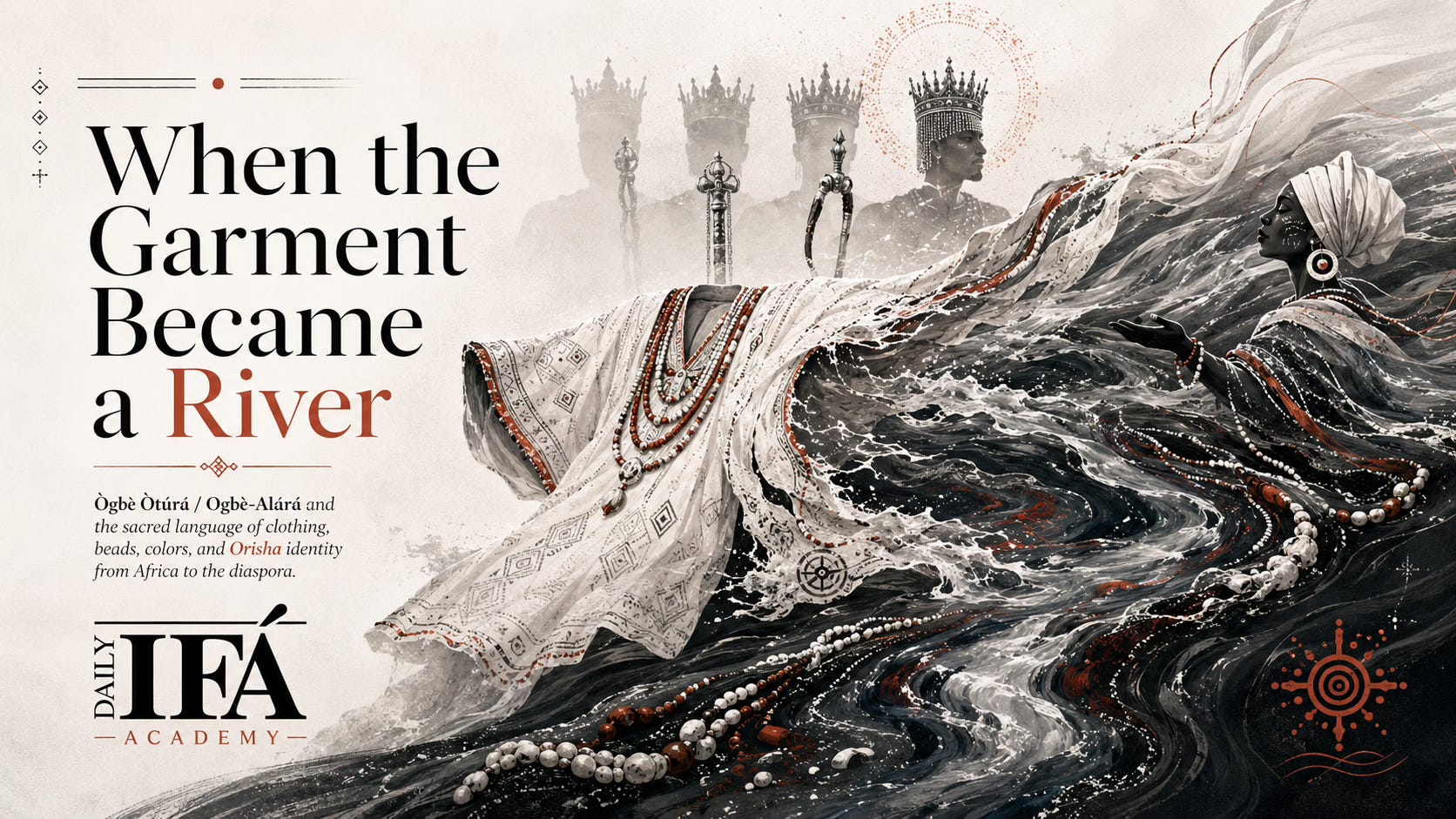
But the deeper discovery is even stranger and more beautiful. In one path of this Odù, a royal garment becomes the hidden origin of Odò Oyá, the river of Oyá. Many devotees first meet Oyá as wind, storm, lightning, cemetery gate, marketplace, warrior queen, buffalo woman, and mother of nine. Some know that Oyá is also a river Orisha and that the Niger River is remembered as Odò Oyá in Yoruba memory. But the idea that a sacred garment, torn through ritual obedience, could release the water of Oyá is a rare and powerful teaching.
It is a discovery worth sitting with. Because it says: what we wear may contain what we have not yet released.
The Myth: Four Kings and One Garment
The story tells of four kings who wished to attend a great celebration. They needed clothing worthy of kingship, but instead of each purchasing his own garment, they chose to acquire one magnificent ceremonial garment and share it among themselves.
This was not ordinary clothing. It was costly. It carried prestige. It announced authority before a word was spoken. Whoever wore it would be seen.
First, the garment came to Alárá. He kept it for years. Then troubling dreams began to visit him. These were not random dreams. They were the kind that carry dust from the invisible world into daylight.
Alárá consulted Ifá. The warning was serious. His road (path of Odù) carried danger, and he was instructed to perform the required spiritual obligation. But the garment was involved. That was the difficulty. He wanted life, protection, and blessing, but he did not want to release the thing that represented status.
He refused. Soon after, he died.
The garment then passed to Ajero. The same dreams came. The same warning arose. The same instruction appeared. Ajero also refused to surrender the garment.
He died.
Then the garment passed to Ọ̀ràngún. Again, the dreams came. Again, Ifá warned. Again, the garment was required. Again, there was refusal.
He died.
Finally, the garment came to the last king. Ọba Olurenpe Giga (Means: The elevated King)He also received the warning, but unlike the others, he obeyed. The Awó took the garment into ritual space. At first, they considered dividing it among themselves, because the cloth was beautiful and valuable. But then they remembered: this garment had been marked by Ifá. It was no longer simply wealth. It had become medicine.
So they tore it.
And when the garment was torn, water began to flow.
That water became Odò Oyá.
This is not a modern geographical claim. It is a mythic revelation. It does not ask us to read the river like a map; it asks us to read the river like a secret. The river of Oyá, in this teaching, does not arise from water alone. It arises from released pride, surrendered status, ritual obedience, and the breaking open of what kings refused to give.
The garment became a river because someone finally allowed sacred beauty to become spiritual function.
The Unknown Teaching Hidden in the Garment
This myth is surprising because it reverses our expectation. We expect water to come from clouds, springs, mountains, wombs, or tears. We do not expect water to come from clothing.
But Ifá often hides wisdom where pride will not look. Clothing sits exactly between the private self and the public world. It is the threshold between body and society. It is what we use to say, “This is who I am,” even before we speak.
So when a garment becomes a river, Ifá is teaching that public identity can be transformed into spiritual flow.
The kings saw the garment as possession. Ifá saw it as a container. The kings saw prestige. Ifá saw trapped water. The kings wanted to wear greatness. Ifá wanted to release blessing.
This is the first teaching of sacred dress: A garment becomes dangerous when it feeds the ego more than it serves Orí.
In Orisha traditions, sacred clothing is never merely about looking spiritual. White clothing cools. Beads identify and protect. Head wraps guard Orí. Ritual skirts hold movement. Pano da Costa carries ancestry, femininity, dignity, and belonging. Elekes and fios de conta mark relationship. Insignia reveal the Orisha’s road. Colors speak, but they do not speak alone; they speak with lineage, divination, elder instruction, and the actual character of the wearer.
A person may wear white and still carry heat. A person may wear beads and still lack humility. A person may dress like a priest and still refuse the command of Ifá.
That is why the garment had to be torn. Not because beauty is wrong, but because beauty without surrender becomes a prison.
From Africa to the Diaspora: The Body as a Shrine
In Africa, sacred dress developed through local lineages, royal systems, priestly offices, textile traditions, beadwork, metals, animal materials, woven cloth, plant knowledge, and the visual language of specific Òrìṣà cults. The body was not treated as neutral. The head, neck, wrists, waist, feet, and hands could all become ritual locations.
The head belongs to Orí, the inner destiny and spiritual consciousness of the person. The neck carries beads close to breath and speech. The wrists mark action. The waist relates to vitality, protection, and ancestral containment. The feet touch the road.
When Africans were taken to Brazil, Cuba, the Caribbean, and the Americas, sacred dress did not disappear. It transformed.
In Candomblé, the ritual wardrobe became one of the most visually developed sacred systems in the Orisha diaspora. White skirts, camisu, pano da Costa, ojá, head cloths, beads, metal tools, and embroidered garments all became part of a living Afro-Brazilian language. The tradition absorbed colonial textile forms, Portuguese and European clothing influences, Indigenous knowledge, Catholic pressure, Brazilian materials, and African memory.
The tradition remembers Portuguese influence in the white skirts, African meaning in colors and ritual symbolism, and Indigenous influence in the development of chains and bead traditions, all adapted to the Orixás.
This must be said carefully. Candomblé clothing is not “Portuguese clothing with African meaning.” It is not “African clothing with Brazilian decoration.” It is a ritual synthesis born from survival, adaptation, secrecy, beauty, and àṣẹ. When the Orixá takes the body, the garment is no longer colonial fabric. It becomes movement. It becomes presence. It becomes the visible body of the sacred.
In Santería / Lukumí, the sacred language of beads is especially central. Elekes or collares are not casual ornaments. They mark relationship, protection, and belonging. They are received through ritual, godparentage, and lineage. A U.S. Bureau of Prisons religious accommodation manual for Orisha worshippers describes collares, also known as elekes, as necklaces representing the colors pleasing to the Orishas, and it identifies Los Collares/Elekes as an early initiation that brings a person into a religious family under godparental protection. (Source)
In Traditional Ifá and Africa-facing Orisha practice in the diaspora, the emphasis is often different. There may be colors, beads, white clothing, and Orisha symbols, but there is usually less dependence on one fixed public color chart. The focus is more strongly on Orí, lineage, divination, cleanliness, simplicity, correct ritual context, and the living relationship between person, elder, and spirit.
This is why we should avoid saying, “This Orisha is always this color everywhere.” That may be useful for beginners, but it is not always spiritually accurate. Candomblé houses differ. Lukumí ramas differ. Traditional Ifá lineages differ. Even qualities or roads of the same Orisha may dress differently.
The garment must be read in context.
Clothing as Protection, Rank, and Responsibility
In many Candomblé houses, white clothing is the basic ritual dress. It cools the body, marks humility, and separates sacred space from the street. The head covering protects Orí. The removal of street shoes signals that one has entered a different order of reality. The standard dress code is white, simple, without adornments, with the head covered; it also states that equality, simplicity, and purity are principles of the dress code.
The fio de conta is also not jewelry. It can identify the Orixá, Nation, role, seniority, spiritual relationship, and sometimes the ritual office of the wearer. Your source explains that fios de conta can identify Nation, rank, role, and Orixá; protect the wearer; strengthen resonance with the Orixá; and serve ritual functions in shrines, altars, and divination.
In Santería, the same principle appears through elekes. The beads are received, not casually bought into spiritual authority. They are cared for, respected, and protected. A necklace can be beautiful, but beauty is not its purpose.
In Traditional Ifá, the same wisdom may appear with more restraint. A Babalawo may wear simple white. An Ìyánífá may choose modest, clean dress. A devotee may wear green and yellow for Ọ̀rúnmìlà in some diaspora contexts, while others may emphasize the ikin, the ọ̀pẹ̀lẹ̀, the opon Ifá, the calmness of character, and the discipline of practice more than the public sign.
Ògbè Òtúrá asks the same question in every lineage: Does what you wear serve your destiny, or does it feed your pride?
The Proverb of the Garment
Aṣọ tí a kò fi ìwà wọ̀, kì í pé lórí ara.
A garment not worn with character does not remain well upon the body.
This proverb is not about fabric tearing. It is about spiritual mismatch. When a person wears what their character cannot support, the garment becomes heavy. It may attract envy, confusion, or false attention. It may announce a spiritual status the person is not yet living. It may create a gap between outer image and inner truth.
That gap is dangerous. The kings in the myth did not die because they owned a beautiful garment. They died because they could not release it when Ifá asked for it. Their clothing had become more important than their life. Their image had become more important than their obedience. Their royal appearance had become stronger than their relationship with destiny.
The final king survived because he understood that the garment was not the highest value. Life was higher. Ifá was higher. Transformation was higher. And when the garment was torn, the river came.
Spiritual Insights and Teachings

The guiding message of Ògbè Òtúrá / Ogbè-Alárá is that visible splendor must be governed by inner humility. This Odù recognizes royal presence, beauty, expansion, and public recognition, but it also warns against ingratitude, arrogance, misuse of people, and attachment to external signs of success.
This is directly connected to clothing. A person can wear the marks of tradition while forgetting the people who carried the tradition. A person can wear beads while neglecting the elders who made the road possible. A person can dress in white and still forget gratitude.
The Orishas connected to this teaching include Ọ̀rúnmìlà, who reveals the hidden meaning behind appearances; Oyá, whose river appears through the torn garment; Obàtálá / Oxalá, who cools Orí and governs white cloth, clarity, and purity; Ọ̀ṣun, who teaches beauty with sweetness and not vanity; Ṣàngó, who reminds us that royal presentation must be matched by justice; and Èṣù, who stands at the threshold where clothing becomes either blessing or trap.
The herbs for this teaching should be cooling, clarifying, and accessible. Basil may be used for blessing and clarity. Rosemary may be used for cleansing and remembrance. Mint may cool and refresh. Lavender may calm emotional heat. White flowers may honor Obàtálá and bring softness. In Candomblé, leaves belong to the mysteries of Ossaim/Ossanyin, and formal ritual use belongs to lineage knowledge. For home devotion, we keep things simple, safe, and respectful.
Prayer for Clothing, Beads, and Orí
Yorùbá
Ọ̀rúnmìlà, ẹlẹ́rìí ìpín,
jẹ́ kí n mọ ohun tí mo ń wọ̀.
Kí aṣọ mi má ṣe di ìgbéraga.
Kí iléke mi má ṣe di ẹ̀wà asán.
Omi tútù, wẹ̀ ọ̀nà mi.
Oyá, jẹ́ kí ohun tí mo fi sílẹ̀ di odò ìbùkún.
Obàtálá, tútù Orí mi.
Kí gbogbo ohun tí mo wọ̀ máa rántí mi sí ìwà pẹ̀lẹ́.
English
Ọ̀rúnmìlà, witness of destiny,
let me understand what I wear.
May my clothing not become arrogance.
May my beads not become empty beauty.
Cool water, wash my road.
Oyá, let what I release become a river of blessing.
Obàtálá, cool my Orí.
May everything I wear remind me of gentle character.
Portuguese
Ọ̀rúnmìlà, testemunha do destino,
que eu compreenda aquilo que visto.
Que minha roupa não se torne arrogância.
Que minhas contas não se tornem beleza vazia.
Água fresca, lave meu caminho.
Oyá, que aquilo que eu entrego se torne rio de bênção.
Obàtálá, refresque meu Orí.
Que tudo o que eu visto me lembre do bom caráter.
Guidance for Spiritual Development
Spiritually, this Odù teaches that the body must become honest before it becomes decorated. Before wearing sacred clothing, ask: What am I trying to show? Before wearing beads, ask: What relationship am I ready to honor? Before covering the head, ask: Am I protecting Orí or performing holiness?
The first garment is character. If the inner garment is torn by jealousy, greed, arrogance, or imitation, no outer garment can fully protect the person. Sacred dress works best when it rests on clean intention.
Guidance for Health
This Odù speaks strongly through cooling. White clothing, cool water, clean fabrics, and gentle herbal baths all belong to the logic of calming the body and protecting Orí.
The Candomblé teaching of Omi Tutu describes cooling water as a ritual act that calms the path, cools the road of arrival and departure, opens a more harmonious energy, and invokes Èṣù, Onílẹ̀, and Egúngún. Your source preserves the phrase: “Only fresh water calms the heat of the Earth.”
For daily life, this means: do not wear sacred items when your mind is overheated. Do not wear beads into conflict. Do not approach shrine work while intoxicated, furious, or spiritually scattered. Cool yourself first.
Guidance for Love and Family
The shared garment is a family teaching. Four kings shared one item, but they did not share wisdom equally. The garment moved from house to house carrying unresolved destiny. Each person inherited not only cloth, but the test attached to it.
Families also pass garments. Some are literal: wedding clothes, head wraps, beads, ritual pieces, inherited jewelry. Others are invisible: pride, shame, silence, debt, status anxiety, fear of being seen.
Ògbè Òtúrá asks: What did your family teach you to wear? Dignity? Shame? Beauty? Survival? Silence? Pride? And what must be torn so the river can flow?
Guidance for Wealth and Business
This Odù has a clear message for wealth: not everything valuable should be kept.
The garment was expensive, but its true value was not in being preserved. Its true value appeared only when it was surrendered to spiritual purpose. In business and public life, this may point to titles, brands, partnerships, possessions, visible success, reputation, or social rank.
There are moments when protecting image destroys life. There are also moments when releasing image opens the river.
Ogbè-Alárá carries warnings around success, gratitude, and relationships with benefactors. Wealth must be matched by remembrance. Visibility must be matched by humility. Recognition must be matched by right conduct.
When to Consult This Odù
Consult Ògbè Òtúrá / Ogbè-Alárá when questions arise around public identity, ritual clothing, sacred beads, spiritual status, initiation symbols, lineage belonging, or the difference between devotion and performance.
Consult this Odù when you feel called to wear sacred items but are unsure whether the call comes from Orí or ego. Consult it when you are preparing for initiation, returning to tradition, building a shrine, or asking how to carry spiritual visibility responsibly.
Consult this Odù when something beautiful has become difficult to release.
Ire vs. Osogbo
In Ire, Ògbè Òtúrá brings dignity, splendor, recognition, prosperity, spiritual protection, and right visibility. Clothing becomes alignment. Beads become relationship. White cloth becomes coolness. The body becomes a shrine. What was worn becomes a vessel of blessing.
In Osogbo, the same energy becomes vanity, spiritual imitation, misuse of status, ingratitude, false authority, and attachment to appearance. The garment becomes heavier than life. Beads become costume. White clothing becomes performance. Sacred identity becomes theatre.
The difference is not in the cloth. The difference is in the head beneath it.
Simple Free Practice: Cooling the Garment
Take one clean white cloth, handkerchief, scarf, or simple garment. Place it near a bowl of fresh cool water. Do not place the cloth inside the water unless it is washable and appropriate.
Sit quietly and say: “May what I wear not hide me from myself. May what I wear help me remember my road.”
Dip your fingers into the water and touch your forehead, then your chest, then the cloth. Ask Orí to help you wear humility, clarity, and protection. This is not consecration. It is remembrance.
Closing Insight
The kings thought the garment was valuable because it was expensive. Ògbè Òtúrá revealed that it was valuable because it could become water.
That is the hidden teaching. The thing we wear may hold a river. The identity we protect may hold a blessing. The beauty we refuse to surrender may be the very place where Oyá waits to open movement.
Do not let sacred clothing become a wall around the ego. Let it become a doorway for Orí.
May your garments cool you.
May your beads remember you.
May your colors guide you.
May what you release become a river beneath your feet.
Stay blessed, and may Omi Tutu cool your road before the storm arrives.
Babá Tilo de Àjàgùnnà
DAILY IFÁ
For Readers of the Free Edition
In the supporting-subscriber section below, we move from story into practical guidance.
Supporting subscribers receive a careful overview of common Orisha colors and numbers as they are often seen in Candomblé, Santería/Lukumí, and Africa-facing Traditional Ifá communities. This is not presented as universal law, because every house, lineage, rama, and elder may differ.
You will also receive a safe guide for devotional bead care: how to distinguish a personal devotional chain from a formally consecrated fio de conta or eleke, how to respectfully awaken a non-initiatory chain with herbs, water, prayer, and gentle smoke, and how to cleanse beads later with fresh flowing crystalline water. The section also includes a spiritual bath for the wearer and a prayer that can be used before wearing sacred clothing or beads.