


To those who have carried a blessing farther than they expected,
and to those who are beginning to wonder what must be protected before it is lost —
May wisdom sit beside you today, not as a judge, but as an elder who has seen many roads and therefore no longer confuses movement with arrival.
There are seasons in life when everything seems to open at once. A door that resisted us for years suddenly swings inward; a name begins to travel ahead of us; money comes with less resistance; people notice what we are doing; the work begins to bear fruit, and perhaps, because human beings are wonderfully vulnerable to their own good fortune, we begin to believe that what has opened will remain open simply because it opened once.
Òdí Méjì does not despise such confidence, but it watches it carefully.
This Odù knows prosperity intimately, yet it also knows the peculiar loneliness that may grow around success when the walls of a life are built too late.
It knows houses filled with valuable things and conversations that have gone silent, families connected by blood but separated by years of unfinished words, people who have crossed many thresholds without noticing what they left behind each time the door closed.
Within the vast body of stories surrounding Òdí Méjì there is a recurring lesson that becomes more profound the longer one sits with it: prosperity is not only about what reaches us; it is also about what we are capable of keeping alive once it has arrived.
That may be one of the great misunderstandings of our age, because we have become astonishingly skilled at acquisition while remaining strangely untrained in preservation. We know how to enlarge a business, widen a network, move to another city, increase our visibility, replace what is broken and begin again somewhere else, yet far less attention is given to the subtler question that Òdí Méjì places quietly before us:
What kind of life are you building that can actually hold what you are asking destiny to give you?
Òdí Méjì: The Wisdom of the House, the Boundary, and the Inner Room
The symbolic world of Òdí Méjì is deeply concerned with containment, enclosure, boundaries and the mysterious power of that which is held long enough to acquire form.
A womb is closed before it opens.
A seed disappears into the earth before anyone can point to the tree.
A house becomes a house because somewhere the open world ends and the protected interior begins.
Even language itself requires boundaries, because without the knowledge of what should be spoken, what should remain private, and what should be entrusted only to those capable of carrying it, words become less like medicine and more like windblown fire.
One transmitted interpretation of Òdí Méjì associates it with the closing or completion of the four directions, an image that helps us understand something essential about the Odù. Closure here is not automatically misfortune. It can mean completion, definition, protection, the drawing of a necessary line around something that is still becoming.
That difference matters.
In modern spiritual language, an opening is often celebrated while a closing is treated as a problem to be removed. Òdí Méjì offers a wiser and more complicated vision, because there are doors that close in order to preserve life, just as there are doors that remain open so long that everything of value eventually walks out.
The question is never merely whether the door is open. The question is whether the door understands its purpose.
The Woman Whose Prosperity Traveled Faster Than Her Family
Among the stories connected with Òdí Méjì, the figure of Oníkì Ọlà carries this teaching with particular tenderness and severity.
She was not a woman abandoned by fortune. Quite the opposite. Fortune seemed to recognize her wherever she went.
She moved from one place to another and prospered, rebuilding herself with the strange competence of people who have learned to survive by turning every new town into a beginning. Roads opened. Opportunity followed her. Relationships formed. Children were born. Life, at least from a distance, looked generous.
Yet prosperity has a way of illuminating a person, and illumination does not attract admiration alone.
It also attracts comparison.
Comparison may ripen into envy, and envy, once it acquires a mouth, rarely remains silent.
Again and again, difficulty followed success. Accusations arose. Relationships fractured. Movement became the answer to conflict, and each departure carried Oníkì Ọlà toward another place where she could begin once more.
In time she became the mother of four children by four different fathers, each child belonging to a different chapter of a life that had been written across distance. The years gathered around them. The children grew. Their fathers remained elsewhere.
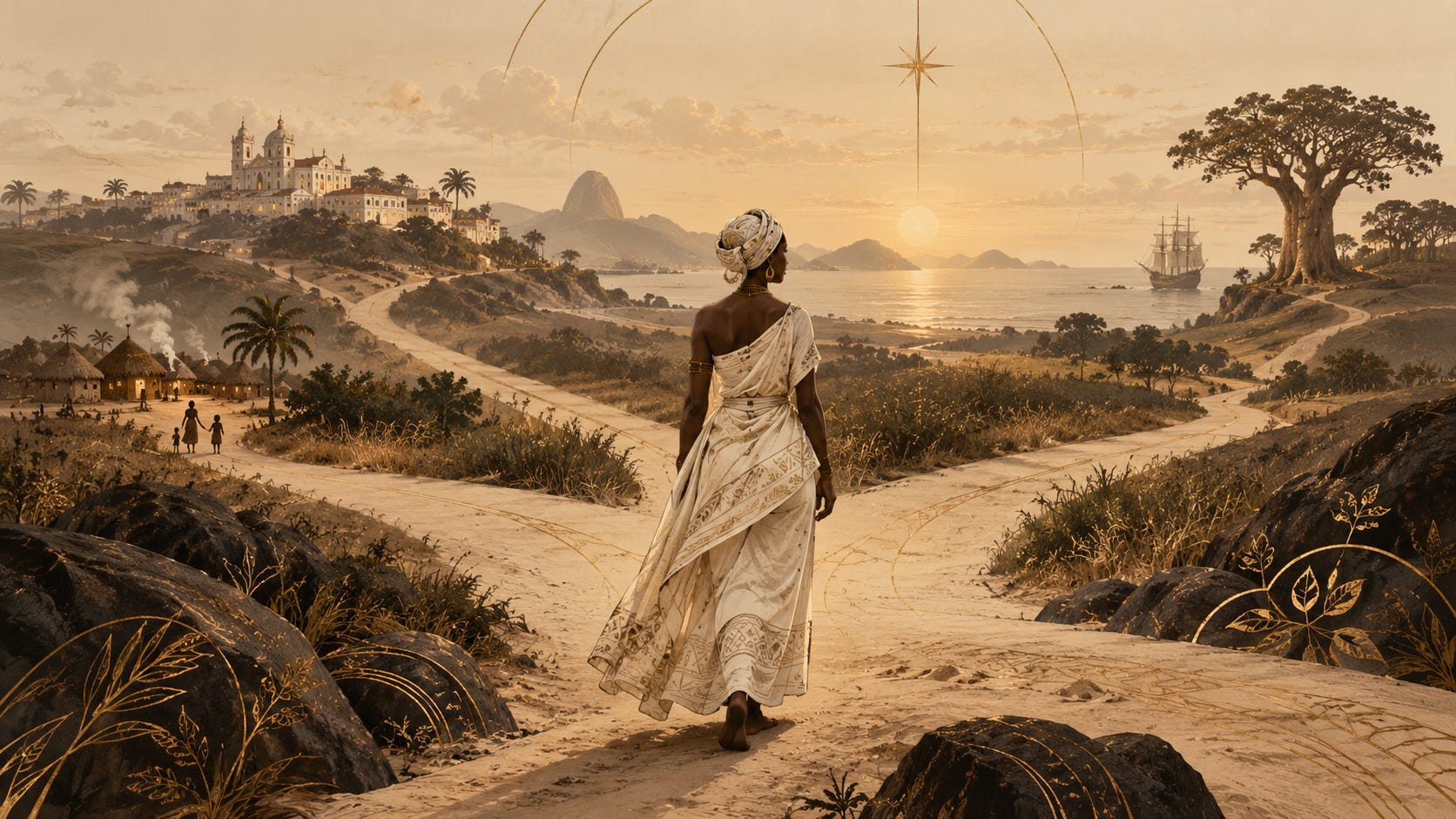
What had once been one woman’s journey gradually became several disconnected histories.
And still she prospered.
That detail is important, because the story would be far easier if material decline had accompanied emotional fragmentation. We could then comfort ourselves with the idea that bad choices always produce immediate and obvious losses.
But Òdí Méjì is not interested in such comforting mathematics.
Sometimes the money stays. Sometimes the reputation grows. Sometimes the doors continue opening even while something less visible is quietly disappearing.
When Oníkì Ọlà eventually returned and attempted to gather what had been dispersed, she discovered what many people learn only after success has made the lesson expensive: wealth can finance a reunion, but it cannot manufacture the years that were not shared.
It cannot purchase childhood again. It cannot transform strangers into intimate siblings merely because blood recognizes blood. It cannot restore every conversation that should have happened when everyone was younger and more reachable.
The story does not condemn her as a woman who prospered. Nor does it reduce her life to punishment. Its power lies elsewhere, in the recognition that there are forms of wealth which money cannot replace once neglected long enough.
That is where Òdí Méjì becomes a teaching for almost anyone living now.
What Does Prosperity Actually Mean?
We often speak of prosperity as though it were a single substance, something like water that can simply be measured by quantity.
Òdí Méjì complicates that idea.
A person may be rich in money and poor in peace. Another may have an abundance of people around them but no one with whom they can speak without performing. Someone else may own little and still possess a home in which three generations know they belong.
There are forms of prosperity that announce themselves publicly, and there are forms whose value becomes visible only when difficulty arrives.
A trusted friend.
Children who still want to visit.
A reputation that can survive accusation.
A partner who knows the difference between your public face and your tired one.
A mind capable of sleeping.
A name that does not need constant defense.
Òdí Méjì asks us to enlarge our definition of Iré, favorable fortune, until it becomes mature enough to include continuity.
Because a blessing that cannot remain with us may still be a blessing, but it has not yet become a home.
When Words Become Residents of the House
Another strong current running through Òdí Méjì concerns speech, gossip, disclosure, accusation and the danger of saying what has no need to be said.
This teaching becomes much more interesting when it is removed from the simplistic idea that “gossip is bad,” because every culture already knows that at the level of manners. Òdí goes further by treating speech as something that alters the structure of relationship itself.
A word does not vanish merely because the speaker has stopped talking. It enters someone else’s memory.
There it may combine with fear, resentment, loyalty, misunderstanding or desire, and what returns later may bear only a faint resemblance to what originally left the mouth.
Anyone who has lived within a family, a religious community, a workplace or even a small circle of friends understands this intuitively. Entire conflicts can arise from a sentence that changed slightly every time it crossed another threshold.
Òdí Méjì therefore treats privacy not merely as secrecy but as ethical intelligence. Some knowledge belongs in the marketplace. Some belongs within the family. Some belongs between two people.
Some belongs only in the presence of those who understand the weight of what they are hearing.
This is why boundaries and speech belong together in this Odù. A house without doors cannot distinguish hospitality from intrusion, and a person without discretion cannot distinguish honesty from unnecessary exposure.
The mature question is not simply, “Is this true?” It is also, “Why am I saying it, to whom, and what will this truth become once it leaves me?”
Before We Go Deeper: A Greeting from My House to Yours
To all of you walking with DAILY IFÁ, whether you arrived through Yorùbá Ifá, Candomblé, Santería/Lukumí, another Afro-Atlantic tradition, or simply through a sincere desire to understand the wisdom preserved in the Odù:
I greet you with affection and respect.
These teachings were never meant to become flattened collections of mystical slogans. They have survived because generations listened, debated, remembered, corrected, adapted and carried them across languages and oceans. When we study them today, we enter a conversation that began long before us and, if we handle it responsibly, will continue after us.
May Òdí Méjì help us recognize what deserves protection without turning protection into fear, and may it teach us how to value what is close enough to be overlooked.
Babá Tilo de Àjàgùnnà
DAILY IFÁ
Hear the Prayer, Not Only the Explanation

There comes a moment in the study of Ifá when explanation reaches its natural limit.
A prayer can be translated and analyzed, but a sung prayer belongs partly to breath, repetition, memory and presence, and because of that I wanted this newsletter to include not simply a reference to prayer but my own voice carrying it.
In the prayer connected with Òdí Méjì, the invocation of Orí reminds us that wisdom is never only external knowledge.
Orí wa jí, Òdí Méjì. May our Orí awaken.
Orí, in the philosophical and spiritual world of Ifá, refers not only to the physical head but to the intimate center of destiny, consciousness and individual direction. To awaken Orí is therefore not merely to “become spiritual”; it is to become more available to one’s own responsibility.
You can listen to my sung prayer for Òdí Méjì here:
I recommend listening without multitasking. Allow the voice to carry the words before returning to their meaning. Sometimes understanding enters through the ear before the mind knows what it has received.
Continue Studying Òdí Méjì in the Full Book
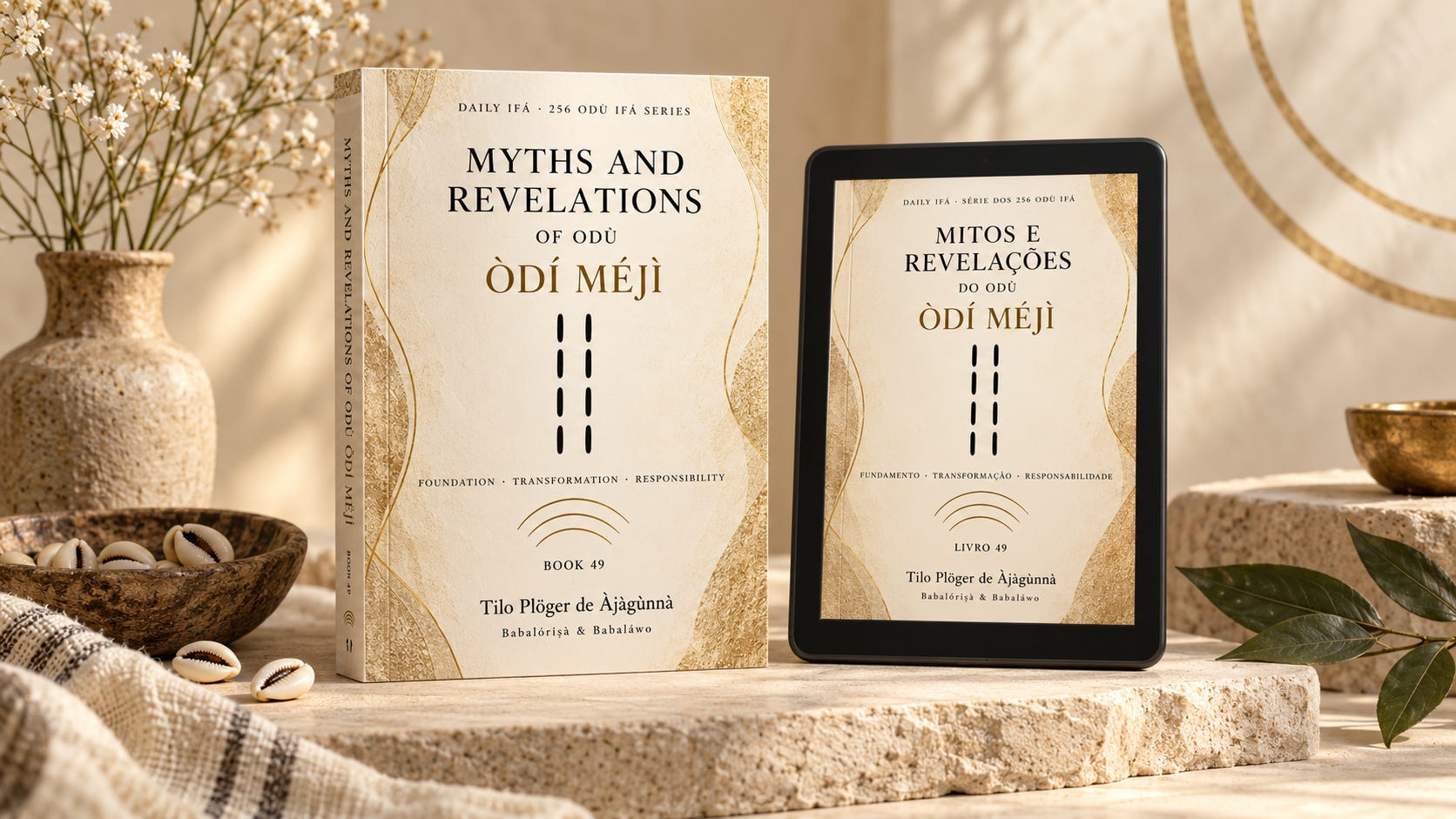
For those who want to go beyond this newsletter and enter the larger body of myths, revelations, comparative material and traditional layers surrounding Òdí Méjì, I have collected that work in the dedicated volume of my 256 Odù Ifá Series (work in progress).
The book allows far more room than a newsletter ever could for the diversity preserved around Òdí Méjì: African and Afro-Atlantic narratives, prayers, proverbs, interpretive traditions, associated powers, warnings, historical layers and the many stories through which this Odù reveals itself differently depending upon context.
These books are meant as study companions rather than substitutes for living lineage transmission. Their purpose is to make the breadth of the corpus visible and to preserve the conversation between traditions rather than pretending that every region has always spoken with one voice.
The Threshold: Where the Free Teaching Ends
So far we have remained with the central architecture of Òdí Méjì: the house, the boundary, prosperity, family, speech, continuity and the strange truth that sometimes what must be protected becomes visible only after it has been neglected.
The deeper study begins where these themes separate into different manifestations.
For Supporting Subscribers, we will now examine what changes when Òdí Méjì appears in Ire and when its same powers move toward Osogbo or Ibi; we will look at why containment can become either protection or imprisonment, why transmitted taboos require context rather than internet-style lists, how family and wealth are connected in the Odù, and why the many Òrìṣà and Irúnmọlẹ̀ associated with Òdí illuminate different dimensions rather than forming one simplistic fixed roster.
This is also where we can address an important scholarly problem: a warning contained in a story is not automatically a universal taboo, and a restriction connected with one divinatory circumstance should not automatically be applied to every person associated with Òdí Méjì.
That distinction is essential if knowledge is to remain knowledge rather than become superstition.
SUPPORTING SUBSCRIBERS
To those who have crossed this second threshold with me—
I greet you again, this time from the inner room.
The first part of our journey asked what a life must contain if it is to hold its blessings. Here we turn the question around and ask what happens when the very structures meant to protect us become too rigid, too secretive, too fearful or too proud.
May we enter this deeper part of Òdí Méjì with patience, because the Odù becomes most useful precisely where its meanings refuse to remain simple.