


To the Ones Who Walk With Orí Before the Road Opens
The one who goes out in the morning is not always the same one who returns home.
- Ìwòrì Méjì
This is not a proverb only about travel. It is about transformation.
A person may leave the house with pride and return with humility. A person may leave with certainty and return with wisdom. A person may leave thinking they know the road, only to discover that the road was also studying them.
This is the mystery of Ìwòrì Méjì.
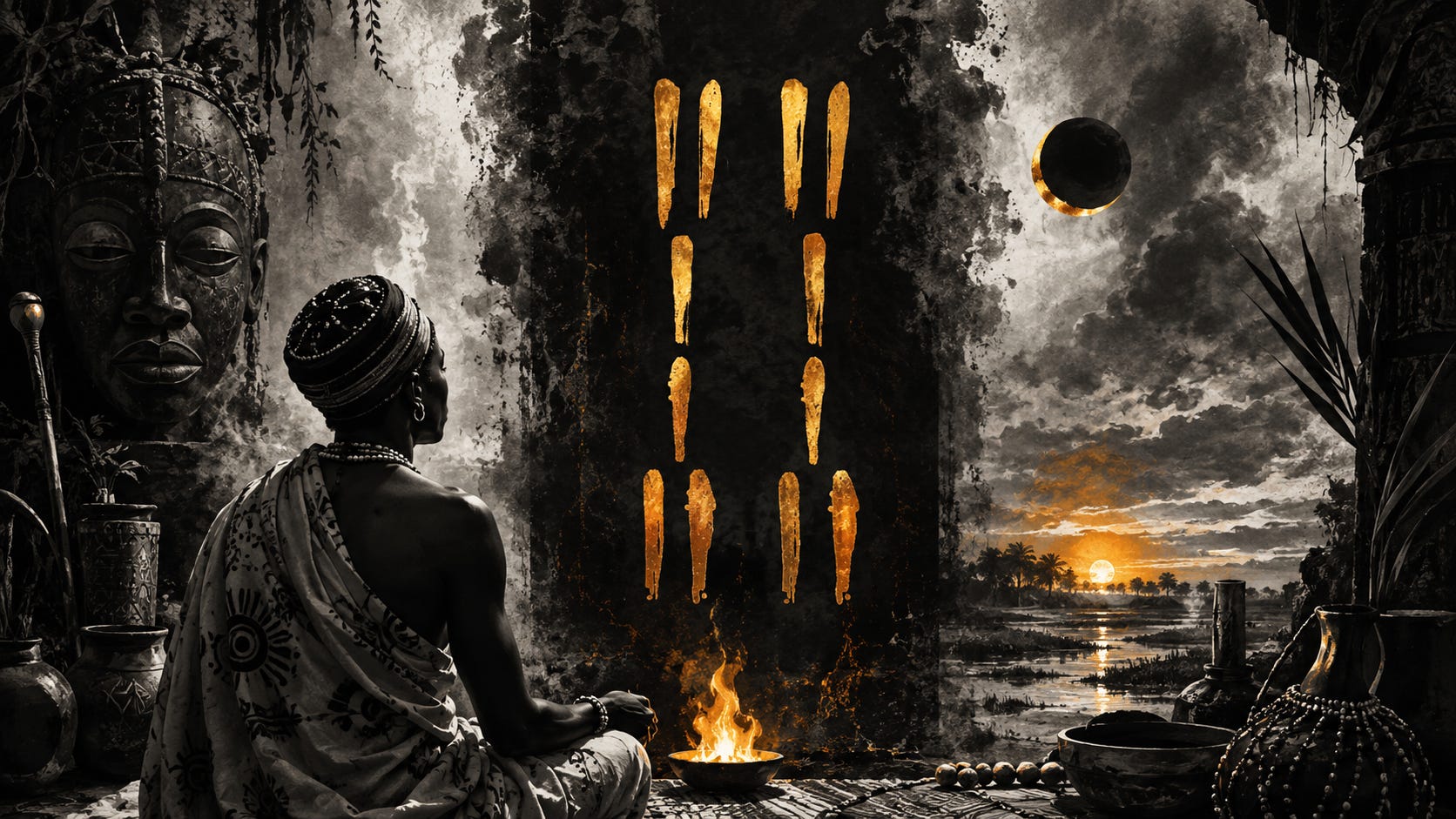
Ìwòrì Méjì is the Odù of spiritual sight, inner fire, delayed manifestation, hidden knowledge, disciplined speech, and the shaping of destiny through character. It teaches that not everything that shines is ready, not everything that is delayed is denied, and not every darkness is punishment. Sometimes darkness is the place where Orí learns to see.
In my extensive work on this Odù, Ìwòrì Méjì is presented as a sign of head, eye, threshold, fire, earth, hidden knowledge, strong Orí, dangerous appetite, delayed success, and strict spiritual discipline. It asks: what is being seen, what is being hidden, what is being cut away, what is being protected, and which force inside the person is overheating?
This Odù does not flatter us. It refines us. It asks us to examine the quality of our consciousness.
And here we must come to one of the deepest keys of this sign: Ìwà + Orí.
Ìwà means character, conduct, behavior, the lived expression of who we are.
Orí means the head, but not only the physical head. Orí is inner consciousness, destiny-bearing self, spiritual authority, and the place through which blessings may enter or be blocked.
So when we speak of Ìwà-Orí, we are speaking of the character of consciousness. We are asking: what kind of head do I carry? What kind of character has my destiny taken? What kind of inner fire is shaping my actions?
One major interpretation links Ìwòrì with Ìwà Orí, the character or condition of the inner head. In this sense, Ìwòrì is consciousness taking form; the being begins to carry a distinct interior, a destiny, a way of seeing, remembering, reacting, and judging.
This is why Ìwòrì Méjì is not only about mystical vision. It is about the responsibility that comes after vision.
Many people want spiritual sight. Fewer are ready for the character required to carry what they see.
The Fire That Creates or Destroys
Ìwòrì Méjì carries fire. But fire is never neutral.
Fire can cook food, forge iron, cleanse a space, illuminate a room, and warm the body. But the same fire can burn the house, destroy the field, and blind the person who does not know how to approach it.
This is why Ìwòrì Méjì speaks strongly about discernment. It warns against rash judgment, uncontrolled speech, spiritual vanity, and the habit of acting before the head has cooled.
The teaching preserved in my work says that fire unites Ìwà and Orí. Character is not an ornament added to consciousness; it is the form consciousness takes under heat. The question is not only what happens to the person, but what kind of self is forged by the event.
This is a hard teaching, but a necessary one. When people are under pressure, their true spiritual structure appears. Under praise, anybody can look wise. Under pressure, the true Orí speaks. Under delay, the true character appears. Under provocation, we discover whether we are guided by Ọ̀rúnmìlà or by impulse.
Ìwòrì Méjì says: do not rush to become visible before your character has been forged.
The children and devotees touched by this Odù may carry strong perception, unusual dreams, sudden insights, and deep spiritual intelligence. Yet they must learn patience, loyalty, and measured speech. Knowledge without character becomes danger. Fire without discipline becomes destruction.
The Mythic Road: Morning, Evening, and the Gaze of Ifá
One of the beautiful teachings of Ìwòrì Méjì tells us that Èjìkókó Ìwòrì was coming from Heaven to Earth. He was advised to worship Ifá, to attend to Ifá, to make offerings, and to learn the prayers and disciplines of the tradition.
The teaching says that the more he worshipped Ifá, the more Ifá would bless him. Then the prayer rises:
Ifá, turn your eyes toward me.
Look upon me with goodness.
If you look upon me, I will have wealth in my hands.
If you care for me, I will have children.
If you keep your eyes upon me, every form of Iré will come.
In the preserved explanation, Ifá’s gaze is not merely sight; it is recognition, protection, and blessing. Iré means blessing, good fortune, and positive fulfillment, including wealth, children, prosperity, and well-being.
This prayer is powerful because Ìwòrì Méjì is an Odù of the eye.
Not only the physical eye.
The spiritual eye.
The eye of Ifá.
The eye of Orí.
The eye that sees what ordinary judgment misses.
How many problems in life come because someone judged too quickly? How many relationships break because someone heard only one side? How many destinies are delayed because the mouth ran faster than the head?
Ìwòrì Méjì says: look again.
Look before you accuse.
Look before you answer.
Look before you sign.
Look before you trust.
Look before you reject.
Look before you declare that the evening has failed simply because morning did not bring the answer.
Sometimes evening is wiser than morning because evening has seen the whole day.
A Special Announcement: My Complete Work on Ìwòrì Méjì Is Now Published
Today I am happy to announce that my complete extensive work on Odù Ìwòrì Méjì is now available on Amazon worldwide.
This newsletter opens the door, but the book is the house.
In the book, I gather the deeper body of myths, divinatory revelations, prayers, songs, proverbs, related Òrìṣà and powers, herbs, taboos, recommendations, and traditional teachings connected to Ìwòrì Méjì. The work includes material from Yorùbá Ifá, Candomblé, Santería, and broader African and diasporic transmissions, preserving the many voices through which this Odù has spoken across time. The master work includes sections on Odù identity, meaning, characteristics, children of Ìwòrì Méjì, prayers, proverbs, related powers, herbs, recommendations, taboos, and myths such as The Creation of the Kola Nut, Why Sacrifice Outlasts Charm, How Morning and Evening Came to Earth, and Why Evening Is More Successful Than Morning.
For every devotee, student, olorisha, awo, spiritual seeker, and child of the tradition who wants to understand this Odù beyond a short summary, this book is an invitation to enter the deeper chamber.
Ìwòrì Méjì is not a sign to be consumed quickly. It is a sign to be studied, prayed with, reflected upon, and lived.
Closing Insight
Ìwòrì Méjì teaches that the road does not only test our feet. It tests our eyes, our tongue, our patience, our loyalty, and our Orí.
Morning may begin the journey, but evening reveals what the journey has made of us.
So do not fear the delay. Do not curse the darkness too quickly. Do not mistake silence for abandonment. When Ifá turns its eyes toward you, even what arrived late can arrive with blessing.
May your Orí remain cool.
May your ìwà become worthy of your destiny.
May the fire inside you become a lamp, not a wound.
May Ìwòrì Méjì teach your eyes to see what impatience cannot.
Stay blessed, and may your evening return wiser than your morning.
Babá Tilo de Àjàgùnnà
DAILY IFÁ ACADEMY
N.B. The prayer you hear in the video is my own devotional prayer for Ìwòrì Méjì. It belongs to a larger work in progress: a complete prayer book for all 256 Odù Ifá. When the cycle is complete, the sung prayers will also be released on Spotify and other streaming platforms.
What to Ask Next?
Ask Voice of Orisha: “Which Òrìṣà can help me cool and strengthen my Orí during a difficult decision?”
Ask Wisdom of Ifá: “How can I recognize whether Ìwòrì Méjì is appearing as Iré or Osogbo in my current situation?”
Ask Voice of Orisha: “What does my spiritual fire need: discipline, rest, protection, or expression?”
Ask Wisdom of Ifá: “Where am I seeing only one side of a matter, and how can I develop better spiritual discernment?”
For Supporting Subscribers: Entering the Deeper Chamber of Ìwòrì Méjì
Supporting subscribers now enter the practical and spiritual guidance of this Odù: how Ìwòrì Méjì speaks to spiritual development, health, love, family, money, business, ancestors, destiny, timing, and the discipline of good character.
This is where the teaching becomes personal.
Ìwòrì Méjì may appear when a person is standing between confusion and clarity. It may come when dreams intensify, when hidden enemies speak, when reputation must be protected, when documents must be read carefully, when a person is tempted to act too soon, or when destiny is ripening but not yet visible.
This Odù also speaks to the person who has power but must learn restraint. The one who has truth but must learn timing. The one who has vision but must learn humility. The one who has fire but must learn how not to burn the house.
Spiritual Development
In spiritual development, Ìwòrì Méjì teaches that sight must be married to character.
The devotee must cultivate Orí through prayer, coolness, discipline, and honest self-examination. It is not enough to dream. It is not enough to receive signs. It is not enough to feel spiritually gifted. Under Ìwòrì Méjì, every gift becomes a responsibility.
