


The First Surprise: Ifá Has a Genesis, But Not a Bible
Beloved companions of the ancient road between Òrun and Ayé,
many people know the Book of Genesis before they ever ask how Ifá speaks about the beginning of the world. They know the garden, the serpent, the forbidden fruit, the fall, the inherited wound. Even people who no longer belong to Christianity often carry its creation story inside their imagination.
So when they come to Ifá, Candomblé, Santería, Lucumí, Umbanda, or other Òrìṣà traditions, they often ask a very understandable question: where is our Genesis?
The surprising answer is this: Ifá has a Genesis, but it was not preserved as one closed book.
It lives across Odù, Itan, Patakí, praise names, ritual memory, house teachings, oral transmission, Yorùbá thought, Brazilian Candomblé, Cuban Lucumí and Santería, and the wider Afro-Atlantic field. It appears through Ọbàtálá and the forming of the human body, through Odùduwà and the first earth, through Olódùmarè and the first source of Àṣẹ, through Èṣù and movement, through Òrúnmìlà and memory, through Nàná and mud, through Olókun and depth, through Orí and destiny.
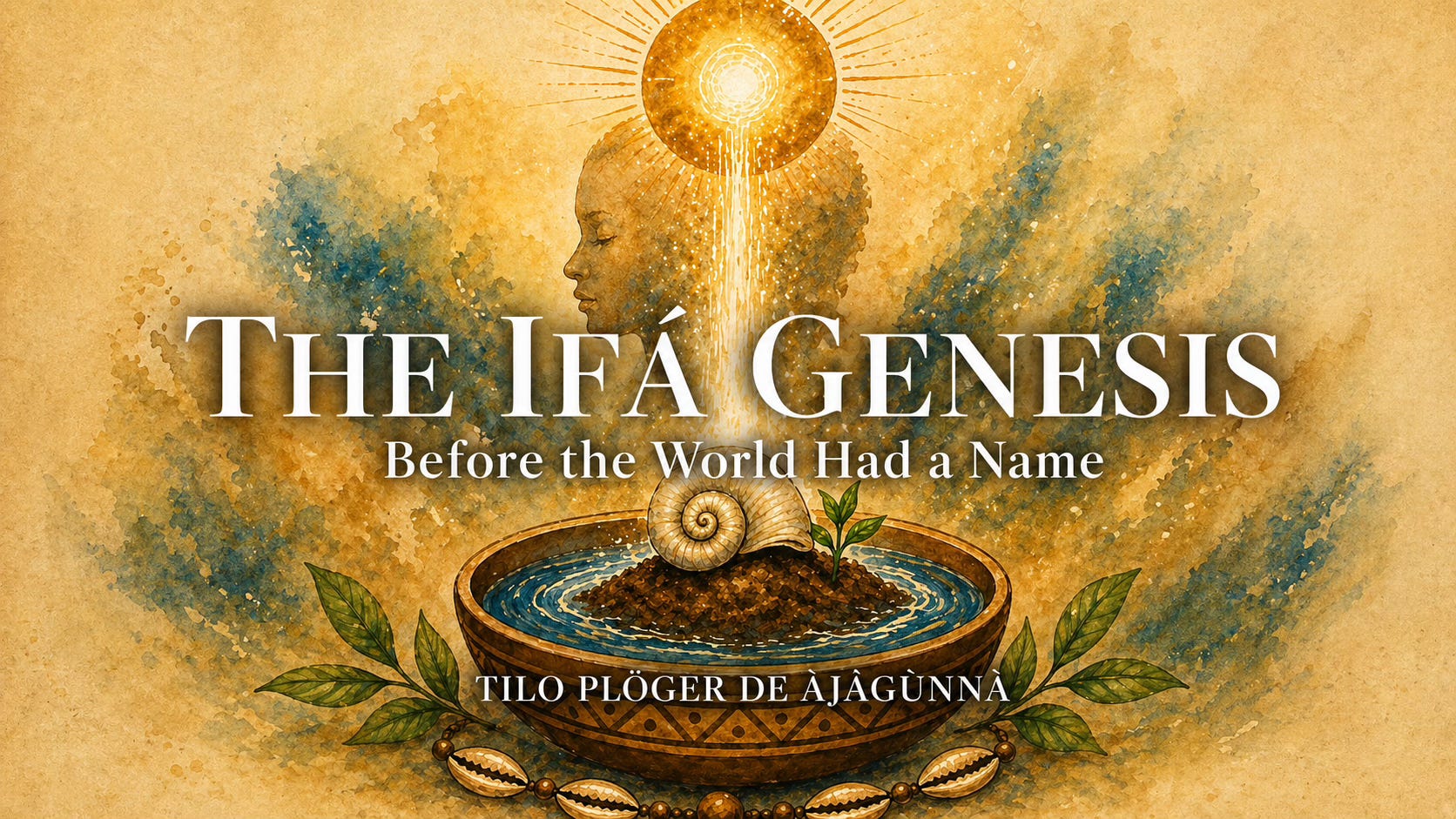
This is why The Ifá Genesis: Before the World Had a Name — The Creation of the Universe, the Òrìṣà, and Human Destiny in Yorùbá Sacred Mythology was written. Not to invent a Genesis, and not to replace any lineage, but to gather the scattered creation teachings of Ifá into one readable sacred architecture. The book’s own structure moves from the unseen before the seen, to Odù, Ayé, the making of the human being, word, sacrifice, society, death, return, and reincarnation.
The Second Surprise: The World Is Not Fallen
The most important difference between Ifá and classical Christian creation theology may be this: Ifá does not begin with original sin.
The human being is not born guilty because of a first ancestor. The body is not shame. Earth is not exile. Desire is not automatically corruption. Death is not punishment for a primordial disobedience. Ayé is not a ruined paradise.
This changes everything.
In much Christian theology, the human condition is explained through the Fall. Something went wrong at the beginning, and humanity inherits the consequence. In Ifá, the problem is not inherited guilt. The problem is misalignment. A person can become misaligned with Orí, with destiny, with ancestors, with Òrìṣà, with character, with speech, with the body, with the dead, with the market, with time.
That misalignment can bring suffering. It can bring illness, loss, confusion, conflict, and disorder. But it is not the same as being born condemned. It can be read, corrected, cooled, redirected, and transformed through divination, Ẹbọ, Ìwà, and right relation.
This is one of the central sentences of the book:
The world is not fallen. It is unfinished.
An Unfinished World Is Not a Broken World
This may be the idea that surprises many devotees most. Unfinished does not mean defective. It means relational. It means the world was not created as a dead mechanism whose meaning was fixed once and forever. It means existence requires participation.
In Ifá, creation does not stop when land appears on water. It does not stop when clay becomes body. It does not stop when breath enters the chest. It continues whenever a person chooses character over appetite, whenever a head is cooled, whenever a road is opened correctly, whenever an offering repairs relation, whenever power is guided by restraint, whenever the dead are placed properly, whenever a child returns and the house learns to recognize the mystery of birth again.
The world needs human beings, not as owners, but as collaborators.
That is why Ifá gives such weight to responsibility. If the world were fallen by nature, people could excuse cruelty by saying corruption is inevitable. If the world were perfect by nature, people could pretend their actions do not matter. Ifá allows neither escape. Every word, decision, offering, refusal, betrayal, healing, burial, birth, market exchange, and act of character enters the unfinished fabric of creation.
The Human Being Is Not Born Guilty. The Human Being Is Born Responsible.
This is where Ifá becomes deeply practical.
The human being is not simply “a soul in a body.” A person is woven from Orí, body, Ẹ̀mí, Bara, ancestors, Ẹgbẹ́, destiny, taboos, obligations, speech, community, and visible and invisible relationships.
This means the self is never isolated.
Orí is individual, but Orí is not alone. A person belongs to lineage, elders, ancestors, Òrìṣà, nature, roads, the unborn, the dead, and the community of the living. This is why names matter. This is why burial matters. This is why the market matters. This is why words matter. This is why character matters.
Modern life often teaches the individual to imagine themselves as separate, self-made, and self-contained. Ifá teaches something different. The person is a crossroads of relationships. To live well is not to escape those relationships, but to become aligned within them.
This is not a theology of guilt. It is a theology of accountability.
Matter Is Sacred Because Àṣẹ Becomes Visible Through It
Another major difference from many Western religious assumptions is Ifá’s view of matter.
Ifá does not ask us to escape the body in order to become spiritual. Matter is not the enemy of the divine. The visible world is not spiritually empty. Clay, water, iron, leaves, stones, breath, blood, womb, river, market, grave, seed, and speech can all carry consequence.
Matter matters because Àṣẹ becomes visible through matter. A leaf can heal or poison. Iron can feed or kill. Water can cleanse or drown. A grave can protect or disturb. A word can bless or destroy. The body can dance the Òrìṣà. The head can carry destiny. The mouth can release power. The earth can receive the dead and prepare return.
Ifá gives the world dignity without making it sentimental. The world is sacred, but not harmless. It is alive, responsive, charged, and consequential.
This is why Ifá cannot be reduced to “mythology” in the decorative sense. The myths are not charming stories around ritual. They are theological diagrams. The snail shell, the hen, the chameleon, the clay, the calabash, the thunderstone, the iron tool, the cemetery gate, the twin figure — each one tells us something about how existence works.
One Supreme Source, Many Sacred Powers
Ifá is often misunderstood because outsiders encounter the many Òrìṣà first and too quickly call the tradition “polytheism.” But that word often hides more than it reveals.
Ifá recognizes a supreme source: Olódùmarè, also called Ọlọ́run and Ẹlẹ́dàá, the source of life, breath, destiny, and Àṣẹ. But creation does not unfold through one divine actor doing everything directly. Olódùmarè delegates. Reality becomes active through sacred plurality.
Odù carry the roads, structures, measures, and destiny-patterns of existence. Òrìṣà bring living qualities, powers, polarities, and forces. Orí chooses destiny. Èṣù makes movement and exchange possible. Ancestors continue lineage. Human beings participate through character, speech, ritual action, and choice.
This is not a universe of disconnected gods competing for attention. It is one source, many powers, one world, many roads.
For devotees, this may clarify something they have always felt: the Òrìṣà are not “characters” in old stories. They are not decorative symbols. They are living powers through which creation remains active.
Odù Are the Roads. Òrìṣà Are the Powers Moving Through Them.
One of the most important theological distinctions in the book is the difference between Odù and Òrìṣà.
Odù are not simply chapters of divination. They are the deep roads of existence. They are structure, measure, pattern, code, destiny-matrix, and revealed intelligence. They explain why one road opens and another closes, why timing matters, why the same action may bless one person and harm another, why character, taboo, offering, and Orí cannot be separated.
Òrìṣà are living powers. They are divine forces, ancestral presences, qualities of creation, and sacred intensities. Ọbàtálá brings form and clarity. Odùduwà brings earth and foundation. Èṣù brings movement and consequence. Òrúnmìlà brings witness and memory. Nàná brings mud and return. Olókun brings depth. Ọ̀ṣun brings sweetness and circulation. Ògún opens the iron road. Ṣàngó judges power. Ọya moves transition.
Odù are the roads before the road. Òrìṣà are the powers that make the roads alive.
Together, they reveal Ifá as a complete cosmological system, not a loose collection of unrelated myths.
Èṣù Is Not Satan
No misunderstanding has harmed the public understanding of Ifá more than the identification of Èṣù with Satan. Èṣù is not the enemy of Olódùmarè. Èṣù is not a fallen angel. Èṣù is not evil incarnate. Èṣù is messenger, threshold, speech, ambiguity, appetite, market, exchange, test, translation, and movement.
Without Èṣù, nothing moves. No message travels. No offering reaches its destination. No road opens. No hidden contradiction is exposed. No exchange becomes active.
Èṣù is difficult because movement is difficult. He is dangerous because thresholds are dangerous. He is ambiguous because real communication is ambiguous. But ambiguity is not evil. A world without Èṣù would be static.
This clarification is essential, especially for readers formed by Christian categories. Ifá does not divide the cosmos into God versus a cosmic enemy. It sees reality as a field of forces, roads, relations, choices, consequences, and corrections.
Ẹbọ Is Not Payment for Sin
If there is no original sin, then Ẹbọ cannot be payment for sin.
This is another major difference. Ẹbọ is often mistranslated or misunderstood as sacrifice in the narrow sense of payment, appeasement, superstition, or bribery. But in Ifá, Ẹbọ is better understood as sacred correction, exchange, and rebalancing.
Ẹbọ is relationship technology.
It moves substance, word, gesture, food, water, leaf, cloth, coin, apology, restraint, or action into the place where relation has become blocked. It says that the world can still be answered. It says the invisible is not deaf. It says matter can carry correction. It says the human hand still has a role in repairing the road.
This is why Ifá is not fatalistic. Destiny matters, but destiny is not mechanical. A road can darken. A road can open. A blessing can be lost through bad character. A difficult path can be improved through alignment, offering, patience, and right conduct.
Good and Evil Are Not Two Absolute Camps
Another surprising difference: Ifá does not usually think in simple absolute binaries.
This does not mean Ifá lacks ethics. It does not mean everything is permitted. It means life must be diagnosed.
A medicine may heal one person and harm another. A silence may be wise today and cowardly tomorrow. A truth spoken at the right time may heal; the same truth spoken without wisdom may destroy. A power may bless when honored correctly and damage when approached without discipline.
This is why Odù can seem contradictory to outsiders. One verse may praise an action; another may warn against a similar action. The difference is not confusion. The difference is context.
Ifá asks: Which road is active? What does Orí require? Is this Ire or Osogbo? Which ancestor is heavy? Which Òrìṣà is involved? Has Ẹbọ been made? Has character failed? Which taboo has been broken? What must change?
This is not moral looseness. It is moral seriousness under the conditions of real life.
Death Is Not Punishment for a Fall
In Ifá, death does not carry the same theological meaning it often carries in Christianity.
Death is not simply the punishment imposed on matter because humanity sinned. Death is part of the cycle of existence, return, ancestry, and rebirth. The dead are not simply gone. They must be placed. They must be remembered correctly. They may become ancestors. The child may return. Lineage continues across visible and invisible worlds.
This is why the book moves into Àṣèsè, Ìbejì, Àbíkú, and repeated birth. Creation cannot be fully understood without death, because Ifá does not treat life and death as isolated opposites. They are part of a wider cycle of departure, transformation, memory, return, and responsibility.
The world is doubled so that it can continue. If death were single, it would be final. But Ifá gives death another side. That side is birth.
Myth Is Not Fiction
Modern readers often hear “myth” and think “not true.” Ifá requires a better understanding.
A myth is not merely an old story. A myth can preserve metaphysics, ethics, ritual memory, social law, psychology, ecological wisdom, ancestral history, and theological truth. It tells us not only what happened, but what kind of world we live in.
The creation myths of Ifá do not simply entertain. They explain why the body matters, why Orí matters, why offerings matter, why roads differ, why speech has power, why matter is charged, why elders matter, why ancestors remain present, why the market can become spiritually dangerous, why character determines whether blessing can remain.
This is why The Ifá Genesis treats myth as a serious theological language. It listens to the old stories until they reveal the architecture beneath them.
Why This Book Matters for Devotees Today
Many devotees have received beautiful practices without always receiving the larger theological map behind them.
They know that Orí matters, but may not have seen how Orí belongs inside a wider Genesis of human destiny. They know that Èṣù opens roads, but may still feel the pressure of Christian misunderstandings. They know that Ẹbọ works, but may not have had language to explain why it is not payment for sin. They know the Òrìṣà are alive, but may not have seen them presented together as a coherent cosmology of creation. They know the dead matter, but may not have understood how death and return belong to the same sacred architecture.
This book is written for that hunger. It is for those who have always felt that Ifá is not only ritual, not only divination, not only mythology, not only culture, but a full vision of existence.
It does not replace elders, houses, lineages, divination, initiation, or lived practice. The book itself is clear on that point: Ifá was not born as a book, and its deepest authority still belongs to the spoken word, the elder’s correction, the oracle, the shrine, the leaf, the offering, the dream, the body, and the road approached correctly.
But a book can gather. It can clarify. It can give language to what devotees already sense. It can show that the tradition is not fragmented because it has many roads. It is alive because those roads still speak.
The Core Difference in One Sentence
Christian Genesis often asks: how did humanity fall, and how can it be redeemed? Ifá’s Genesis asks: how did existence become relational, and how can human beings participate responsibly in its unfolding?
That difference is profound.
It changes how we see the body. It changes how we see nature. It changes how we see destiny. It changes how we see suffering. It changes how we see death. It changes how we see power. It changes how we see the human being.
In Ifá, the beginning is not only behind us. It stands wherever Àṣẹ enters matter and asks what we will do with it. The reader is not returned to innocence. The reader is returned to responsibility.
Where the Book Is Available
The Ifá Genesis has now been announced as live worldwide on Amazon, with editions in English, German, and Brazilian Portuguese. Availability can vary by marketplace, format, and delivery region, but all three language editions are generally searchable through the main Amazon stores.
For readers in the United States: Amazon US – The Ifá Genesis
For readers in Brazil: Amazon Brazil – The Ifá Genesis / A Gênese de Ifá
For readers in Germany: Amazon Germany – The Ifá Genesis / Die Ifá Genesis
All language editions may also appear across different Amazon country stores depending on Amazon’s indexing, Kindle availability, print-on-demand distribution, and local delivery options.
May this work serve your Orí with clarity, your understanding with depth, and your relationship to Ifá with renewed respect. May it help many devotees see what they may have always felt but never fully seen in one place: Ifá does not begin with a fallen world. It begins with a living one.
Àṣẹ fún ìmọ̀. Àṣẹ fún ìwà. Àṣẹ fún Orí rere.
With blessings from the road before the road,
BABA Tilo de Àjàgùnnà
DAILY IFÁ ACADEMY
Comecei a ler hoje e estou achando fantástico. Agradeço mt por isso de coração! Axé!
"Matter Matters" " ...no thing is every thing and every thing is in ALL Things ..ALL Things Matter..
One is will read again and purchase the IFA Genesis
ASE000