


Dear seekers of wisdom,
Before we enter the forest of today’s Odu, allow me to begin with gratitude.
DAILY IFÁ has now reached 5,000 subscribers, with readers in over 25 countries. For me, this is not just a number. It is a sign that the old wisdom still walks. It means that across Europe, Africa, the Americas, and beyond, people are making space for Ifá, Òrìṣà, Egún, Orí, and the living memory of our spiritual traditions.
And maybe, if we are speaking not about short TikTok fragments or Instagram accounts, but about in-depth Ifá newsletters, long-form spiritual education, and a serious community of weekly readers, DAILY IFÁ may now be among the largest spaces of its kind worldwide.
For this, I thank you deeply.
Mo dúpẹ́.
Obrigado.
Thank you.
May Ọ̀rúnmìlà bless every reader who has walked with us. May Èṣù open the roads for all who share these teachings with respect. May Orí never abandon you. May your ancestors remember your name in blessing.
Today we enter Ọ̀kànràn Òsá.
And I want to begin with precision, because in Ifá precision is protection. This Odu is Ọ̀kànràn Òsá, not Òsá Ọ̀kànràn. Ọ̀kànràn is the base, the left leg, the root. Òsá is the second leg, the force that modifies and completes the movement. These two arrangements are not the same. Ọ̀kànràn Òsá carries the heat of confrontation, truth, enemies, protection, voice, Èṣù, Ṣàngó, Orí, and the mysterious authority of the Mothers.
But who are these Mothers?
In Yorùbá spiritual thought, we speak of the Ìyàmi Òṣòróngà — often translated as the “Great Mothers” or “Mothers of the Night.” They are among the most misunderstood powers in the tradition. Some people fear them. Some people reduce them to the word “witches.” Some people speak about them only in whispers, as if silence alone could protect the human being from forces older than our fears.
But Ifá teaches us to look deeper.
The Ìyàmi are not simply evil forces. They are not demons. They are not enemies of humanity. They are the ancient feminine powers connected to womb, blood, birds, night, fertility, death, justice, and the invisible laws that keep creation in balance. They are mothers, judges, witnesses, and guardians of sacred consequence. When life is respected, they can protect. When life is abused, they can correct. When women are dishonored, when promises are broken, when envy poisons the heart, when spiritual power is used without character, the Mothers are not blind.
This is why a person should not approach the Ìyàmi with arrogance. One does not command the Mothers as if they were servants. One does not “fight” the Mothers as if they were ordinary enemies. One approaches them with respect, coolness, humility, and clean character.
From this understanding comes the idea of Ìṣẹ́ta.
The concept of Ìṣẹ́ta
The word Ìṣẹ́ta is often understood as a protective spiritual work against enemies, hostility, envy, hidden attacks, and forces that try to disturb a person’s destiny. Some elders also explain it through the idea of a three-day spiritual work, a protection that seals the person through prayer, medicine, and Odu. In traditional practice, Ìṣẹ́ta can belong to deeper ritual technologies that are not casual, not public, and not for careless hands.
But the principle behind it is simple enough for every seeker to understand:
Ìṣẹ́ta is about spiritual immunity.
It is not about revenge.
It is not about attacking people.
It is not about declaring war against the Mothers.
It is about asking that what is unjust should not be able to enter your body, your house, your destiny, or your road.
It is the prayer of a person who says: “May my Orí not be exposed. May envy not find a place in me. May the anger of others not become my sickness. May hidden hostility return to the law of balance. May the Mothers see that I walk with respect.”
Now we can understand why Ọ̀kànràn Òsá becomes so important.
In certain protective contexts, Ọ̀kànràn Òsá is used as one of the three sacred Odus in the spiritual structure of Ìṣẹ́ta fún Ìyàmi, a protection connected to the authority of the cosmic Mothers. The three Odus are arranged as a spiritual bridge: Èjì Ògbè on the left, Ọ̀kànràn Òsá in the center, and Òsá Méjì on the right.
Èjì Ògbè brings light, life force, clarity, and the support of the spiritual collective. It is the opening of creation, the breath of possibility, the white cloth spread before destiny.
Òsá Méjì carries the wind, the movement of invisible powers, and the deep connection to the Ìyàmi. It reminds us that the Mothers move like birds, like night air, like forces we may not see but must never disrespect.
And between them stands Ọ̀kànràn Òsá.
This is the mystery.
Ọ̀kànràn Òsá stands in the center because it knows the territory of enemies, traps, the evil eye, the misuse of the mouth, hidden aggression, and spiritual confrontation. But it also knows the medicine of truth, Orí, Èṣù, Ṣàngó, and rightful protection. It is the Odu that says: danger must not make you dirty. Enemies must not make you lose your character. Protection must not become revenge.
Èṣù opens the road and reveals what is hidden.
Ṣàngó cuts falsehood and injustice.
Orí gives the person authority to stand.
The Ìyàmi witness whether the person is moving in balance.
This is why Ọ̀kànràn Òsá is not simply “against enemies.” It teaches how to deal with enemies without becoming one. It teaches that the strongest protection is not hatred, but alignment. It teaches that when the mouth speaks truth, when Orí is fed, when Èṣù is respected, when Ṣàngó cuts only what is unjust, and when the Mothers are approached with humility, the person becomes difficult to harm.
That is the lesson I want to share today.
Not the sensational version.
Not the fearful version.
Not the colonial fantasy of “witches.”
But the Ifá understanding.
Ọ̀kànràn Òsá stands in the middle of the protection because it stands exactly where danger must be transformed into authority.
The Odu in the Middle
Two proverb say:
“With truth one wins, even when the enemy wants to take it away.”
“The death of one becomes the life of another.”
These are not comfortable sayings. But Ọ̀kànràn Òsá is not always a comfortable Odu. It speaks of enemies nearby, evil eye, theft, traps, illness, the grave, Egún, women, hidden conflict, and the need to take spiritual protection seriously. It also says that one must care for the dead, respect women, be truthful, and avoid hiding money or acting dishonestly within the family.
This is why the link to Ìyàmi is so strong.
The Ìyàmi are not childish forces. They are not decorative figures. They are the cosmic Mothers, the owners of a deep feminine authority connected to night, womb, blood, birds, justice, fertility, death, and the balance of creation. They are not simply “good” or “bad.” They are guardians of law.
When a person violates balance, the Mothers see.
When a person abuses women, the Mothers see.
When a person lies, steals, betrays, or uses spiritual power without character, the Mothers see.
When a person is unjustly attacked by envy, curse, malice, or hidden hatred, the Mothers also see.
This is why Ìṣẹ́ta is not an attack against the Mothers. One does not “defeat” the Mothers. That is spiritual ignorance. Ìṣẹ́ta is better understood as a protective seal, a pact of recognition, and a spiritual defense line. It acknowledges the authority of the Ìyàmi while asking that the person be made spiritually difficult to harm. It is connected to the idea of becoming protected from hostile forces, envy, and invisible attacks while remaining within the law of balance.
In other words, Ìṣẹ́ta does not say: “Mothers, I fight you.”
It says: “Mothers, I recognize your law. Let what is unjust not touch me. Let what is not mine return to where it belongs. Let my Orí stand clean before you.”
That is a very different spiritual attitude.
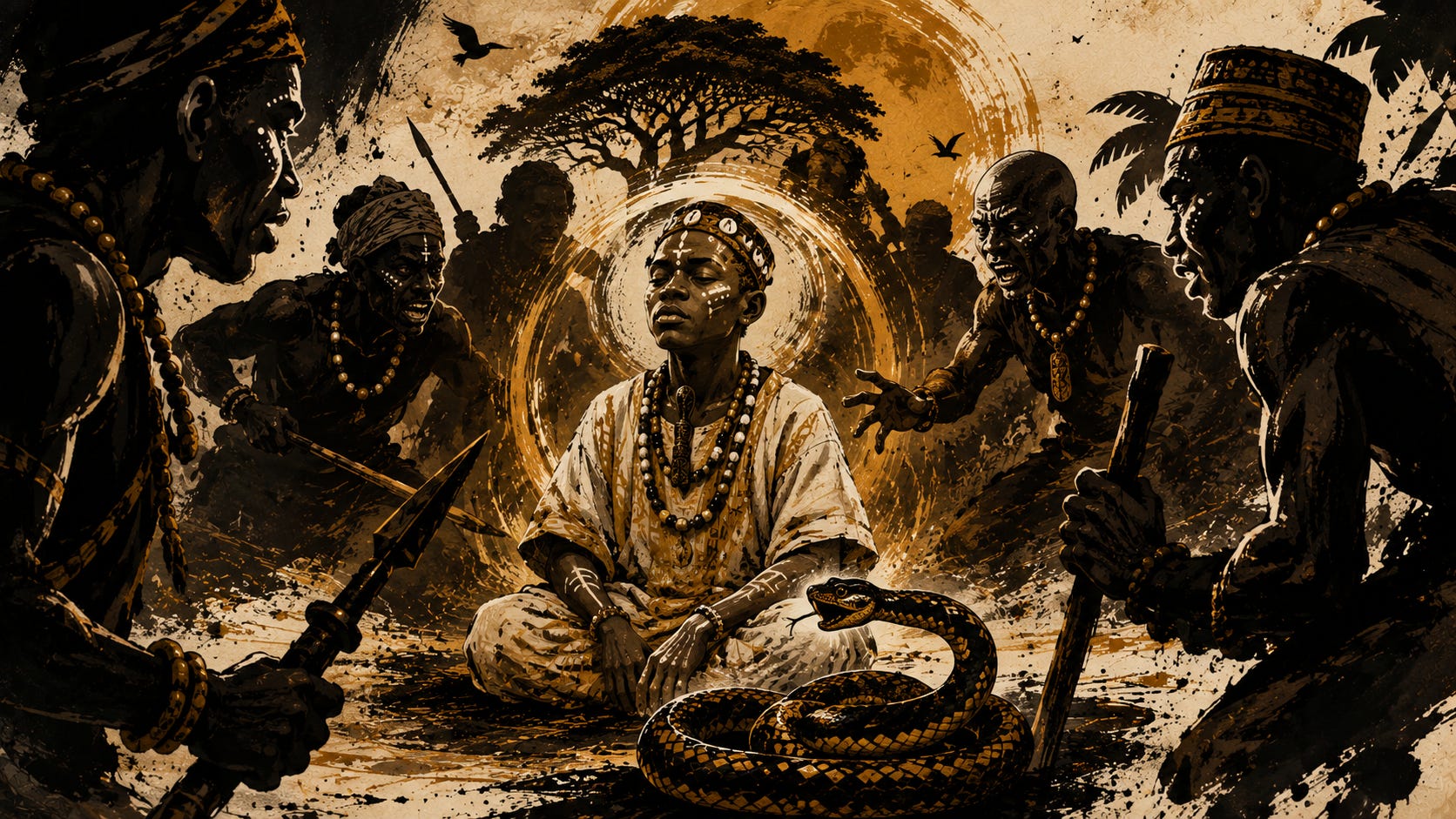
The Snake Among Enemies
One of the central verses of Ọ̀kànràn Òsá speaks of the snake.
Ifá says that the person is in the midst of enemies and must use the mouth as a weapon of protection. The person must also propitiate Orí so that enemies will respect them. In the verse, the snake is surrounded by enemies, yet Ifá says that if not for its Orí, the snake would have been used to tie firewood.
Think about this image.
The snake has no arms.
The snake has no legs.
The snake does not carry a machete.
The snake does not shout in the market.
Yet people fear stepping on it.
Why?
Because the snake carries spiritual authority. The snake’s power is not in noise. It is in presence. It is in Orí. It is in the fact that its enemies know: this one is not to be handled carelessly.
This is one of the reasons Ọ̀kànràn Òsá belongs at the center of the Ìṣẹ́ta structure. It teaches the kind of protection that does not depend on violence. It teaches the protection of Orí, mouth, truth, and sacred authority.
In this Odu, the mouth is not only for talking. The mouth is a weapon. But Ifá is not telling us to curse recklessly, gossip, insult, or fight with words like a child. It is teaching the disciplined mouth.
The mouth that says the truth.
The mouth that prays correctly.
The mouth that calls Orí.
The mouth that invokes Èṣù without confusion.
The mouth that asks Ṣàngó to cut injustice, not to feed ego.
This is why the taboos of Ọ̀kànràn Òsá are so revealing. The person must not remain silent when they are supposed to speak, but they must also not use violence to confront issues. They must not be greedy and must not act with fear or cowardice.
That is the balance: speak, but do not become violent. Defend yourself, but do not become unjust. Stand in truth, but do not confuse truth with arrogance.
Why Ṣàngó and Èṣù Stand in This Odu
In the three-Odu protection, Ọ̀kànràn Òsá is said to activate Èṣù and Ṣàngó. This is not random. It is rooted in the nature of the Odu itself.
Èṣù is the opener and tester of roads. He is the one who knows the crossroads, the hidden agreement, the place where the enemy hides, the place where the blessing waits. In one verse of Ọ̀kànràn Òsá, Ifá says that the day one enters covenant with Èṣù, all the Ire of life are released.
Ṣàngó is the power of justice, thunder, fire, strategy, and decisive authority. In the Cuban revelations of this Odu, Ṣàngó is strongly present; the sign speaks of his anger, of the palm, of elders pleading with him, and of offerings and ritual materials directed to Ṣàngó.
Èṣù opens the road.
Ṣàngó cuts the falsehood.
Orí gives the person spiritual legitimacy.
The Ìyàmi judge whether the person stands within balance.
This is why Ọ̀kànràn Òsá is not merely defensive. It is juridical. It belongs to the court of invisible justice.
The War That Weapons Could Not Win
Another powerful verse of Ọ̀kànràn Òsá says that a war could not be won with javelin or spear. The person did not need a gun, sword, spear, arrow, or any dangerous weapon. Instead, Ifá says that it was Ìróké and Ìrùkẹ̀rẹ̀ that Edu used to dismiss war, death, and evil forces.
For readers who are new to these terms, let me explain.
Ìróké is the sacred Ifá tapper, often made of wood or ivory, used by the Babaláwo to call attention, mark presence, and awaken spiritual authority during divination and invocation. It is not merely an object. In the hands of an initiated priest, it becomes a voice of Àṣẹ.
Ìrùkẹ̀rẹ̀ is the horsetail or fly-whisk carried by kings, priests, and spiritual authorities in many Yorùbá and Afro-diasporic traditions. It is a sign of command, dignity, blessing, and the ability to direct spiritual force without physical violence.
So when Ifá says that war was dismissed with Ìróké and Ìrùkẹ̀rẹ̀, it is teaching that the battle was not won by aggression. It was won by Àṣẹ, by spiritual authority, by the disciplined voice, by rightful invocation, and by standing in one’s sacred office.
This is one of the deepest keys to the Odu.
Ọ̀kànràn Òsá teaches that there are battles you cannot win by behaving like your enemy. If they use lies, you do not become a liar. If they use manipulation, you do not become manipulative. If they use invisible attack, you do not become spiritually dirty. If they come with violence, you do not automatically answer with violence.
You stand in Àṣẹ.
You strengthen Orí.
You call Èṣù.
You ask Ṣàngó to cut what is false.
You honor Egún.
You respect the Mothers.
You speak when you must speak.
You remain silent when silence is wisdom.
This is why Ọ̀kànràn Òsá sits in the center of the Ìṣẹ́ta pattern. It is the Odu of spiritual self-defense without spiritual corruption. It says: do not let the enemy decide the quality of your character. Do not let conflict make you forget who you are. The highest protection is not always a stronger weapon; sometimes it is a cleaner mouth, a steadier Orí, and Àṣẹ that cannot be bought or broken.
The Mother Worthy of a Crown
There is also a beautiful verse in Ọ̀kànràn Òsá where Ifá speaks for Yèyé mi Otoro Efon, a mother lamenting her inability to bear a child. She is told to make ebo, she complies, and the verse calls on Òṣun. It asks whether the mother is worthy of salutation, and the answer is yes. It asks whether the mother is worthy of a crown, and again the answer is yes.
This is not a small detail.
The Odu that stands in the center of protection against hostile forces also contains a praise of the mother. It contains Òṣun. It contains fertility. It contains the dignity of feminine power.
So when we speak of Ìyàmi here, we must not speak with fear alone. We must speak with respect for mother-power, womb-power, and the law that protects women, children, and the continuity of life.
This is also why Ọ̀kànràn Òsá warns clearly: do not abuse women. Respect your wife. Give thanks to women, because blessing may come through them.
A man cannot pray to Ifá in the morning and humiliate women in the evening.
A woman cannot call the Mothers and then dishonor her own feminine line.
A devotee cannot ask for protection from Ìyàmi while living in contempt of motherhood, ancestry, and truth.
The Mothers are not fooled by candles. They read character.
So may our protection begin there: in truth, in respect, and in the quiet discipline of walking with clean hands.
Babá Tilo de Àjàgùnnà
DAILY IFÁ ACADEMY
For Supporting Subscribers
In the members-only part of this newsletter, we go deeper into the practical meaning of Ọ̀kànràn Òsá in health, love, family, wealth, spiritual development, ancestral work, and protection from envy and unseen attack.
We will also look more closely at why this Odu stands between Èjì Ògbè and Òsá Méjì in the Ìṣẹ́ta structure, and I will share a special safe, non-animal, non-cutting, home-based Iyami protection ritual inspired by the principle of Ìṣẹ́ta.
This is not a traditional “cura” (cuts). It is not a replacement for initiation, divination, or priestly medicine. I will not teach cuts, dangerous preparations, or anything that belongs only in the hands of trained elders. What I will offer is a respectful devotional working for spiritual cooling, truth, Orí protection, and right relationship with the Mothers.
No shortcuts today. No fear. Only water, earth, prayer, character, and Àṣẹ.
Members’ Teaching: The Deeper Meaning of Ọ̀kànràn Òsá
Spiritual Development
Ọ̀kànràn Òsá teaches that spiritual maturity begins when we stop confusing protection with aggression.