


Dear readers,
In a world increasingly obsessed with image, validation, and performance, we must ask: what happens when self-love becomes self-worship? And what does Ifá teach us about those who reflect nothing but their own shine?
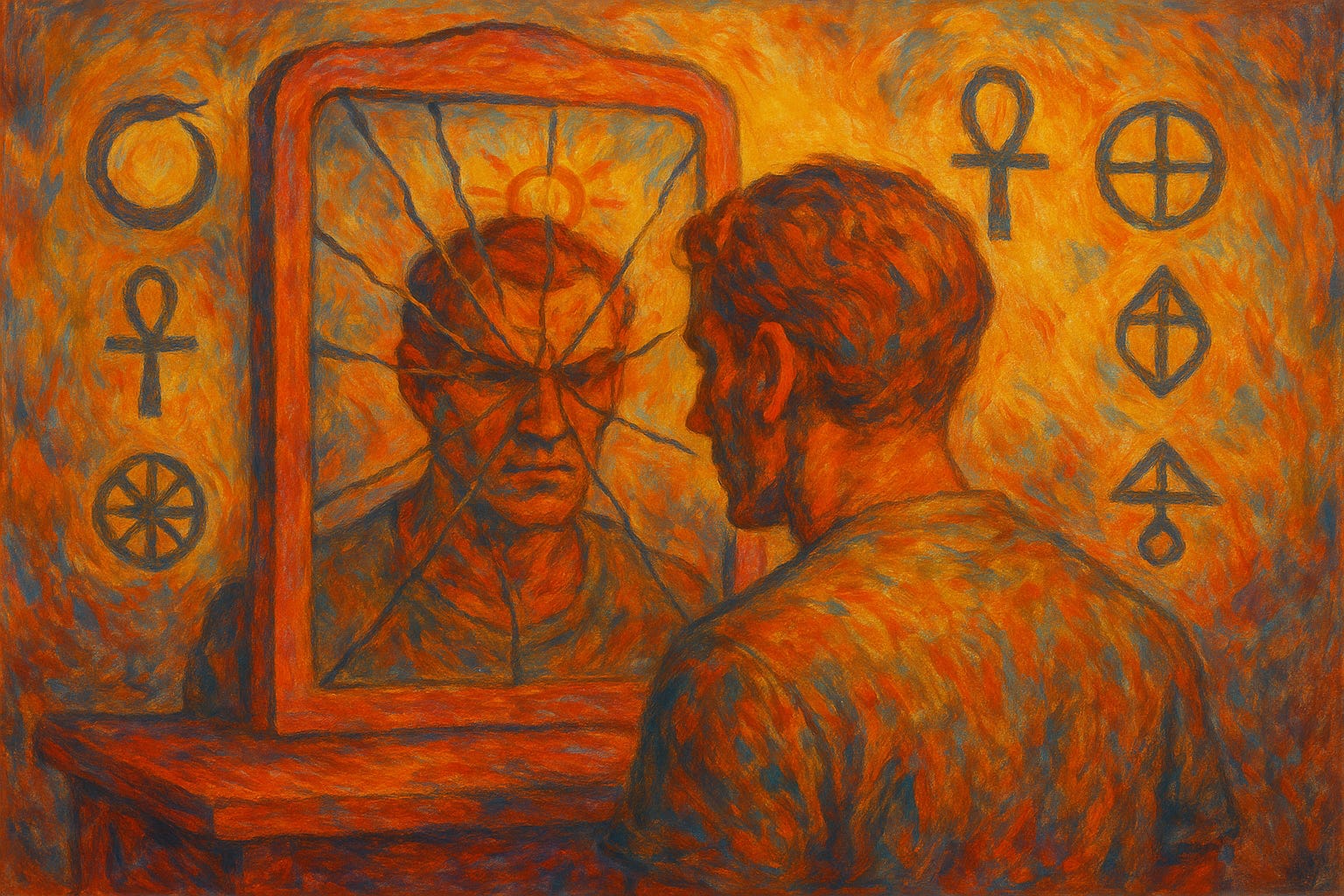
Today we turn our gaze to narcissism—not just as a psychological condition, but as a spiritual mirror. Let us walk together with Ọ̀rúnmìlà and the Odu, to understand what the narcissist comes to teach… and what they themselves might never learn.
What is narcissism?
Modern psychology defines Narcissistic Personality Disorder (NPD) as a pattern of grandiosity, entitlement, and a lack of empathy. Such individuals often seek control, admiration, and will manipulate or gaslight others to preserve their self-image.
Yet, Ifá reminds us:
“Kò sí ohun tí a fi ẹ̀sùn kàn ni aiye tí kò ní orí burúkú kan ní ọrun.”
“There is no flaw in the world that is not the echo of a difficult destiny from heaven.”
— Odu Otura Meji
In this light, narcissism may not simply be a “disorder”—but the fated expression of a soul shaped by unique karmic winds.
The karma of the narcissist: a soul bound by its own reflection
Some souls come into the world wearing masks they can never remove.
In the Odu Otura Meji, we find the tale of a crab who asks Olofin for a head like the humans. Olofin, in compassion, grants the wish. But the crab, still crawling sideways, never sees straight—forever desiring, never satisfied.
Just like the narcissist: they crave admiration yet cannot feel it. They manipulate love but cannot truly receive it. This is their prison. Their Ori chose a destiny where transformation may not be the goal—but repercussion is certain.
Why? Perhaps to learn humility in another life. Or to become the painful hand that teaches others to awaken.
The lesson for others: boundaries, clarity, and return to self
If you have ever been ensnared by a narcissist—be it a parent, lover, boss, or friend—know this: your pain was real, and so is your growth.
The Odu Odi Meji tells the story of someone deceived by appearances, who trusted a smooth-talker and fell. But the fall taught discernment. They rose again, more rooted in Ori inu—their inner self.
From such encounters, we learn:
The importance of boundaries
The courage to say “no” to manipulation
The power of returning to our authentic self, away from the narcissist’s projection
As Irosun Meji says:
“A liar may build a palace, but truth will one day own the land.”
Not everyone is here to change…
This is the hardest lesson. Ifá teaches us that not all destinies are forged for transformation. Some are here to reveal contrast, to catalyze growth in others.
So we ask: can a narcissist change? Sometimes yes, but often—no. But can they still serve a divine purpose? Absolutely.
They are the mirror that teaches. Through them, we learn our worth, our limits, and our divine right to peace.
Coming next…
In our next issue, we will explore: “What if change is not the path? Destiny, Ori, and the limitations within karmic cycles.” We’ll ask: Are some souls here only to endure? Can karma be renegotiated? How do we accept the unchangeable?
Final blessing
May you be granted the clarity of Ọbàtálá, the boundaries of Yemoja, and the compassion of Ọ̀rúnmìlà—not to fix what cannot be fixed, but to walk away with your crown intact.
Stay blessed, and may your Ori always guide you straight.
Àṣẹ, Àṣẹ, Àṣẹ.
Babá Tilo de Àjàgùnnà
DAILY IFÁ
💬 Curious? Ask the Orisha:
Supporting readers can send questions like the following to our recently launched GPTs, Voice of Orisha or Wisdom of Ifá:
“What Odu can help me break a cycle with a narcissist?”
“What can I do if I suspect I have narcissistic traits?”
“What Ebó is recommended after emotional betrayal?”
Preview: Next week’s edition of DAILY IFA ACADEMY dives deeper into Òtúrá Méjì — the Odu of crossroads, destiny, and decision. When you’re unsure which way to turn, this sacred wisdom reveals how to align with your Orí and move with clarity. Don’t miss it: DAILY IFÁ ACADEMY