


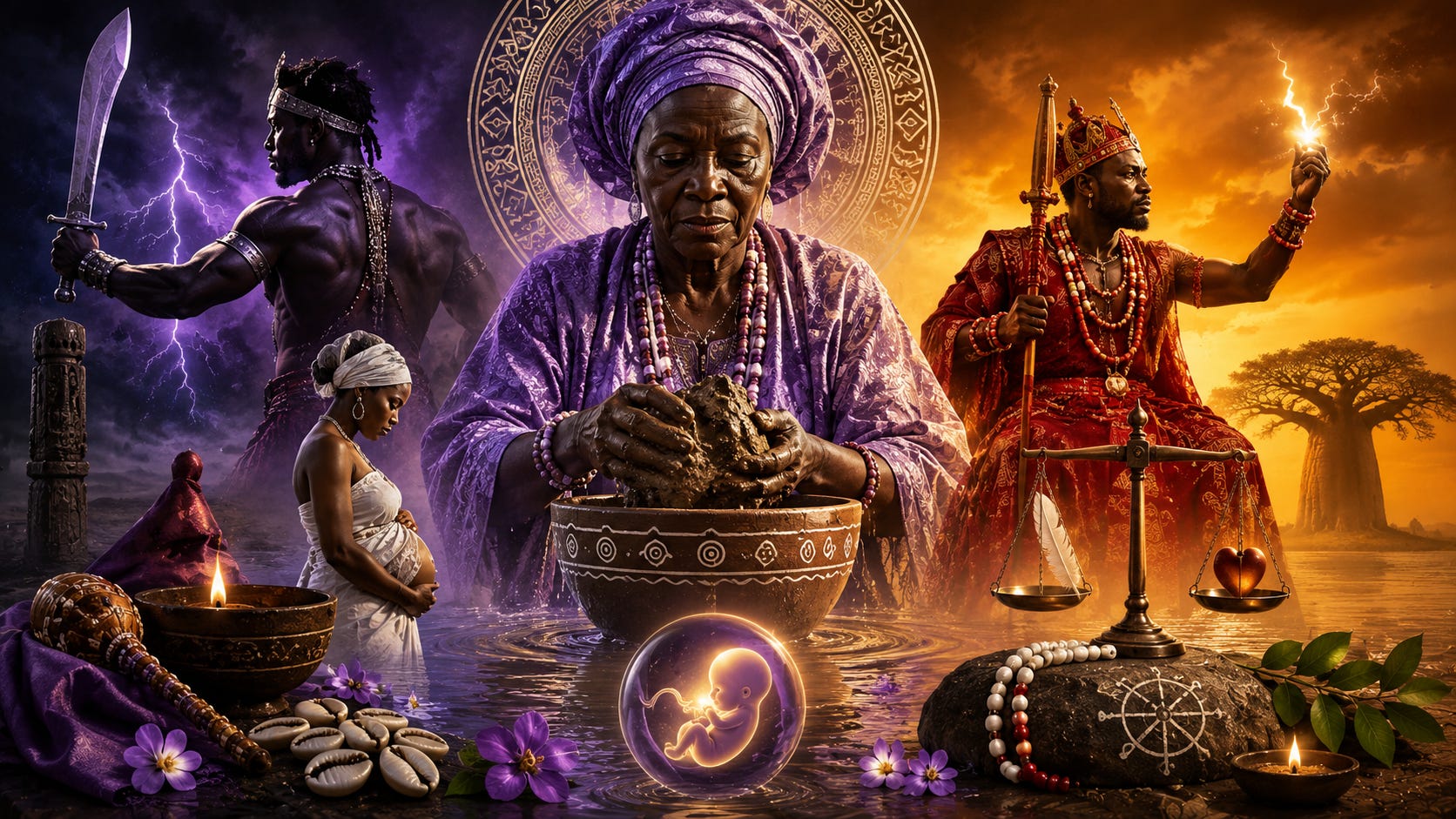
“The mud does not ask whether the village approved.
It remembers what entered, what departed, and what was left unfinished.”
To all who seek the law beneath appearances,
A woman once came to me for an Ifá reading many years after she had terminated a pregnancy.
She did not initially ask about the abortion. She came because her life had stopped moving in a way she could not explain. Her spiritual development had once felt clear and active, yet she now experienced an invisible barrier. She continued praying, learning, and seeking guidance, but every new beginning seemed to lose its strength before becoming established.
During the reading, Ifá returned repeatedly to an interrupted process involving the arrival of a child.
As our conversation unfolded, she told me about the pregnancy. The decision had been made under circumstances that belonged to her alone, and I had neither the right nor the intention to judge it. The task of the reading was not to reopen a courtroom inside her heart. It was to understand why part of her spiritual life still seemed connected to an event she believed had already ended.
The divination indicated that the soul associated with the pregnancy had not completed its departure. The physical process had ended, but the spiritual relationship had not been properly closed.
This did not mean that she was being punished.
It meant that a threshold had been crossed without every participant in the process having been acknowledged.
A rite of release was later performed. It was not designed to condemn the woman or reverse what had happened. It gave recognition to the soul, restored the woman’s relationship with her own Orí, and allowed the interrupted process to reach a conclusion.
Afterward, the movement in her spiritual life slowly returned.
I have encountered variations of this pattern in other readings. Sometimes the unresolved field appears through recurring dreams of a child. Sometimes it appears around later pregnancies, fertility, grief, or the feeling that one dimension of life has become inaccessible. At other times, Ifá reveals no continuing spiritual disturbance at all.
There is no mechanical formula.
An abortion does not automatically produce spiritual blockage, illness, infertility, or punishment. Such physical and psychological concerns require proper professional care and must never be attributed to a spiritual cause without careful discernment.
What Ifá sometimes reveals is not a violation of morality.
It is an interruption of spiritual order.
That distinction is the foundation of this newsletter.
Is Nàná Burúkú the Guardian of Morality?
Nàná Burúkú—often written Nanã Buruku in Brazilian traditions—is frequently described as the guardian of morality, justice, seriousness, oaths, and proper conduct.
At first, this appears reasonable. Nàná is the ancient mother who remembers what younger powers forget. She is associated with judgment, consequence, ancestral memory, birth, death, and the return of the body to the earth. She does not tolerate deception lightly, nor does she treat promises as disposable words.
Yet the description creates a philosophical problem.
Morality changes.
Ideas about family, sexuality, marriage, gender, authority, property, punishment, and social duty differ from one culture to another. What one society considers honorable may be rejected by the next generation. A custom praised in one century may appear cruel in another.
Nàná Burúkú, however, does not belong to one century.
She is older than the legal systems through which human beings organize themselves. She belongs to the mud beneath civilization, to the union of earth and water, to the matter from which bodies arise and to which they return.
How could a timeless Òrìṣà defend a morality that continually changes?
The answer is that she does not.
Nàná Burúkú is not the guardian of every social convention that human communities have called moral. She is the guardian of something deeper: the spiritual principles through which life, death, exchange, consent, embodiment, and consequence remain in relationship.
Morality asks what society approves.
Spiritual order asks what an action enters, what it alters, and what must follow from it.
Social Morality and Spiritual Principle Are Not the Same
Social morality is negotiated through history. It is influenced by politics, law, religion, economics, family structures, and collective experience.
Spiritual principles operate at another level. They concern relationship, jurisdiction, reciprocity, timing, acknowledgment, consent, and consequence.
A society may change its laws concerning marriage, but betrayal still alters trust.
A government may permit the exploitation of workers, yet the imbalance between taking and returning remains.
A person may legally reveal another’s private history, but the sacred relationship of confidence has still been violated.
An action may be socially celebrated and spiritually destructive. Another may be socially condemned while carrying no corresponding spiritual transgression.
This is why Ifá cannot be reduced to a list of commandments.
Ifá reads patterns. It asks what relationships are involved, what agreements have been made, what boundary has been crossed, and whether the action remains aligned with destiny, character, and the wider field of life.
Spiritual law is not simply a stricter version of human morality. It is a different category.
Nàná Burúkú and the Clay of Life
The deepest teaching of Nàná Burúkú begins with clay.
In the creation myths, Ọbàtálá—or Òṣàlá in many Brazilian/Cuban/African traditions—attempts to form the human being. Different materials fail because they cannot hold the balance required for embodied life. Some are too rigid, others too unstable. Some cannot receive form, while others cannot retain it.
Nàná reaches into the depths of her waters and provides mud.
This mud is not merely soil made wet. It is matter standing between states. It is earth capable of receiving shape and water capable of carrying transformation. It already contains the mystery of womb and grave, formation and decomposition, arrival and return.
From this material, the human body can be shaped.
Nàná gives the substance. Ọbàtálá gives form. Ajálá participates in the mystery of the head. Orí bears personal destiny. Olódùmarè gives the breath through which the formed body becomes living presence.
In some lineages, Omolu or Ọbalúayé is also understood as mediating the relationship between spirit and embodied life.
The precise theological arrangement varies between traditions, but the central principle remains: incarnation is not the private work of one being.
Life emerges through cooperation. Matter, breath, destiny, body, spirit, ancestry, and time meet within one process. No individual human being owns the whole of that process.
Abortion: A Spiritual Principle, Not a Moral Condemnation
This is where the spiritual understanding of abortion must be stated clearly.
Within the cosmology I practice, deciding over the arrival or departure of life is a taboo because life does not belong exclusively to human jurisdiction.
I am not using the word taboo as a moral accusation.
I am not saying that every woman who terminates a pregnancy is evil, impure, irresponsible, or condemned by the Òrìṣà. I am not ignoring medical emergencies, violence, coercion, poverty, danger to health, unbearable circumstances, or the complexity of individual life.
The spiritual principle is more precise.
A process involving life has begun, and the human being intervenes in a process whose full dimensions are not entirely human. This does not necessarily mean that the intervention must never occur. It means that the intervention should not be treated as though nothing beyond the visible body were involved.
Where a pregnancy must be ended, or where a woman decides that it cannot continue, I would recommend spiritual accompaniment—not as a legal requirement, not as permission from a man or religious institution, and never as a substitute for medical care.
Urgent or necessary health care must never be delayed for ritual reasons. Quality abortion care should be timely, safe, respectful, and free from stigma or coercion. (WHO)
Spiritual accompaniment may include divination before the procedure when circumstances permit, acknowledgment of the soul connected with the pregnancy, a request for spiritual permission or understanding, a rite of release afterward, care for the woman’s Orí, and the restoration of her relationship with the reproductive and ancestral field.
These rites are not punishments. They are acts of relationship.
They say: “I recognize that more has happened here than a medical event. I acknowledge the life process that began. I acknowledge the soul that approached. I acknowledge my own circumstances, grief, fear, or necessity. I ask that every participant be released into the proper road.”
The aim is not guilt. The aim is completion.
Why Taking Life Requires Exchange
This principle is not limited to human reproduction.
Across many land-based and Indigenous spiritual cultures, the taking of an animal or plant is accompanied by prayer, offering, gratitude, apology, or exchange.
The hunter does not necessarily believe that hunting is morally wrong.
The healer does not believe that harvesting a medicinal plant is forbidden.
The farmer does not believe that cutting grain is an act of evil.
The prayer exists because taking life establishes a relationship.
Something is being removed from one cycle so that another life may continue. Recognition and exchange prevent the act from becoming mere consumption.
The principle is not: “Never take.” The principle is: “Do not take as though nothing has been received and nothing is owed.”
Modern society often hides these exchanges from us. Food arrives packaged. Plants become products. Animals become anonymous materials. Death is removed from view, allowing consumption to appear disconnected from life.
The spiritual traditions preserve memory. They remind us that survival itself involves taking—and that taking must remain inside gratitude, restraint, and reciprocity.
Nàná Burúkú and Ògún: Power Does Not Create Permission
The myths of Nàná Burúkú and Ògún offer one of the clearest teachings about the difference between ability and jurisdiction.
Ògún is iron, force, technology, labor, roads, cutting, and the ability to make human intention effective. Where the forest blocks passage, Ògún opens a road. Where matter resists, he creates a tool.
Nàná belongs to a world older than iron. Her mud, wood, water, and clay belong to a primordial order that existed before metal transformed civilization. This is why iron is often excluded from her sacred field.
In one family of myths, Ògún challenges Nàná’s authority or attempts to enter her territory through the confidence of his weapons. He assumes that because iron can cut almost anything, no boundary can remain closed to him.
But mud cannot be conquered in the same way as forest. The harder he advances, the deeper the ancient earth receives and restrains him.
The myth is sometimes interpreted as an argument about whether old customs should submit to new technology. Its deeper meaning concerns spiritual jurisdiction.
Ògún is not morally evil, and Nàná is not morally superior.
The problem is that force has mistaken its ability for permission. Ògún can enter many places, but he does not therefore possess the right to enter every place.
Nàná’s territory answers according to its own law. This principle remains relevant wherever people confuse power with legitimacy. Wealth can open doors, but it does not make every entrance rightful. Knowledge can influence people, but it does not create consent. Spiritual power can obtain results, but it does not sanctify every desire.
The ability to do something is not proof that it should be done.
Nàná’s Desire for a Child
Another myth makes the same point from the opposite direction.
In one difficult version, Nàná desires a child with Òṣàlá. He warns against the union or refuses it, but her desire is so powerful that she attempts to overcome the boundary placed before her. She causes him to sleep and conceives the child she wanted.
The story is not a simple moral tale about female desire. The desire for a child is not itself condemned. Nor does the myth suggest that maternity is shameful.
The transgression lies in turning desire into jurisdiction. Nàná wants something sacred, but the sacredness of her longing does not give her authority over the other participant.
Consent and spiritual timing have been displaced.
The resulting relationship carries consequence. Trust is broken. The children born within this wider mythic field are often marked by difficult powers—illness, transformation, secrecy, death, healing, serpentine continuity, and the burden of ancient knowledge.
The message is not that such children are punishments. The message is that creation carries the pattern through which it was entered.
Even Nàná Burúkú, primordial mother and guardian of birth and death, cannot suspend spiritual order merely because her longing is great. The Òrìṣà live within these principles. They do not stand above them.
Even the Mother Is Answerable to Life
The myth of Omolu deepens this teaching. Nàná gives birth to a child whose body is marked by disease. Unable to accept his condition, she rejects and abandons him. Yemọja later receives, heals, and raises the child.
Again, Nàná is not presented as an untouchable moral perfection. She makes an act of rejection and must live within its consequences. The myth does not destroy her sacred authority. It reveals its depth.
Nàná knows the law of acceptance partly because she has violated it. She knows the gravity of life partly because she has failed to receive the life that came through her.
The Òrìṣà are not distant examples of flawless social behavior. Their myths teach through conflict, failure, restoration, pride, loss, and consequence.
Their divinity does not remove them from spiritual order. It makes that order visible through them.
The King Who Must Wear White
Ṣàngó provides another powerful image.
He is the king, the thunderer, the ruler whose fire makes authority visible. He represents justice, judgment, charisma, courage, vitality, and royal power.
Yet the recurring pattern in his relationship with Ọbàtálá is that Ṣàngó’s heat cannot become the final law.
When royal fire collides with the elder white order, Ọbàtálá’s principle ultimately prevails—not because Ṣàngó is weak, but because kingship must remain answerable to something older than the throne.
This is reflected symbolically in the red and white associated with Ṣàngó. Red carries heat, vitality, blood, passion, movement, judgment, and royal force. White carries coolness, clarity, restraint, elderhood, legitimacy, and the order represented by Ọbàtálá.
The white in Ṣàngó’s necklace or regalia is therefore not decorative. It is a theological statement. The king wears the sign of the law above kingship.
Ṣàngó may rule, judge, command, and punish, but he cannot become the source of all order simply because he possesses power. His fire must remain connected to white coolness, just as political authority must remain answerable to truth and spiritual authority must remain answerable to principle.
Even a sacred king must submit. Universal order does not disappear when the powerful arrive.
Ògbè Òfún: Success Does Not Prove Righteousness
Odù Ifá approaches the problem of morality with remarkable honesty.
A revealing example appears in Ògbè Òfún, where Ogbè is the base Odù on the left and Òfún stands on the right. This is not the same configuration as Òfún Ogbè; the order changes the movement and emphasis of the teaching.
In one verse, Ogbè consults Ifá because he wants to seduce the wife of Òfún.
The divination does not respond with a conventional moral sermon. It reveals that the plan can succeed if the prescribed offering is made.
Ogbè performs the offering and achieves what he desired.
This is precisely what makes the verse uncomfortable and spiritually important. Ritual success does not prove ethical alignment.
The fact that a person can obtain a result does not mean the result belongs to good character. Spiritual knowledge can be used in the service of appetite, competition, manipulation, or pride.
Ifá reveals cause and consequence. It does not remove the practitioner’s responsibility to develop Ìwà Pẹ̀lẹ́—balanced, patient, and ethically formed character.
Later teachings within the same field call for what was taken to be returned, for dishonest possession to end, and for relationship to be restored.
The principle is not merely that adultery violates one society’s morality. The deeper issue is that another person’s relationship was treated as an object to be acquired. Desire became entitlement. Spiritual power was used to override reciprocity.
Ògbè Òfún reminds us that not everything that can be achieved should be pursued.
The ritual may work. The spiritual debt may remain.
Ìwòrì Méjì: Moral Judgment Without Full Sight
If Ògbè Òfún warns against confusing success with righteousness, Ìwòrì Méjì warns against confusing personal certainty with truth.
One of its teachings states that the person who passes judgment after listening to only one side becomes a ruler among the wicked.
This is an essential correction to spiritual moralism.
A person may speak strongly about principle while refusing to understand another person’s circumstances. They may condemn a woman’s decision without knowing the danger, violence, poverty, illness, pressure, or fear surrounding it. They may defend tradition while ignoring the harm produced by the way that tradition is applied.
Such judgment does not protect spiritual order. It replaces discernment with arrogance.
Ìwòrì Méjì demands deeper sight. It asks the diviner, priest, elder, and community to look beyond the visible action and understand the complete field.
Why did the person act?
What forces were involved?
What alternatives were genuinely available?
Was there coercion?
What relationship remains unfinished?
What form of repair is actually needed?
Spiritual principles may be enduring, but their application requires wisdom. The law may be universal. The reading of the individual life must remain particular.
Taboo as the Protection of Relationship
The word taboo often sounds like an irrational command. Do not touch this. Do not enter there. Never eat that. Never do this.
When the principle beneath the taboo is forgotten, only fear remains. Yet many sacred prohibitions exist because they protect a relationship, boundary, concentration of Àṣẹ, or sequence of transformation.
The absence of iron in Nàná’s rites protects the memory of her pre-metal world and preserves the distinction between primordial matter and technological force.
Confidentiality protects the sacred vulnerability of consultation.
Sexual boundaries protect consent, lineage, and the circulation of power.
Ritual closure protects both the person and the spiritual forces involved when an initiation, pregnancy, relationship, or vow has been opened.
A mature spiritual practice does not merely repeat the prohibition. It asks what the prohibition protects.
Some taboos are cultural forms and may change. Others protect principles that remain: consent, reciprocity, respect for life, proper closure, acknowledgment of the dead, and the obligation to repair what one has disturbed.
The difficulty lies in learning to distinguish between them.
Spiritual Consequence Is Not Divine Revenge
When spiritual order is violated, many people imagine that an angry Òrìṣà sends punishment. Sometimes the pattern is better understood as consequence rather than retaliation.
If one enters unstable mud without respect, one may sink. The mud does not need to become angry.
If trust is manipulated, intimacy may collapse. Trust does not need to curse anyone.
If a spiritual process is opened and abandoned, part of life may remain organized around what was never completed.
If a soul approaches incarnation and the process is interrupted without acknowledgment, an unresolved relationship may remain—not because the soul seeks revenge, but because no one helped the relationship find its proper end.
The consequence is often contained within the structure of the action. This is why restoration matters more than punishment. The question is not, “How can I suffer enough to prove that I am sorry?” The question is, “What relationship must be acknowledged, repaired, released, or completed?”
Moral Life in Iré and Òṣogbo
In Iré, a person recognizes that freedom and responsibility belong together. They consider consequence before acting, but they do not become paralyzed by fear. When a difficult decision must be made, they seek clarity, support, and spiritual accompaniment. When they discover that something remains unfinished, they pursue restoration without turning shame into identity.
In this state, morality becomes less theatrical. The person is not primarily concerned with appearing pure. They are concerned with remaining in right relationship.
In Òṣogbo, two opposite distortions appear.
The first is moral rigidity. Spiritual principles are converted into weapons for controlling, humiliating, or condemning others. The person speaks of sacred law but lacks mercy, context, and discernment.
The second is radical irresponsibility. Because cultural morality changes, the person concludes that no enduring principle exists. Every desire becomes valid simply because it is personally felt. Freedom is separated from consequence, and power is treated as its own permission.
Nàná Burúkú stands between these distortions. She does not approve everything. She does not condemn without understanding. She remembers the whole cycle.
When to Seek Divination and Spiritual Accompaniment
This teaching becomes especially important when a person faces a decision involving life, death, sexuality, reproduction, initiation, binding promises, or the use of spiritual power over another person.
Divination may also be appropriate after a process has already occurred and something remains unsettled: recurring dreams after an abortion or pregnancy loss, unresolved grief, the sense that an initiation was abandoned without closure, persistent difficulty after breaking a vow, or a spiritual blockage that began after a decisive act.
The purpose is not to discover whether the person is morally bad. The purpose is to identify the relationships that remain active.
Where abortion is concerned, spiritual accompaniment may involve a rite of permission or acknowledgment when time and circumstances allow, a release ritual for the soul, prayers for peaceful continuation in Ọ̀run, attention to the mother’s Orí, and restoration of the reproductive and ancestral field.
The exact form should be determined through divination and lineage practice. It should not be copied mechanically from the internet.
Closing Insight: The Mud Remembers the Whole Cycle
Human morality will continue to change. Some changes will represent genuine growth. Others will simply rename old forms of selfishness. New freedoms will emerge, and new ways of abusing freedom will appear beside them.
Nàná Burúkú does not stand outside history protecting one culture’s list of respectable behavior. She stands beneath history.
She is the mud from which form rises and to which form returns. She remembers the beginning of a process when human beings see only its end. She remembers the relationship when human beings remember only the decision. She remembers the exchange when human beings see only what they received.
Her justice is therefore deeper than social judgment. She does not ask merely whether the village approved. She asks what order was entered, what boundary was crossed, what relationship was created, and what remains to be restored.
Even Ògún’s iron must stop at the edge of her mud. Even Nàná’s own desire cannot erase consent and consequence. Even Ṣàngó, king of thunder, wears white beside his red because sovereign fire must remain answerable to a law older than kingship.
The Òrìṣà do not stand above spiritual principle. They reveal it.
Stay blessed, and may Nàná Burúkú grant us the wisdom to distinguish changing morality from enduring spiritual responsibility—and the humility to restore what our hands have left unfinished.
Babá Tilo de Àjàgùnnà
DAILY IFÁ ACADEMY
Your posts always leave me wanting to dig deeper, have not yet decided if that’s a curse or a blessing, my plate is full
Im a victim of Identity Theft. 242, 11:11, 1:11.