


Religion is regarded by ordinary people as true,
by the wise as false, and by rulers as useful.”
— a line often attributed to Seneca
To those who still believe that faith and reason belong at the same table—welcome.
I like this sentence because it irritates almost everyone. It patronizes believers, flatters skeptics, and casts suspicion on those in power. Yet beneath its arrogance lies a question worth asking: Why do we believe what we believe, and what happens when belief becomes useful to someone else?
I am a spiritual man. I pray, I work within tradition, and I believe that human life reaches beyond what we can measure with our senses. But for me, faith has never meant switching off the mind. On the contrary, a faith that cannot tolerate a sincere question eventually becomes difficult to distinguish from fear.
We human beings need meaning. Religion can give us language for grief, gratitude, death, birth, uncertainty, and the experience of belonging to something greater than ourselves. It can hold communities together and carry wisdom across generations. But religion can also become performance, and spiritual authority can become a tool of control.
Between blind belief and cynical rejection, however, Ifá offers another possibility: a spirituality that must prove itself through character.
For this reflection, our base Odù is Ogbè, and we are working specifically with Èjìogbè, Ogbè Méjì. Among the teachings preserved under Èjìogbè is a Cuban story about Olófin, his worshippers, and a basket of gold. It may be one of the clearest spiritual commentaries on hypocrisy I know.
When the Gold Hit the Ground
Every morning, Olófin’s subjects came before him to receive his blessing. They bowed, kissed his hands, feet, and sacred garment, and assured him of their devotion. From where Olófin sat, their sincerity seemed obvious: surely people who showed such reverence must also be living according to the moral principles they praised.
Èjìogbè was less convinced. Unlike Olófin, he also encountered these same people at parties, gatherings, and in their homes, where their behavior told a different story. He had watched jealousy appear behind friendly faces and selfishness hide beneath beautiful words. Most importantly, he noticed something Olófin did not want to see: the people who spoke so passionately about their love for the divine often showed remarkably little love toward one another.
Olófin defended them. Their worship, he argued, was proof of their sincerity. Èjìogbè knew that another argument would accomplish little, so he asked permission to demonstrate the difference between what people proclaim and what they actually value.
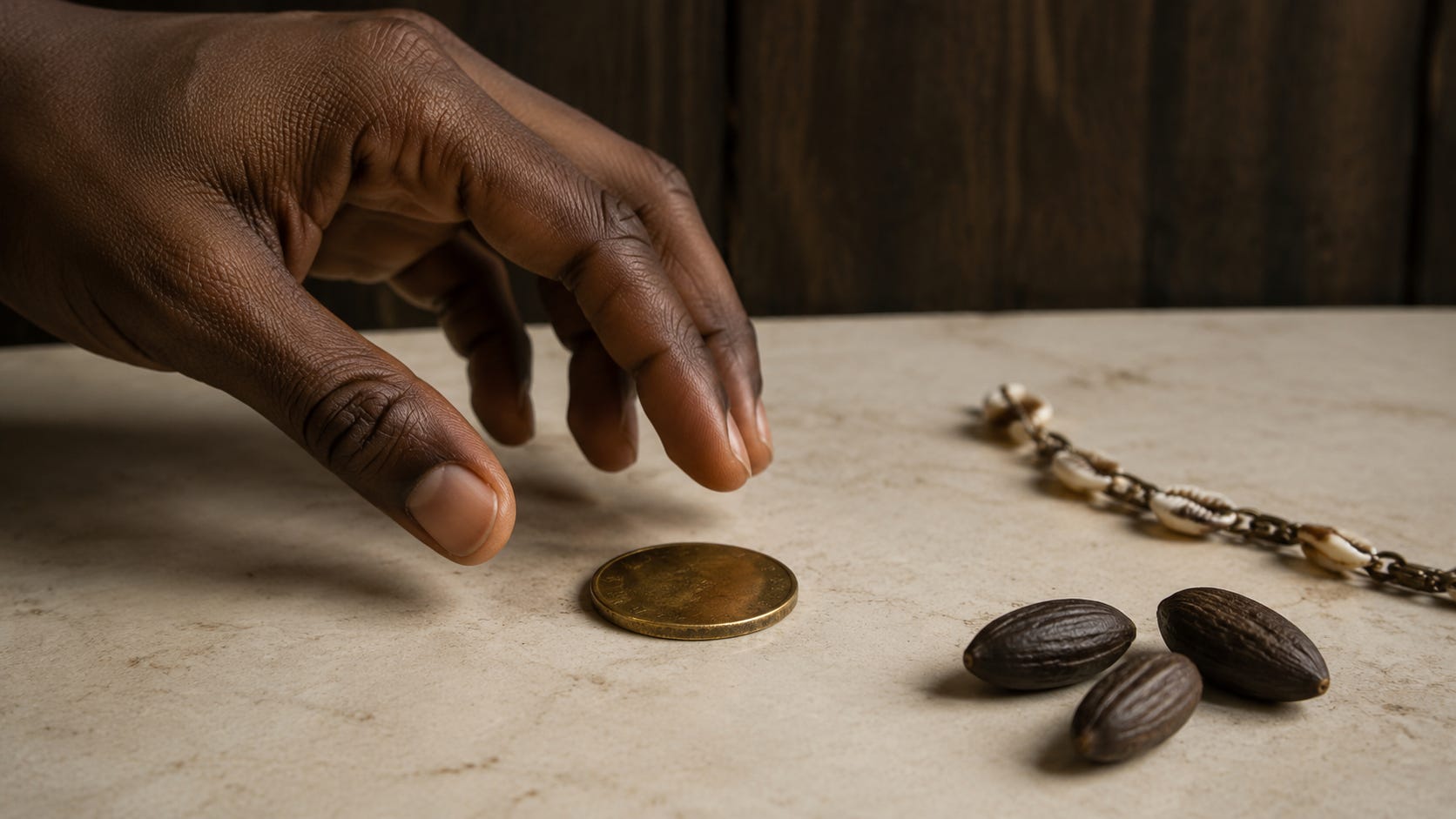
At the next gathering, Èjìogbè arrived carrying a basket filled with gold coins. As the worshippers prepared to kneel before Olófin, he lifted the basket and hurled the coins behind them. In an instant, the ceremony lost its importance. The crowd turned toward the gold, scrambling and pushing so fiercely that Èjìogbè had to move Olófin out of their path before the very people who had just professed their love trampled him while chasing the money.
The gold had not changed them. It had simply revealed them. That is the uncomfortable genius of this story.
Faith Is Easy Before the Test
Èjìogbè is not mocking prayer, ritual, or devotion. The story asks something far more personal: What becomes of our values when something we desperately want enters the room?
For Olófin’s subjects, the test happened to be gold. For us, it may be money, recognition, sexual desire, influence, professional status, the approval of a community, or simply the pleasure of being right.
Most of us find it easy to defend principles when those principles cost us very little. Honesty sounds wonderful until the truth threatens an opportunity. Loyalty feels sacred until temptation appears. Humility is attractive until someone else receives the recognition we believe belongs to us.
This is where spirituality leaves the altar and enters daily life.
The real question is not merely whether I believe in God, Olódùmarè, the Òrìṣà, the ancestors, or any other sacred reality. It is whether that belief has changed the human being who returns home after the prayer is finished.
A person can know prayers and still lie. Someone can wear sacred clothing and remain consumed by envy. A priest can possess profound ritual knowledge and still misuse authority. We can speak beautifully about ancestors while treating living family members badly.
Ritual and transformation are not the same thing. The worshippers knew how to bow. Their difficulty began when they stood up.
Perhaps Doubt Is Not the Enemy
This is also why I resist the idea that “the wise” must necessarily reject religion. Intelligence does not automatically lead to disbelief any more than faith automatically proves wisdom.
There is another possibility: we can believe and still question.
We can respect elders without pretending that every elder is infallible. We can love a tradition while asking whether every claim made in its name truly belongs to that tradition. We can believe in God without defending everything human beings have done while invoking God’s authority.
Sometimes doubt does not destroy faith; it removes what fear, habit, or social pressure had placed around it.
Èjìogbè himself behaves like a discerning observer. He does not accept appearances simply because they are beautiful. He watches the same people in different circumstances, compares their words with their actions, and allows reality to reveal the contradiction.
That is not disbelief. That is discernment. And perhaps mature faith begins when we no longer need every question to have a predetermined answer.
When Religion Becomes “Useful”
The final part of the old quotation deserves particular attention because spiritual authority carries unusual power. A political leader may say, “Obey me because I have authority.” A religious leader can go further and say, “Obey me because the sacred requires it.”
That difference matters. There is a profound distinction between a teacher saying, “I have knowledge that may help you understand your path,” and someone saying, “Without me, your life will collapse.”
Traditional religions need teachers, elders, lineage, training, and transmission. In Ifá, Candomblé, Santería, and related traditions, not everything can or should be reduced to individual intuition. Yet healthy spiritual authority should gradually deepen discernment rather than manufacture helplessness.
Your priest may guide you. Your elder may correct you. Divination may advise you. But your Orí—your spiritual head, consciousness, and relationship with destiny—does not become somebody else’s property.
And this is where the Seneca-like sentence misses its fourth possibility. Religion may be believed, rejected, or used, but spirituality can also be lived.
In Yorùbá thought, we would call that ìwà: character. The more revealing question, then, is not simply, What do I believe? It is: What is my belief producing in me?
For Supporting Subscribers
In the Supporting Subscribers section below, we turn Èjìogbè’s story into a practical framework through The Four Tests of Mature Faith. We will look at how to distinguish truth from inherited fear, spiritual growth from religious performance, guidance from dependency, and prosperity from the desires that quietly make us compromise our values. We will then apply these questions to Orí and destiny, love and family, wealth and business, health, and ancestral tradition, before examining Èjìogbè in Ire and Osogbo.
There is no ritual in this edition. This time, the work is observation.
Before You Continue—or Before You Leave
Whether you continue below or close this letter here, carry one image with you this week: the sound of gold hitting the ground.
Not because money is evil, and not because desire makes us bad, but because certain moments remove the comfortable distance between who we imagine ourselves to be and how we actually behave. Those moments can be embarrassing, yet they can also become extraordinary teachers.
May your faith be strong enough to survive a sincere question, and may your questions remain humble enough to receive an answer you did not expect. May those who guide you help you grow in wisdom rather than shrink in fear, and may your Orí remain clear enough to distinguish living conviction from inherited anxiety.
Kí Orí rẹ̀ gbé ọ, kí òtítọ́ má bà ọ́ lẹ́rù — may your Orí carry you, and may truth never become something you are afraid to face.
Stay blessed, walk attentively, and when the gold touches the ground, do not look only at the crowd.
Remember to look at yourself.
Babá Tilo de Àjàgùnnà
DAILY IFÁ
🔒 SUPPORTING SUBSCRIBERS
The Four Tests of Mature Faith
The story becomes useful when we stop treating Olófin’s worshippers as foolish characters from another age and recognize ourselves in them. Spiritual maturity does not mean becoming free of contradiction; it means becoming more capable of noticing contradiction before it governs our choices.