


Dear seekers of wisdom,
before the mouth says “God,” the head has already chosen a road. Before the hands lift in prayer, Orí has already carried the person through sleep, memory, fear, hunger, longing, and decision.
Before the hands lift in prayer, Orí has already carried the person through sleep, memory, fear, hunger, longing, and decision. Before we ask whether heaven believes in us, Ifá asks a quieter question:
Does your Orí agree with the life you are trying to live?
Mo júbà Orí.
I pay homage to Orí.
Mo júbà Ọ̀rúnmìlà, Ẹlẹ́rìí Ìpín.
I pay homage to Ọ̀rúnmìlà, witness of destiny.
There is a modern philosophical question that sounds almost like thunder inside the mind: does God believe in God? It is a strange question, almost scandalous. But Ifá would not rush to answer it with theology. Ifá would turn the question inward and ask:
When you speak of God, destiny, purpose, blessing, or calling, where is your own head in this matter?
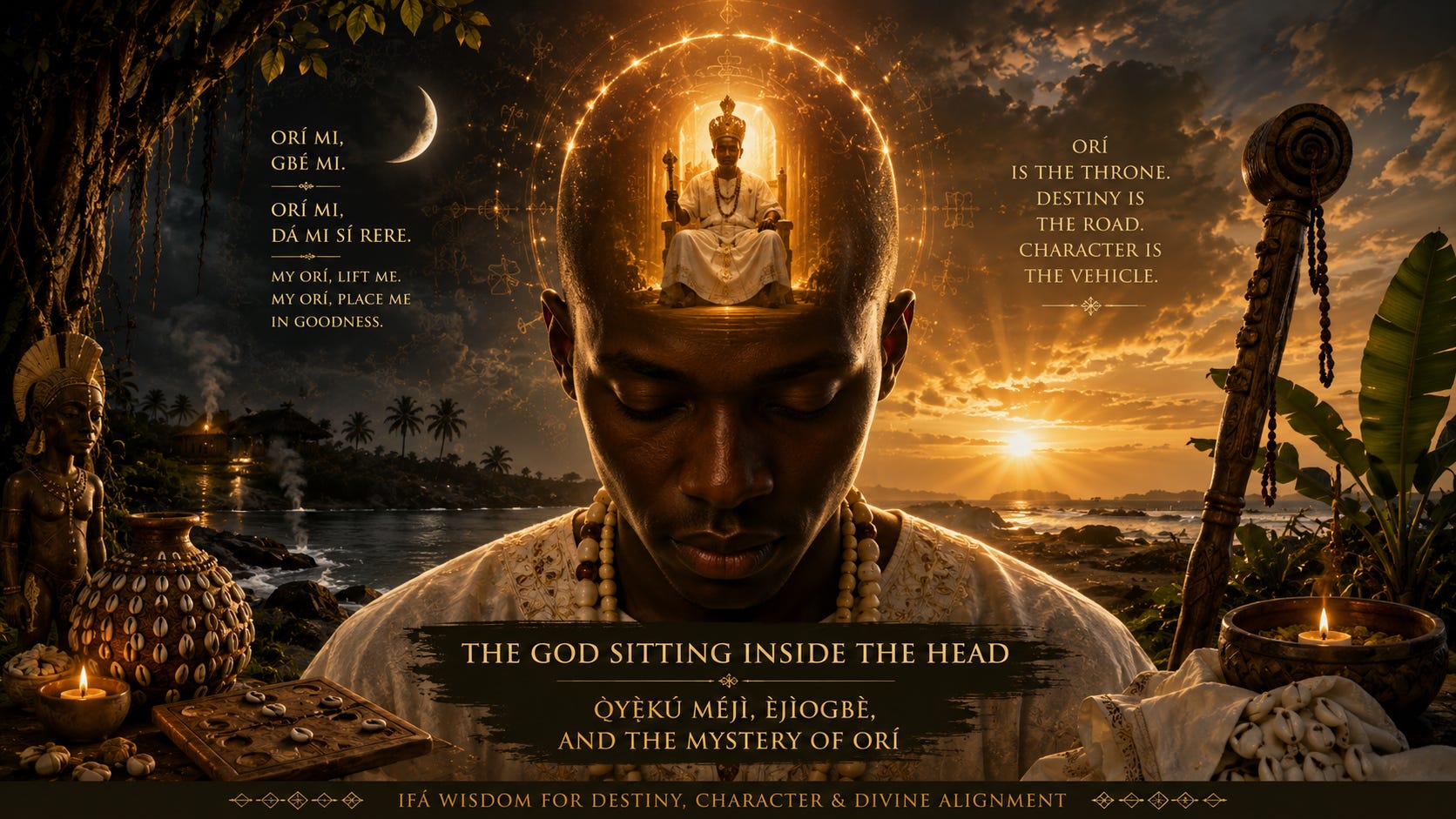
Because in Ifá, the human being is not only a body seeking a God outside. The human being carries a mystery on the head and inside the head. This mystery is called Orí.
Orí means head, but not only the physical head. Orí is consciousness, destiny, personal spiritual essence, and the inner divinity that accompanies a person from heaven to earth. In one of the teachings preserved in the Èjìogbè material, Orí is described as fundamental to Ifá; without Orí, nothing can be accomplished, wisdom cannot be comprehended, and evolution cannot be achieved.
This is why a person can have many prayers and still remain confused. A person can visit many shrines and still sabotage their own road. A person can receive many blessings and still not know how to hold them. The problem is not always that heaven has refused the person. Sometimes the person’s Orí has not been honored, cooled, listened to, or aligned.
There is a story. About the Creation of Orí
Long ago, in the realm of heaven, the divinities were created without heads. This sounds strange until we understand the reason: the Head itself was already a divinity. Orí was not merely a part waiting to be attached. Orí was sacred in its own right.
Ọ̀rúnmìlà wanted a complete form, including a head, so he went to a wise diviner named Amure. He was told to pray and make offerings so that a head would come to him. He followed the instruction. Four kola nuts were kept on his Ifá shrine, waiting for the divinity who could break them.
Many divinities tried to break the kola nuts, but they could not. Then Orí came. Ọ̀rúnmìlà saw Orí approaching and did not treat him as something ordinary. He welcomed him. He washed him. He anointed him. He honored him.
Then Orí broke the kola nuts with a great sound. From that moment, the head became united with the body. From that moment, Orí became king of the body.
This story is not only a myth of anatomy. It is a myth of spiritual government.
The body without Orí has movement, but not direction. Desire, appetite, beauty, strength, even ritual power — all these can exist, but without Orí they do not yet know where to go. Orí is the one who says: this is your road, this is not your road; this is your blessing, this is a distraction; this is your crown, this is only decoration.
In Yorùbá we say:
Orí mi, gbé mi.
My Orí, lift me.
Orí mi, má ṣe mí níyà.
My Orí, do not let me suffer.
Orí mi, jẹ́ kí n mọ ọ̀nà mi.
My Orí, let me know my road.
This is not ego worship. It is not the modern idea of “I am my own god” without responsibility. Orí is not arrogance. Orí is sacred accountability. It reminds us that no blessing can remain with a person whose character cannot hold it.
This is where the question becomes personal.
Many people ask, “Why is my destiny delayed?” But Ifá may ask, “What does your character do with the destiny you already have?”
Many people ask, “Why does God not answer me?” But Ifá may ask, “When your Orí answered quietly, did you listen?”
Many people ask, “Why do I keep losing opportunities?” But Ifá may ask, “Is your outer life fighting your inner head?”
Orí-Inú and Orí-Òde
Èjìogbè (Ogbe Meji) contains another teaching that makes this painfully clear. It speaks of Orí-Inú, the inner head, and Orí-Òde, the outer head or destiny in the world. These two are inseparable companions. Yet destiny alone is not enough. Those destined for wealth may become poor because of destructive character. Those destined for kingship may become slaves to their own bad habits. Those destined to lead may become followers of people less qualified than themselves. Ifá says that personality and character must align with destiny, otherwise destiny cannot fully manifest.
This is one of the most important teachings for our time.
We live in a world full of people asking for manifestation, abundance, spiritual power, love, visibility, success. But Ifá asks: can your Orí trust you with what you are asking for?
Can your Orí trust your mouth?
Can your Orí trust your friendships?
Can your Orí trust your discipline?
Can your Orí trust your relationship with money?
Can your Orí trust your sexuality, your anger, your promises, your patience?
Because destiny is not only something we receive. Destiny is something we must become capable of carrying.
This is why Orí is more intimate than public religion. You can perform devotion loudly before others, but Orí knows how you speak to yourself at night. Orí knows where you betray your own road. Orí knows when you are praying for one thing and preparing the opposite. Orí knows when you are asking for love but protecting your wound more carefully than your heart. Orí knows when you are asking for wealth but still living with the disorder that pushes wealth away.
Ọ̀yẹ̀kú Méjì stands at the gate of this reflection because Ọ̀yẹ̀kú carries the atmosphere of night, death, hiddenness, silence, ancestral depth, and the unseen. It teaches us that not all darkness is punishment. Some darkness is womb. Some darkness is the place where the head remembers what daylight made us forget.
Èjìogbè brings the light. Ọ̀yẹ̀kú brings the depth. Together — not as a mixed Odu, but as a philosophical conversation — they show us that Orí is the lamp inside the darkness.
Closing Insight
The question was never only whether God believes in God.
The deeper question is whether the divinity inside the head is being heard.
Orí is the small throne we carry everywhere. It goes with us into love, business, illness, prayer, sleep, grief, success, and failure. It knows when we are pretending. It knows when we are ready. It knows the road we chose before memory covered it.
May we stop asking only for bigger blessings and begin asking for a steadier head. May our character become strong enough to carry our destiny. May our Orí not be spoiled by pride, fear, haste, or forgetfulness.
Orí mi, gbé mi. Orí mi, dá mi sí rere.
My Orí, lift me. My Orí, place me in goodness.
Stay blessed. May your head be cool, your road be clear, and your destiny find a worthy home inside your own character.
Babá Tilo de Àjàgùnnà
DAILY IFÁ
Source note: This newsletter does not treat Òyèkú Ogbè or Ogbè Òyèkú as a mixed Odu. The philosophical gate is Ọ̀yẹ̀kú Méjì, because it speaks to darkness, hiddenness, death, and the invisible depth beneath consciousness. The central myth of Orí as a divinity and king of the body is drawn from the Èjìogbè corpus, where the origin of the Head as a divinity is preserved.
For Supporting Subscribers
In the full section below, we go deeper into what many seekers truly desire to know: how to recognize whether your Orí is aligned or resisting you.
We will explore the signs of Orí in ire and osogbo, how Orí affects spiritual development, health, love, family, wealth, business, and ancestral connection. I will also share a simple, safe, no-sacrifice Orí practice and a cooling bath for clarity.
Supporting Subscribers: The Secret Conversation With Orí
Orí rarely shouts.
When Orí is aligned, life may still be difficult, but there is a quiet thread of direction. You may not have everything you want, but something inside you knows the road is real. You recover faster. You recognize false doors sooner. You lose less time explaining yourself to people who were never assigned to walk with you.
When Orí is misaligned, even blessings become heavy. Doors open, but you do not enter. People help you, but you sabotage the help. You receive signs, but you mistrust