


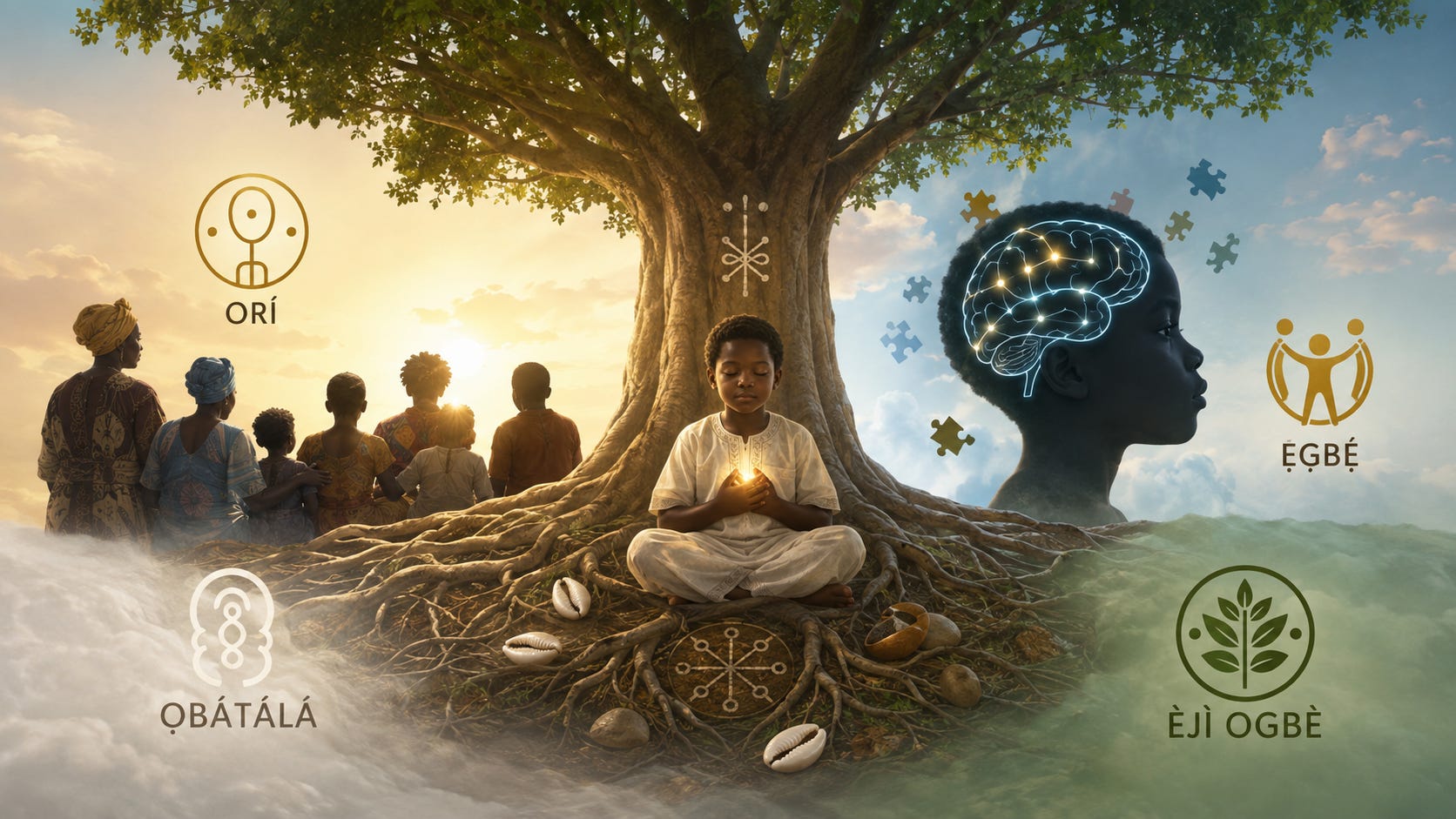
“A grove is stronger than a single tree, but each tree must grow from its own root.”
Dear seekers of wisdom,
A forest survives because its trees are not identical.
Some rise directly toward the sun. Some bend around stone. Some spread wide roots near water, while others protect themselves with bark thick enough to endure fire. A forest does not call the bending tree defective because it has learned another relationship with the wind.
In one of the teachings preserved under Òfún, Ọ̀rúnmìlà explains that spiritual discovery may be solitary, yet people gather because a grove withstands the wind better than one isolated tree. The purpose of gathering is not to make every tree grow in the same manner. It is to allow each one to develop while strengthening the soil shared by all.
This may be one of the most useful images through which Ifá can approach autism and neurodivergence.
Not because Ifá contains a hidden ancient diagnosis of autism. It does not.
Not because autistic people should be classified as Àbíkú, spiritually disturbed, possessed, incomplete, or insufficiently attached to Earth. They should not.
The value of Ifá lies elsewhere. Its wisdom can help us question the social demand that every mind communicate, regulate itself, form relationships, learn, work, worship, and express emotion in the same way.
The First Boundary: Autism Is Not a Spiritual Disorder
Autism is understood today as a diverse group of conditions related to brain development. Autistic people can differ considerably in communication, sensory experience, movement, learning, focused interests, everyday independence, and support needs. Characteristics generally begin in early development, although many people are identified only in adolescence or adulthood. (World Health Organization (WHO))
Any Ifá-based discussion must begin with a clear ethical boundary:
Autism is not caused by ancestors, Ẹgbẹ́, Àbíkú companions, broken taboos, spiritual attack, parental failure, or insufficient ritual attention.
Spiritual interpretation must never replace developmental assessment, medical care, communication support, mental-health care, occupational support, or educational accommodation. A diviner can help someone reflect on destiny, character, belonging, and spiritual life. A diviner should not claim to diagnose or cure a neurodevelopmental condition.
This distinction does not weaken Ifá. It protects both Ifá and the autistic person from misuse. The purpose of this reflection is therefore not diagnosis. It is to ask a different question:
What might Ifá teach a community that has mistaken one form of human consciousness for the only acceptable form?
Orí: One Humanity, Many Inner Configurations
The most fruitful Ifá concept for this conversation is not Àbíkú. It is Orí.
Orí is more than the anatomical head. It refers to the inward head, the bearer of consciousness, personal direction, character, possibility, and destiny. Odus in Ifá describe human consciousness as coloured by one of the 256 configurations of Ifá. Difference is explained through the image of water: water remains water, yet the water of a thunderstorm, a cold river, and a stagnant well do not move or affect the world in identical ways.
This image permits unity without sameness.
From an Orí-centred perspective, the first question is not, “How do we make this person resemble everyone else?”
The first question becomes, “What conditions allow this particular Orí to live truthfully and develop good character?”
That question does not deny disability or practical difficulty. Some autistic people require extensive lifelong support. Some experience disabling sensory pain, difficulties communicating urgent needs, dangerous levels of overwhelm, epilepsy, sleep problems, anxiety, or other co-occurring conditions. Respecting neurodivergence does not require pretending that suffering is unreal.
Orí simply prevents support from becoming erasure.
The spiritual-psychological treatment of Orí in my book The Orishas and the Human Soul asks whether a person’s outward life corresponds to the inward head carrying it. It also warns that prolonged adaptation to family expectations, social performance, or externally rewarded identities can create estrangement from one’s own form.
That insight is particularly relevant to autistic masking: the effort to suppress natural responses, imitate expected social behaviour, endure overwhelming environments silently, or construct a socially acceptable personality at great internal cost.
An Orí-centred approach would not romanticize withdrawal or distress. But it would ask whether the suffering comes entirely from the person—or partly from the demand that the person continually betray their own nervous system in order to be accepted.
Ọbàtálá: Form Without Shame
Ọbàtálá offers a second important bridge.
As the divine shaper of human form, Ọbàtálá is often discussed in relation to embodiment, clarity, patience, coolness, structure, and the dignity of created life. Yet the mature psychological meaning of Ọbàtálá is not perfection in the narrow sense. It is the creation of a form capable of carrying life.
As explained in The Orishas and the Human Soul Ọbàtálá may be seen as a therapeutic image of containment: rhythm, boundaries, reflective pause, steadiness, and the capacity to remain within experience without being overwhelmed by it. People whose bodies have been disabled, shamed, racialized, or treated as spiritually inferior may need a sacred framework through which their form can once again be experienced as worthy.
This has direct conceptual value for neurodivergence.
For an autistic person, “containment” may mean a predictable schedule, reduced sensory pressure, clear language, recovery time after social demands, permission to move or stim, access to familiar objects, or a reliable way to communicate “stop,” “pain,” “not now,” and “I need help.”
These are not indulgences. They are ways of constructing a vessel in which the person can participate without being flooded.
The shadow of Ọbàtálá also matters. Structure can become rigidity. Calm can become emotional suppression. Purity can become shame. A desire to help can become a demand that the autistic person appear quiet, compliant, socially conventional, and easy for others to manage.
The question is therefore not merely whether structure exists. It is whether structure serves the person’s life—or forces the person to serve someone else’s image of normality.
Èjì Ogbè: The Whole Is Not Made by Repetition
Èjì Ogbè provides the central Odù foundation for this newsletter.
Èjì Ogbè is an Odù of acceptance, totality, and interdependence. Its greatness rests in perceiving the whole landscape and recognizing how distinct parts sustain one another. Creation is not complete because every element repeats the same pattern. It is complete because different elements participate in a living unity.
This offers an Ifá-based critique of compulsory normality.
A community does not become harmonious by reducing every person to one approved style of eye contact, speech, affection, productivity, learning, worship, or social participation. Harmony requires relationship between differences.
One person may speak fluently but struggle to identify bodily distress. Another may use few spoken words while understanding far more than others assume. One may need solitude before offering profound insight. Another may communicate through movement, repeated phrases, images, typing, music, or an augmentative communication device. Some may desire extensive social connection; others may flourish with a small number of dependable relationships.
Èjì Ogbè does not ask which of these people most closely resembles the majority. It asks whether the entire calabash is being perceived.
In practical terms, this means that inclusion is not achieved merely by allowing autistic people into an unchanged space. The space itself must become capable of receiving them.
Ẹgbẹ́: Is There a Connection?
There is a meaningful connection to Ẹgbẹ́, but it must be framed as a connection of belonging, not biological or spiritual causation.
The common Ẹgbẹ́ philosophy describes Ẹgbẹ́ as the celestial peer group or heavenly society of a human being. It situates the soul’s earthly journey within relationships that precede birth and introduces the idea of a celestial counterpart or double.
Èjì Ogbè similarly presents Ẹgbẹ́ as a gathering or society of spiritual companions in Ọ̀run. Within that cosmology, the ties between earthly life and celestial companions can remain powerful after birth.
This should not be converted into the claim that an autistic person prefers solitude because celestial companions are calling them away.
A more responsible modern interpretation is relational.
Many neurodivergent people describe feeling as though the unwritten rules of ordinary society were designed for another kind of mind. They may understand systems, animals, music, numbers, images, language, or specialized subjects more easily than the shifting expectations of a social group. They may feel deeply lonely in a crowded room and unexpectedly at home with one person who shares their mode of perception.
Ẹgbẹ́ can become a sacred language for the question:
Where are the people among whom I do not have to translate my existence every minute?
In that sense, an “earthly Ẹgbẹ́” might be a friendship network, an autistic peer group, a family that learns new forms of communication, an inclusive spiritual house, or an online community in which someone encounters others who recognize their internal world.
The connection is therefore strong at the level of companionship, mirroring, affinity, and belonging.
It is weak—and potentially harmful—when used as a supernatural explanation of autism.
Àbíkú: A Necessary Caution
The relationship to Àbíkú requires greater restraint.
In Yorùbá cosmology, Àbíkú refers primarily to children associated with repeated early death and return. The Odù Ifá revelations connect the category with recurrent infant mortality, severe childhood vulnerability, and the grief of families whose children repeatedly die before reaching maturity.
Some interpretive passages also attribute solitude, resistance to external authority, unusual self-guidance, intense dream life, or proximity to the spiritual world to Àbíkú figures.
At first glance, a modern reader might see superficial similarities to descriptions sometimes applied to autistic children: social withdrawal, unusual sleep, imaginary companions, independence from social convention, or a rich interior world.
But resemblance is not equivalence.
A child who does not respond in an expected way may be processing language slowly, protecting themselves from sensory overload, focusing deeply elsewhere, or communicating through a channel the observer has not learned to recognize. To call that child Àbíkú without evidence would transform misunderstanding into spiritual certainty.
It could also frighten parents, encourage unnecessary intervention, delay assessment, or burden the child with the idea that they do not fully belong among the living.
The most valuable use of Àbíkú in this newsletter is therefore not as an identity for autistic people. It is as a mirror for adult anxiety.
Across history, communities have created explanations for children whose lives, bodies, communication, or behaviour could not easily be understood. The spiritual explanation could create care and communal responsibility—but it could also generate fear, projection, coercion, or stigma.
A modern Ifá community should preserve the sacred meaning of Àbíkú while refusing to use it as a substitute diagnosis for neurodevelopmental difference.
Ìwòrì Méjì and the Ethics of Misreading
Ìwòrì Méjì offers another powerful interpretive route because it concerns sight, discernment, analysis, and the danger of judgment made without complete perception.
One of its narratives tells how Ọbàtálá is arrested and punished without being allowed to explain himself. The resulting suffering spreads through the entire kingdom. The interpretation is direct: misfortune grows when judgment is passed without full sight.
This is deeply relevant to autism.
A child covers their ears and is called disobedient. An adult avoids eye contact and is judged dishonest. Someone speaks directly and is called rude. Someone cannot speak during overwhelm and is accused of manipulation. A person withdraws after a social event and is described as uncaring.
In each case, behaviour is interpreted without seeing the conditions producing it.
Contemporary autism scholarship has proposed the “double empathy problem”: communication breakdown between autistic and non-autistic people may be reciprocal, arising from differing experiences, expectations, and styles rather than from a one-sided absence of empathy. (Kar)
Ìwòrì Méjì offers a spiritual ethic compatible with that insight: Before judging the person, examine the limits of the observer’s sight. Before correcting communication, ask whether both parties understand the same signs. Before declaring a behaviour meaningless, ask what information the behaviour may be carrying.
From Cure to Support: A Therapeutic Bridge
A modern “therapeutic” interpretation of Ifá should focus on relationship, environment, autonomy, communication, and wellbeing—not on removing the person’s neurotype.
Neurodiversity-affirming guidance emphasizes respecting the autistic person’s identity and identifying support needs without seeking to cure autism. It also stresses personalization, collaboration, cultural responsiveness, participation, and supportive environments. (autismcrc.com.au)
In an Ifá-informed framework, several bridges become possible.
Orí asks about individuality. What helps this specific person think, communicate, rest, learn, and participate? What is genuinely theirs, and what has been imposed through fear or comparison?
Ọbàtálá asks about the vessel. Is the environment too loud, bright, unpredictable, crowded, or verbally confusing? What structure would reduce overwhelm without becoming imprisonment? Sensory sensitivities can produce anxiety and even physical pain, so accommodations should be treated as matters of wellbeing rather than preference alone. (Nice)
Èṣù asks about translation. Has communication been made accessible? Are words concrete enough? Is adequate processing time given? Are visual supports, writing, symbols, or augmentative communication available where needed?
Ẹgbẹ́ asks about companionship. Does the person have relationships in which their communication and interests are not continually treated as problems? Is there access to autistic peers, trusted family members, mentors, or communities built around shared understanding?
Ọ̀ṣọ́ọ̀sì asks about focused intelligence. The spiritual-psychological analysis in The Orishas and the Human Soul describes people whose minds are structured around exact attention, research, distance, and specialized pursuit. Such people may be misread as cold or antisocial when their intelligence simply takes a less socially immediate form. The task is to honour concentration while helping the person develop safe ways of returning from solitude into relationship.
None of these symbolic questions replaces professional care. They can, however, make care more humane.
Iré and Òṣogbo in This Framework
In Iré, neurodivergence is met with dignity. The person receives appropriate support without being treated as spiritually defective. Their communication is taken seriously. Their environment becomes more accessible. Their focused interests can become sources of knowledge, livelihood, joy, or contribution. Family members learn to distinguish distress from defiance. Spiritual community becomes a place of belonging rather than correction.
In Òṣogbo, difference is met with fear, shame, coercion, ridicule, neglect, or romanticization. The person is either treated as broken or declared spiritually superior in a way that hides their real needs. Sensory pain is dismissed. Communication is interpreted only through the expectations of others. Clinical support is delayed because every difficulty is attributed to spirits. The person learns that belonging depends on performance.
The movement from Òṣogbo toward Iré does not require making the autistic person less autistic. It requires making the relationship more truthful.
Closing Insight: The Wisdom of the Forest
Ifá teaches that creation contains many roads because destiny does not repeat itself mechanically.
The forest is not strong because every tree grows straight. It is strong because roots meet beneath the visible ground, because shade and sunlight are distributed differently, and because each living form contributes according to its nature.
Autism should not be collapsed into Àbíkú. Ẹgbẹ́ should not become an explanation for neurology. Ọbàtálá should not be used to divide perfect bodies from imperfect ones. Orí should not become an excuse to ignore disability or practical support.
Used responsibly, however, these concepts can help spiritual communities move from fear to curiosity, from correction to accompaniment, and from superficial inclusion to genuine belonging.
The deepest Ifá question is not whether a person resembles the other trees. It is whether the forest has learned how to receive the life growing within it.
Stay blessed in the knowledge that difference does not cancel destiny. It asks the community to deepen its sight.
Babá Tilo de Àjàgùnnà
DAILY IFÁ
What to Ask Next?
For Voice of Orisha or Wisdom of Ifá:
How can the concept of Orí help me distinguish authentic needs from social masking?
Which teachings of Ọbàtálá support bodily dignity without promoting perfectionism?
How can Ẹgbẹ́ be understood as healthy belonging rather than spiritual dependence?
What does Ìwòrì Méjì teach families about judging behaviour without seeing its full context?
Beautifully done. Eye-opening. There are a number of people who write about neurodivergence here on Substack, and I hope they'll see this post and take it into their pool of experience and knowledge.
This seems, to me, to describe true diversity. Thanks for sharing these.