


Dear seekers of wisdom,
A woman once came to me for an Ifá reading.
She arrived carrying several questions, but beneath those questions was a deeper exhaustion. Her life did not feel entirely blocked, yet it did not flow. Her body seemed to be speaking a language that neither medicine nor ordinary explanation had fully translated for her. She had already endured pain, disappointment, and the repeated experience of feeling that something remained unresolved.
When I cast Ifá, three forces immediately stood out.
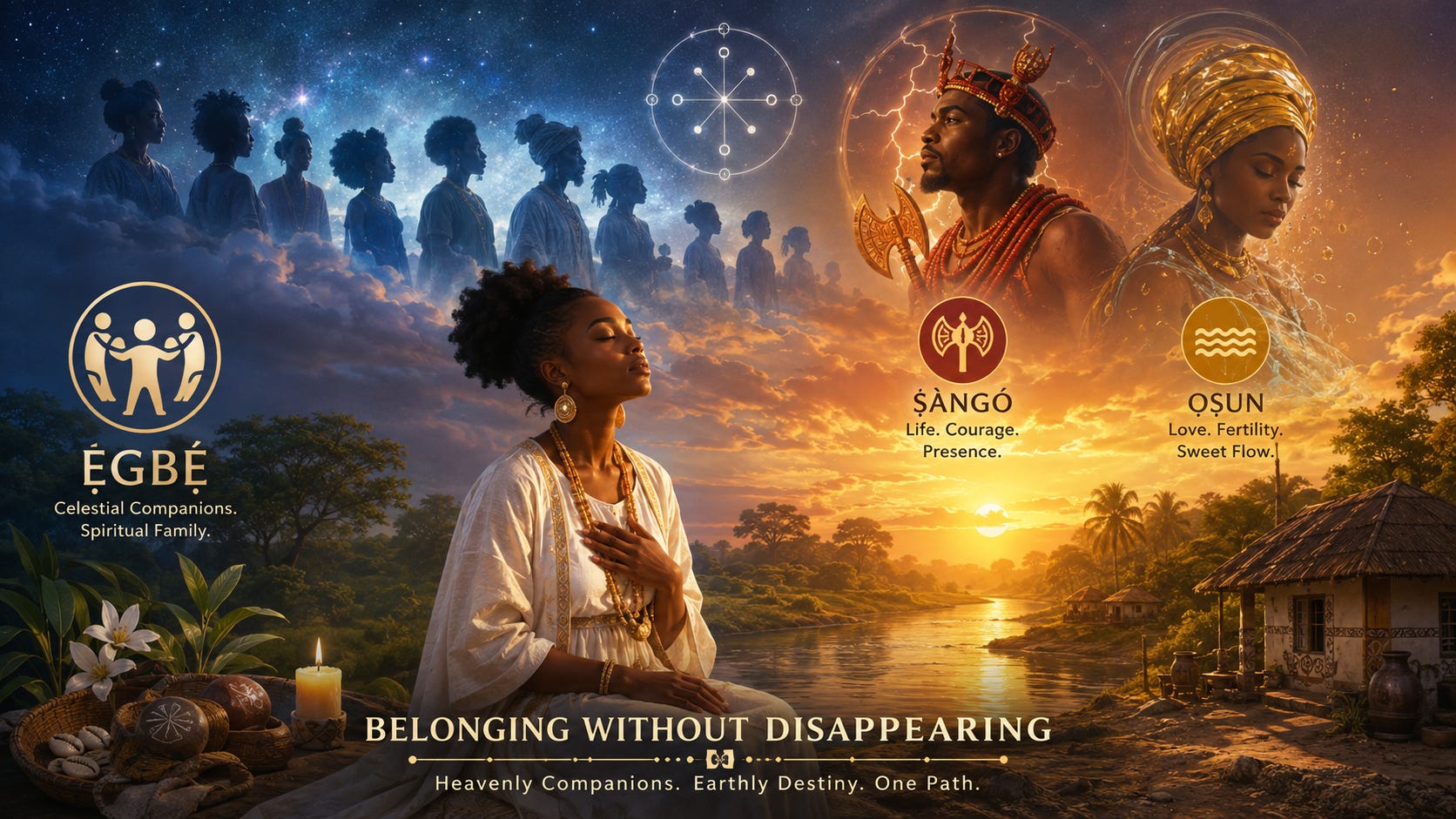
The Odù indicated that she was a daughter of Ṣàngó. It also showed that many of her difficulties were connected symbolically with Ọ̀ṣun. And finally, Ifá revealed a problem involving Ẹgbẹ́—her spiritual companions, her celestial family in Ọ̀run.
At first, these messages seemed to belong to separate worlds.
Ṣàngó spoke of fire, vitality, courage, presence, justice, and the force that insists on life.
Ọ̀ṣun spoke of the river, fertility, menstruation, sexuality, intimacy, sweetness, value, and the body’s ability to receive and generate.
Ẹgbẹ́ spoke of something even more mysterious: a community that existed before her earthly relationships and continued to influence her after birth.
As we spoke, the connection became clearer.
The woman suffered from serious physical symptoms connected to the reproductive field, including endometriosis, ovarian cysts, infertility, and chronic pain. These conditions required medical attention, and I want to be absolutely clear: an Òrìṣà does not “cause” endometriosis, and a spiritual reading must never replace proper medical care.
Ifá was not diagnosing her body. It was revealing the spiritual landscape surrounding her experience.
When the Soul Is Loved Too Strongly by Heaven
The reading showed that this woman had enjoyed an exceptionally close relationship with her Ẹgbẹ́ before incarnation.
Her celestial companions loved her deeply. So deeply, in fact, that they did not want to release her.
Yet Ẹgbẹ́ does not stand above destiny. Even the spiritual family must respect the laws that govern incarnation. This soul had obligations in Ayé, the visible world. She had a body to enter, experiences to undergo, relationships to form, and a destiny to fulfil.
She had to come. The love of her celestial companions could not cancel that responsibility. But it could complicate the process.
In the language of the reading, part of her remained emotionally turned toward Ọ̀run. She was physically present, yet something within her had not fully accepted the distance from her spiritual family.
This is one of the ways an unresolved Ẹgbẹ́ relationship may appear: not necessarily through open conflict, but through a longing that has no earthly name.
Some people describe it as homesickness for a place they cannot remember. Some feel that no human community truly understands them. Some experience a deep desire to withdraw from life, even when their circumstances do not fully explain that desire.
Others carry vivid dreams, unusual sensitivity, strong intuition, or what is sometimes called “the second sight”—a natural openness toward the invisible side of existence.
This woman had exactly that kind of perception. She felt spiritual presences easily. She received impressions before events occurred. Her dreams were vivid and emotionally charged. She possessed a strong awareness of realities that many people do not consciously perceive.
Such sensitivity can be a gift. But when it is not grounded, it can also make earthly life feel distant, heavy, or incomplete.
Why Ṣàngó Appeared First
The most striking part of the reading was the role of Ṣàngó.
In this specific case, Ṣàngó appeared as the force that had accompanied her into incarnation so that she could remain fully connected to life.
His presence was not accidental. Ṣàngó is heat, pulse, courage, visibility, movement, sound, dignity, desire, and the royal command to stand upright in the world. He does not disappear quietly. He announces himself. He occupies space. He insists that life must be lived with presence.
Within this reading, Ṣàngó represented a spiritual counterweight to the pull of Ọ̀run.
His message was simple:
You must live. Not merely survive. Not remain half-present. Not spend your entire life longing for the world you left behind. Live here. Speak here. Love here. Create here. Take your place here.
This does not mean that children of Ṣàngó cannot experience depression, despair, or suicidal thoughts. No Òrìṣà affiliation makes a person immune to mental illness or emotional crisis. Any persistent desire to die must be taken seriously and addressed with qualified professional support.
But symbolically, Ṣàngó often carries a powerful life-affirming force. In this woman’s reading, that force was essential. Her destiny required an Òrìṣà who could repeatedly call her back into embodiment.
Why Ọ̀ṣun Carried the Symptoms
If Ṣàngó represented the command to live, Ọ̀ṣun revealed where the struggle had settled.
Ọ̀ṣun governs much more than romance or beauty. She is the intelligence of attraction, fertility, emotional circulation, intimacy, sensuality, menstruation, conception, self-worth, sweetness, and the ability of life to become generative.
Her waters connect desire with consequence.
When the reproductive field suffers, the symbolism of Ọ̀ṣun may become important—not because she created the illness, but because the body and the spiritual story may be speaking through the same sacred territory.
In this woman’s life, the question was not only whether conception was medically possible. The deeper question was whether incarnation itself had ever felt entirely welcome within her.
Could her body become a place of belonging?
Could life flow through her without awakening the old tension between staying and leaving?
Could she experience earthly love without comparing it to the perfect belonging she remembered from Ọ̀run?
Could she allow the river of Ọ̀ṣun to move forward rather than remain caught between worlds?
The reading did not offer a simplistic answer. It revealed a relationship that needed to be harmonized. Her Ẹgbẹ́ did not need to be rejected. They needed to understand that loving her meant supporting her destiny in Ayé.
What Is Ẹgbẹ́?
The Yorùbá word ẹgbẹ́ can refer to a group, society, association, peer group, or community. In the spiritual context of Ifá, Ẹgbẹ́ refers to the celestial companions connected to a person before birth. We may call them a spiritual family, a heavenly society, or companions of the soul.
The concept suggests that before we enter an earthly family, we already belong to a community in Ọ̀run. Before we learn the names of our parents, siblings, partners, or friends, the soul may already have bonds, affinities, responsibilities, and attachments.
This is important because Ifá does not imagine the human being as an isolated individual. We are born with an Orí, but we are also born into relationships. We carry destiny, but we also carry memory.
We arrive as individuals, but not as beings without history. Ẹgbẹ́ expresses the social dimension of the soul.
Ẹgbẹ́ Is Not the Same as an Ancestor
Ẹgbẹ́ is often misunderstood because people confuse different spiritual relationships.
An ancestor is someone who once lived in Ayé. Ancestors belong to the lineage of the dead, whether through blood, family, community, initiation, or spiritual inheritance.
Ẹgbẹ́ is different. Ẹgbẹ́ refers to peers or companions connected to the soul in Ọ̀run.
The relationship is not primarily vertical, like the relationship between descendant and ancestor. It is more horizontal. Your ancestors stand behind you. Your Orí stands within you. The Òrìṣà move through the powers of creation. Ẹgbẹ́ stands beside you. Even when you cannot see them.
Ẹgbẹ́ and the Mystery of Belonging
One of the deepest human needs is the need to belong. Many people spend their lives searching for the feeling that others understand them without constant explanation. They move from family to family, relationship to relationship, spiritual house to spiritual house, hoping to find the community that feels familiar.
Sometimes that longing comes from childhood. Sometimes it comes from social exclusion. Sometimes it comes from trauma. And sometimes Ifá reveals that the soul remembers an earlier form of companionship.
A strong Ẹgbẹ́ connection may create the feeling that one’s true family is elsewhere:
A person may be surrounded by people and still feel alone.
They may meet someone for the first time and experience immediate recognition.
They may feel more at home in dreams than in waking life.
They may possess friendships that feel older than their actual history.
They may repeatedly create chosen families because ordinary structures never feel sufficient.
In balance, this can produce loyalty, intuition, deep friendship, community-building, creativity, and spiritual sensitivity. Out of balance, it can produce isolation, disappointment, spiritual homesickness, or difficulty accepting the limitations of human relationships.
When Celestial Love Becomes Possessive
We often speak of spiritual companionship as if it were always gentle and supportive. But every relationship contains the possibility of imbalance:
Love can protect.
Love can also refuse to release.
A parent may love a child so strongly that the child cannot become independent.
A partner may call control devotion.
A family may demand loyalty at the expense of destiny.
A spiritual community may resist the departure of one of its own.
The problem is not always hatred. Sometimes the problem is attachment without freedom.
The woman from my reading did not have hostile celestial companions. She had loving companions whose bond had become too strong. Her task was therefore not spiritual warfare.
It was spiritual negotiation. She did not need to break the relationship. She needed the relationship to support her incarnation rather than compete with it.
Closing Insight: Belonging Without Disappearing
The deepest mystery of Ẹgbẹ́ is not simply that invisible companions may exist.
The deeper mystery is that the soul can belong to more than one world without betraying either. We may enter Ayé carrying relationships we do not consciously remember.
Some become talents.
Some become dreams.
Some become immediate recognition when we meet certain people.
Some become unexplained homesickness.
Some become patterns that must be renegotiated before life can flow.
The woman from the reading did not need to reject her spiritual family. She needed them to bless her incarnation. Ṣàngó reminded her that life was not a punishment imposed on a heavenly soul.
Life was the place where her destiny had agreed to become visible.
Ọ̀ṣun asked her to honour the body, the river, the grief, the longing, and the possibility of sweetness without reducing any of them to simple spiritual explanations.
Ẹgbẹ́ asked to be acknowledged.
But Ẹgbẹ́ also had to learn to release.
Perhaps this is the mature form of every love, visible or invisible:
Not, “Stay where I can keep you.”
But, “Go where your destiny needs you, and let our bond become a blessing on the road.”
Stay blessed, and may your celestial companions strengthen your footsteps in Ayé while your Orí guides you toward the life you came here to fulfil.
Babá Tilo de Àjàgùnnà
DAILY IFÁ ACADEMY
Supporting Readers: Go Deeper into Ẹgbẹ́
In the Supporting Readers’ section, we will explore how Ẹgbẹ́ may influence dreams, relationships, prosperity, spiritual perception, and the feeling of belonging.
We will also examine how to distinguish an Ẹgbẹ́ issue from ancestral influence, psychological patterns, medical concerns, or ordinary relationship difficulties.
Finally, I will share a simple home practice for acknowledging benevolent Ẹgbẹ́ while strengthening your commitment to life in Ayé.
This practice requires no initiation, no animal sacrifice, and no expensive materials. It is a gentle way to honour celestial companionship without inviting dependence, fear, or obsession.