


Dear seekers of wisdom,
before the blade cuts the sugarcane, it must first know the difference between harvest and harm. This is the first teaching of Ògúndá Méjì: power is not proven by force alone, but by the wisdom to know what must be opened, what must be repaired, and what must never be wounded.
When the Blade Does Not Come to Destroy
The machete can clear a path, harvest the field, divide what is unfair, or wound what should have been protected. The same iron that opens the road can close a destiny when it is held by anger.
This is the first mystery of Ògúndá Méjì, also known as Èjì Òkó. We are not speaking here of Ògúndá Ìròsùn, Ìròsùn Ògúndá, or another crossed Odu. We are speaking of the double force of Ògúndá itself: the blade doubled, the conflict doubled, the possibility of repair doubled.
Many people hear Ògúndá and immediately think only of Ògún: iron, war, tools, roads, blood, labor, technology, surgery, and the courage to cut through resistance. All of that belongs here. But Ògúndá Méjì is much more than the predictable story of the warrior. In this Odu, the blade is also a judge. The blade is also a healer. The blade is also a teacher of fairness.
The ancient Ògúndá revelations describe this Odu as a force of accomplishment, progress, growth, success, family, and destiny fulfillment, while also warning of disputes, hostility, violence, and deceitful friends. They also say that Ifá and Obàtálá are strong in this Odu, and that blessings come through honesty, cooperation, and good character.
So the question is not simply: “Where is Ògún fighting?”
The better question is: What must be cut so that sweetness can appear?
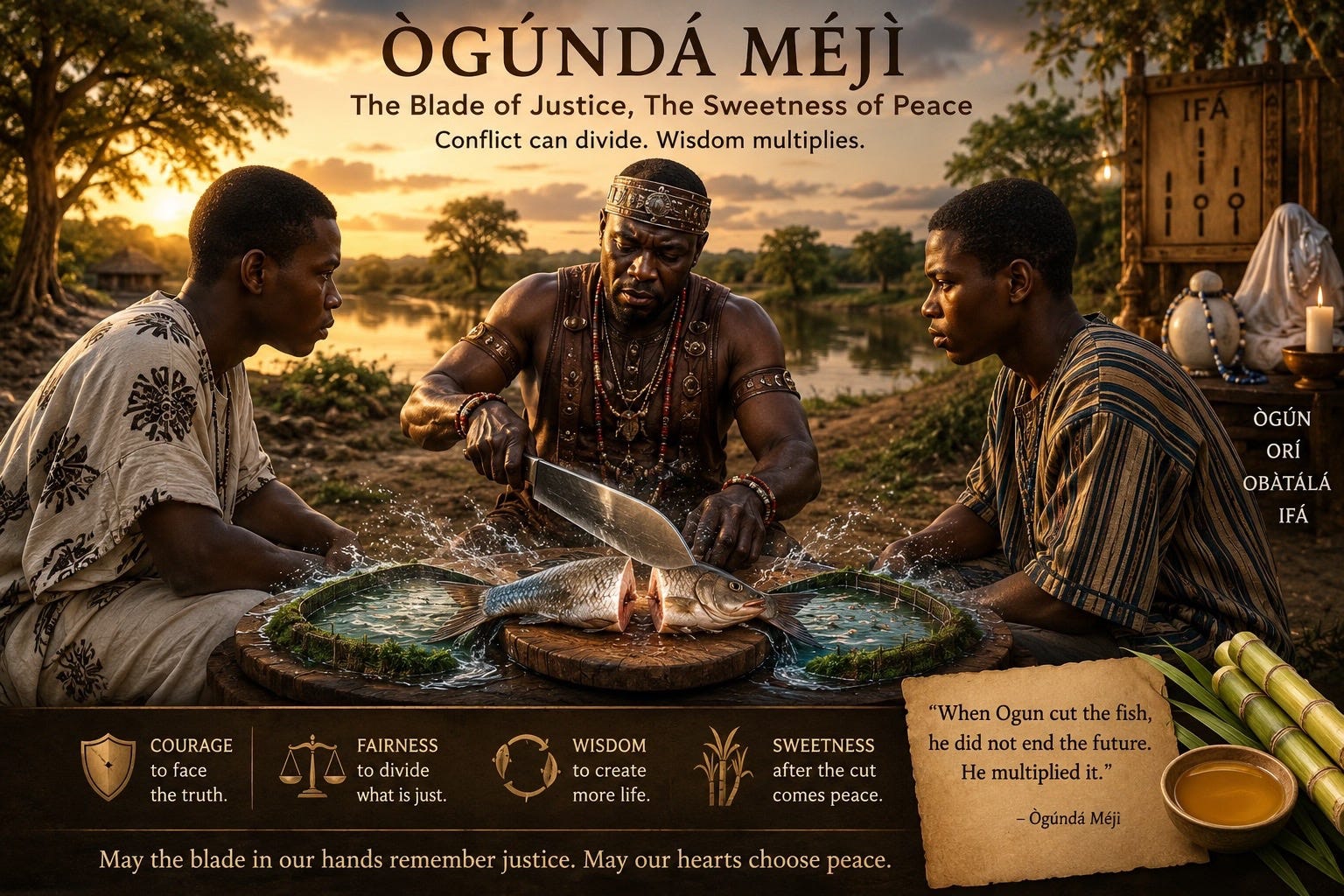
The Story: The Fish That Became Two Farms
There were two friends who entered a partnership in fish farming. One had the pond. The other stood as guarantor. Together, they succeeded. Their agreement was simple: when the pond produced, they would share the harvest fairly.
Years passed. The partnership grew. Then both men died, and their children inherited not only the pond and the guarantee, but also the unresolved human temptation to claim more than one’s share.
One year, after failure and difficulty, only one fish remained. The child of the pond owner said, “Without my father’s pond, this fish would never have lived.” The child of the guarantor replied, “Without my father’s guarantee, there would have been no pond to begin with.”
The dispute hardened. Each side had a reason. Each side had a wound. Each side believed justice stood only beside them.
Then Ògún intervened.
He listened. He looked at both of them. Then he used his machete to cut the fish in two. But this was not ordinary cutting. When the two halves were revealed, they became two fish farms. Each side received not only a portion, but a future. From that moment, this path of Ògúndá became associated with the smile that comes after conflict is resolved.
This is one of the great teachings of Ògúndá Méjì: when a conflict is handled with spiritual intelligence, the solution can become larger than the original problem.
The immature blade says, “I will win.”
The sacred blade says, “Let fairness create more life.”
The Proverb Inside the Story
Ògúndá Méjì teaches that not every conflict is evil. Some conflicts reveal where an agreement was unclear, where inheritance was poisoned, where loyalty was assumed but never spoken, where a partnership succeeded materially but failed spiritually.
In the story, both children were right in a limited way. The pond mattered. The guarantee mattered. Structure mattered. Trust mattered. But each person became trapped inside one half of the truth.
This is why Ògún’s machete is so important. He does not cut to destroy them. He cuts through the illusion that only one side deserves to live.
In our lives, Ògúndá Méjì appears when we need to ask:
Where am I confusing pride with justice?
Where am I calling something “mine” because I am afraid of losing?
Where does a partnership need a clearer agreement?
Where must I divide responsibility before resentment becomes war?
This Odù warns that those connected to Ògúndá Méjì should be straightforward, honest, and accommodating in joint ventures, avoiding unnecessary quarrels, arguments, misunderstandings, or cheating during contributions and profit-sharing.
This is not only business advice. It is spiritual law.
A marriage is a partnership. A family is a partnership. A temple is a partnership. A friendship is a partnership. Even the relationship between Orí and the hands is a partnership: the head chooses destiny, but the hands must work it into the world.
The Hidden Sweetness of Ògúndá Méjì
Ògúndá is hot, sharp, and intense. Yet inside this Odu, there is sweetness.
The Odù says that those born under Ògúndá Méjì are favored by Obàtálá and Ifá, and that, “as long as honey remains sweet,” nothing can prevent them from enjoying life fully except their own actions. It also says they are chosen to spread happiness so the world becomes more habitable.
This is the surprising medicine of the Odu.
Ògúndá Méjì is not only about fighting enemies. It is about becoming the kind of person whose victory does not poison the community.
There is a kind of person who wins and leaves bitterness behind.
There is another kind of person who wins and makes room for others to rise.
Ògúndá Méjì asks us to become the second kind.
It teaches that power without humility becomes danger. Influence without character becomes a trap. Courage without listening becomes violence. This Odù specifically warns that children of Ògúndá Méjì must not repay good with evil, must not repay evil with evil, must not show ingratitude to benefactors, and must not become drunk with power.
The blade must bow to wisdom.
When the blade bows, sugarcane appears.
Orí, Obàtálá, and Ògún: The Three Powers Behind the Blade
Ògún is present in Ògúndá Méjì, but he is not alone.
Orí is the inner head, the seat of destiny and personal spiritual authority. Without Orí, the strongest iron loses direction.
Obàtálá cools the heat. He brings consciousness, patience, ethics, and the white cloth of reflection. When Ògúndá becomes too hot, Obàtálá reminds us that being right is not the same as being wise.
Ifá holds the pattern. Ifá shows when to act, when to wait, when to cut, when to repair, and when to refuse the fight entirely.
The ancient materials name Orí, Ifá, Obàtálá, Òsányìn, Ògún, Èṣù Òdàrà, Òṣóòsì as affiliated powers of Ògúndá Méjì, connecting this Odu not only to battle but to healing, protection, destiny, realistic judgment, obstacle removal, and support in dilemmas.
This is why we should not reduce Ògúndá Méjì to “war energy.”
It is also road energy.
It is healing energy.
It is negotiation energy.
It is the courage to repair the broken gate before thieves enter.
It is the humility to say, “I was wrong,” before the relationship becomes a battlefield.
Free Reflection: What Is Your Fish?
Everyone has a fish.
The fish is the thing people fight over when the deeper issue is not the fish.
In one home, the fish is money. In another, inheritance. In another, attention. In another, loyalty. In another, who sacrificed more. In another, who gets recognized.
Ògúndá Méjì asks us not to stare only at the fish.
It asks us to look at the pond, the guarantee, the history, the labor, the silence, and the agreement that was never written clearly.
Where there is fairness, Ògún can cut a road.
Where there is pride, Ògún may cut the rope holding everything together.
The blessing of this Odu is that crying can become laughter, and what was lost can return. The proverbs of Ògúndá include warnings of deception and wrong decisions, but also the possibility that tears may turn to laughter and lost things may be found.
The knife is already on the mat.
Now the question is whether we will use it as a weapon, a tool, or a sacred instrument of repair.
Closing Insight
The fish in the story was never only a fish.
It was the memory of two fathers.
It was the labor of one family and the trust of another.
It was the danger of inheritance without wisdom.
It was the test of whether the next generation would repeat conflict or transform it.
Ògún cut the fish, but he did not end the future. He multiplied it.
That is the prayer of Ògúndá Méjì for us: may what must be cut not become destruction. May what must be divided become fair. May what feels like conflict reveal a road. May the blade in our hands remember the sweetness hidden inside the sugarcane.
Stay blessed. Kí ọ̀nà rẹ ṣí, kí Orí rẹ tútù — may your road open, and may your head remain cool.
Babá Tilo de Àjàgùnnà
DAILY IFÁ
Supporting Subscribers Continue Below
In the segment for supporting readers, we go deeper into how to work with Ògúndá Méjì in daily life without making the practice too heavy or complicated.
You will receive:
What the paid segment includes
Clear guidance for spiritual development, health, love, family, business, and money
A practical explanation of Ògúndá Méjì in Iré and Osogbo
A simple discernment checklist for conflict, contracts, partnerships, and emotional decisions
A short DIY ritual: Cooling the Blade, Sweetening the Path
A gentle spiritual bath using accessible herbs and safe substitutions
A Yorùbá prayer with English and Portuguese translations
Segment for Supporting Readers
How Ògúndá Méjì Speaks to Your Life
Spiritual Development
Ògúndá Méjì teaches that spiritual power must be joined with character. A person may have courage, spiritual gifts, strong intuition, and the ability to push through obstacles, but if the head is hot, the same gifts become weapons.