


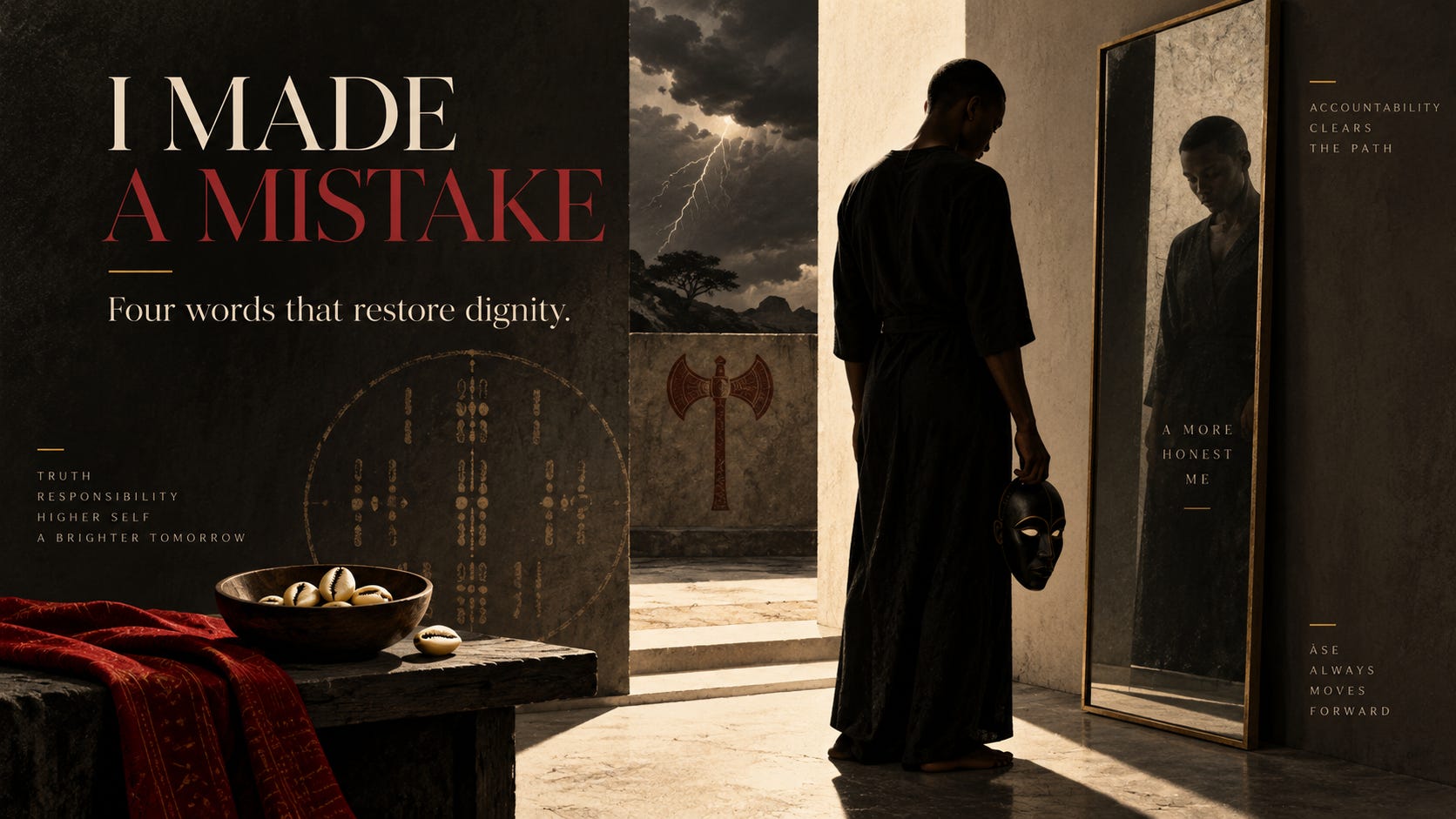
The Four Heaviest Words in the World
Dear seekers of wisdom,
There are sentences that become longer the farther a person wanders from the truth. They usually begin innocently enough, with an explanation of circumstances, a reference to difficult conditions, or that peculiar grammatical magic by which a decision suddenly loses the person who made it. Before long, nobody has actually done anything. Things have merely “happened.” A bad decision becomes a “reassessment.” A broken promise becomes “an adjustment to changing conditions.” What yesterday was announced with confidence, applause, and a straight back appears the next morning like an orphan left on the steps of history, with no father, no mother, and certainly no one willing to recognize the family resemblance.
And yet there is another sentence, so small that it could fit into any language, any office, any marriage, any family, and probably any palace ever built by human beings.
I made a mistake.
Four words, and still they may weigh more heavily on the tongue than stone.
Perhaps this is because they ask us to surrender something we defend with astonishing determination: not our possessions, not our position, but the image we have constructed of ourselves. As long as the mistake remains outside us, as long as it belongs to the market, the economy, our childhood, our partner, our employees, poor advice, bad timing, unfortunate circumstances, or destiny itself, something inside us can remain beautifully untouched. There we may continue to live as the intelligent, reasonable, essentially blameless person who has simply suffered the misfortune of being surrounded by a less intelligent and considerably less reasonable world.
Life, however, has the irritating habit of being unimpressed by our explanations.
A river does not alter its course because we offer it an eloquent explanation of why the dam was badly built. A burned field does not become green again because the person who lit the fire had excellent intentions. The trust of someone we have wounded does not mysteriously return at sunrise because our motives were more complicated than our actions. Between intention and consequence there is sometimes a wide and silent country, and it is there that responsibility begins.
Ṣàngó and the Memory of the World
In the stories surrounding Ṣàngó, Òrìṣà of thunder, kingship, power, and justice, responsibility often moves through the world like a distant storm. It may remain beyond the horizon for a long time, invisible under a blue sky, but invisibility should never be confused with absence.
One of the traditions preserved in the Ṣàngó narratives tells of an obligation that remains unpaid. What begins as a matter between an individual and Ṣàngó does not remain private forever. The unresolved debt begins to disturb a larger order until acknowledgment and repayment become necessary for balance to return. The story is concerned not merely with punishment, but with obligation, accountability, consequence, and restoration.
There is something profound hidden in this image, something larger than the idea of a divine king keeping accounts in the clouds. It suggests that reality itself remembers.
What we refuse to settle does not always disappear. Sometimes it simply changes its name.
The conversation we avoid for years becomes distance. The promise we neglect becomes mistrust. The injustice we refuse to acknowledge becomes bitterness. The apology withheld long enough becomes a silence that eventually seems older than the people trapped inside it. A small error, defended over many seasons, can become an atmosphere, and one day everybody in the house feels the heaviness although nobody remembers when the windows were first closed.
We often believe that consequences arrive like punishment, dramatically, with thunder and broken doors. More often they come quietly. A person stops telling us the truth. A child stops asking. A colleague stops trusting. A lover begins speaking carefully where once there was ease. Something leaves before anyone notices its departure.
And when we finally ask what happened, the answer may be waiting in a room we have avoided entering for years.
Ṣàngó’s double-headed ax is an appropriate symbol for this mystery, because justice cannot cut only in the direction we prefer. The blade that sees what others have done must also be capable of turning toward us. Power without that second edge easily becomes vanity. Judgment without self-examination becomes hypocrisy. Authority without accountability becomes merely the privilege of making consequences that other people must carry.
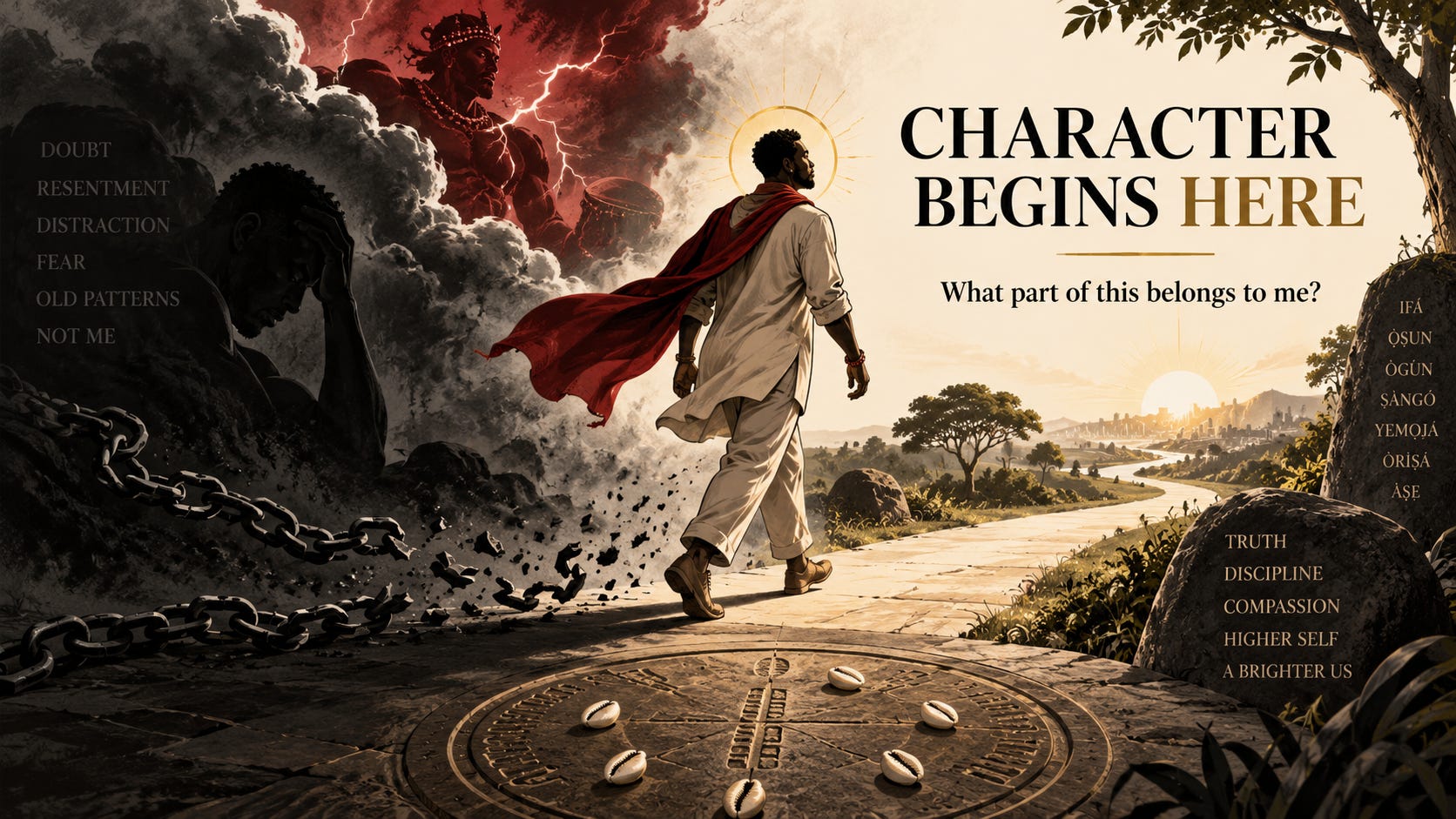
The first question of responsibility, therefore, is rarely the familiar one: Who is to blame? A more dangerous question is waiting beneath it: What part of this belongs to me?
Ìwà: What Remains After the Applause Ends
Yorùbá thought gives extraordinary importance to Ìwà, character. In the familiar expression Ìwà l’ẹwà, beauty and character become inseparable: the deepest beauty of a human being is not something placed upon the body but something cultivated within the person.
Reputation and character may resemble one another from a distance, but they are not twins. Reputation lives in the eyes of others. Character lives with us after the room has emptied.
Reputation worries about being seen making a mistake. Character worries about leaving the mistake unrepaired. Reputation asks what people will think if the truth is known. Character wonders what we will become if the truth is continually denied.
Most of the decisive moments of character do not occur beneath bright lights. They arrive on ordinary mornings, when nobody is watching and there is no audience to applaud our honesty. A message is waiting to be answered. A debt has been postponed once too often. An employee deserves an apology. A friend was right. A partner has been carrying the consequence of a decision we still insist on explaining rather than owning.
There, in those unremarkable moments, Ìwà quietly takes shape.
We have become accustomed to confusing strength with certainty. The person who never hesitates appears strong. The person who dominates a room appears strong. The leader who never retracts a statement, never publicly changes direction, never says “I was wrong,” may even acquire the aura of granite.
But granite does not grow.
There is another kind of strength, less theatrical and much more difficult to counterfeit. It belongs to the person whose sense of self is large enough to contain an error without collapsing around it. Such a person does not need to become smaller because the mistake has become visible.
An immature ego requires uninterrupted correctness because each mistake feels like an attack upon identity. A mature person can survive being wrong because identity has become deeper than reputation.
That difference may be one of the quiet thresholds of adulthood.
The Sophisticated Art of Remaining Innocent
Human beings have always been talented at avoiding responsibility, but modern life has given the talent an impressive vocabulary.
In organizations, an individual’s poor judgment may become a “process issue.” In relationships, cruelty may be described as a “communication problem.” Neglect becomes “limited capacity.” Cowardice becomes “risk management.” Arrogance becomes “strong leadership.” Betrayal becomes “changing priorities.”
Language, one of our greatest gifts, is also one of our most elegant hiding places.
Of course systems can fail. Processes can indeed be badly designed. Communication can collapse. Circumstances matter. Other people may carry large portions of responsibility, and sometimes we are genuinely the victims of injustice rather than its authors.
Responsibility does not require us to simplify a complicated world into one guilty person. Its challenge is subtler. Because everything is rarely our fault, we are tempted to conclude that nothing is our responsibility.
Between those two extremes lies a territory that the ego dislikes. There I can acknowledge that someone harmed me while still becoming responsible for what I do next. I can understand the childhood that shaped my fears without making my childhood responsible for every person I hurt at fifty. I can recognize betrayal without turning betrayal into a lifelong license for bitterness. I can explain why I acted as I did and still say that what I did was wrong.
Understanding an error is not the same as absolving it. And accepting responsibility is not the same as hating oneself.
In fact, self-condemnation can become another sophisticated form of escape. A person may spend months declaring himself terrible without repairing a single thing. The ego has simply changed costumes. Yesterday it wore the crown of innocence; today it wears the ashes of shame. Either way, it remains at the center of the stage.
Responsibility is far less dramatic. It does not ask first, What does this mistake say about my worth as a human being? It asks, What does this mistake require of me now?
Orí and the Return of Personal Power
Within Yorùbá spirituality, Orí, the inner head, is connected with individual destiny, consciousness, direction, and the path a person carries through life. To speak of responsibility through the lens of Orí is therefore to speak of something much greater than blame. It is to speak of sovereignty.
As long as my life is narrated entirely as something other people have done to me, those people remain strangely powerful.
If my employer alone possesses responsibility for my future, I must wait for my employer. If my partner alone determines my happiness, then my partner possesses the keys to an interior house that should never have had an external landlord. If everything I am today belongs entirely to yesterday, then the past continues governing the future long after its kingdom should have ended.
And if every poor decision becomes, in retrospect, the property of circumstances, then I may preserve the comforting purity of innocence at the cost of something far more precious: my ability to change.
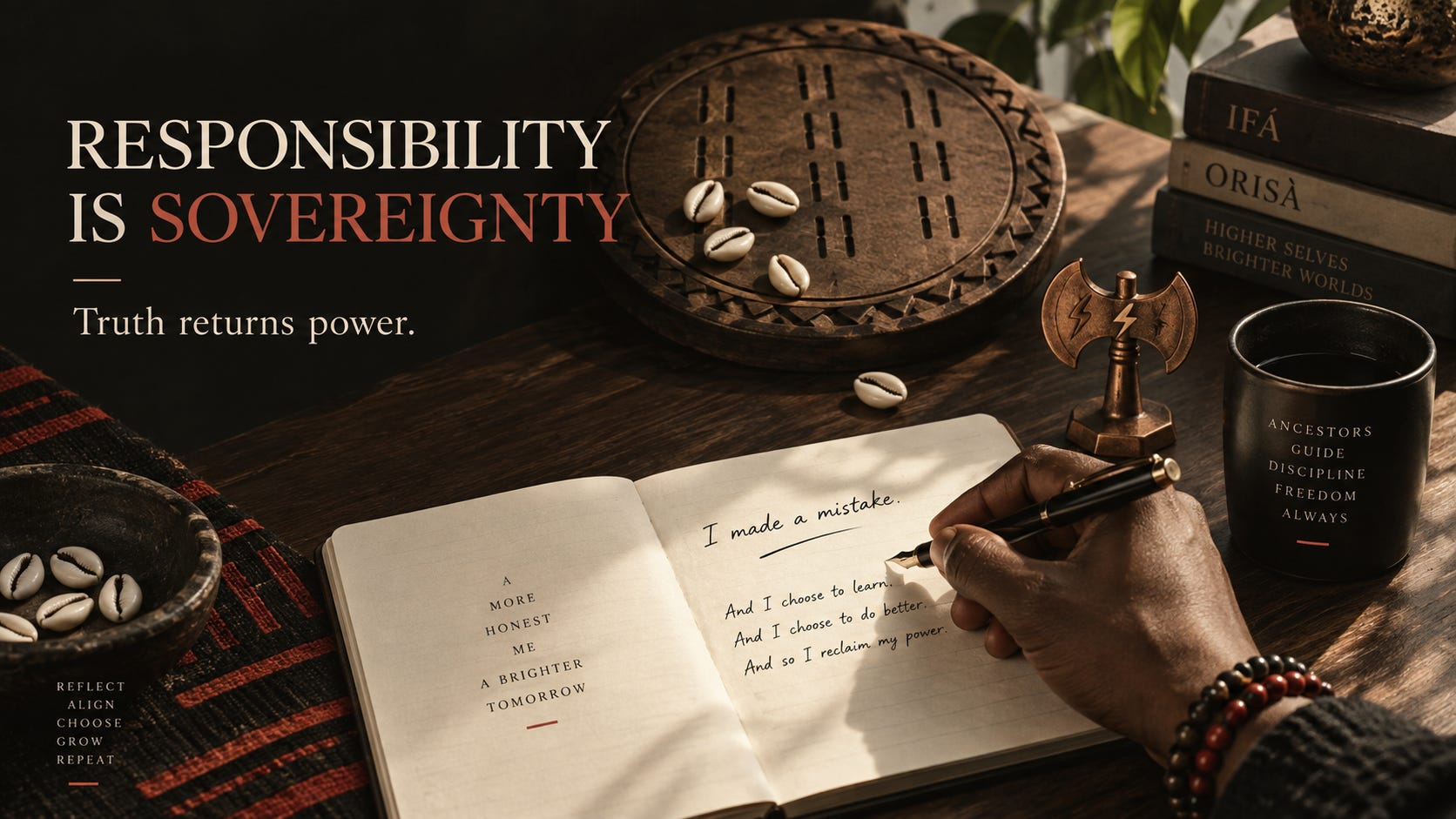
This is why the sentence “I made a mistake” can be understood not merely as confession but as reclamation.
It says: My hand was here. My judgment was incomplete. Fear was involved, or pride, or desire, or convenience, or ignorance. Perhaps others played their part as well, perhaps circumstances were cruel, perhaps the entire situation was unfair—but this portion is mine.
And what is mine can be worked upon.
There is dignity in this that we often fail to recognize. At first responsibility seems to add weight to the shoulders. Then, slowly, we discover that hidden underneath the weight is movement.
The person who is never responsible eventually becomes the person who is never powerful. The moment we say, “This part was mine,” we return to the steering wheel of our own existence.
Àṣẹ Without Responsibility Is Only the Desire for Power
In Òrìṣà traditions we speak of Àṣẹ, the force through which words, intentions, actions, and sacred things become effective in the world. But power divorced from responsibility is an adolescent fantasy of Àṣẹ.
If we desire our words to possess weight, we must be prepared to carry the weight of those words after they have been spoken. If we wish to make decisions, we cannot embrace only the successful consequences and leave the failures anonymously at someone else’s door. Whoever loves the crown must eventually learn to love the obligations that accompany the crown.
This is one of the spiritual lessons that Ṣàngó makes difficult to ignore. Thunder is not merely spectacle. It is echo. Something occurs, and something answers.
The universe of the Òrìṣà is full of relationships, exchanges, promises, consequences, prohibitions, obligations, transformations, and restoration. Human beings are not imagined as creatures floating outside causality. We act within a web. Our words enter it. Our promises enter it. Our failures enter it as surely as our virtues do.
To possess Àṣẹ, then, cannot mean merely possessing the ability to influence the world. It must also mean becoming someone capable of standing beside what one’s influence has created.
Perhaps this is why a leader who openly acknowledges an error does not necessarily become smaller. Sometimes, for the first time, we discover the true dimensions of that person’s strength. Something has been placed above image: truth.
When a Mistake Stops Becoming a Destiny
We will make mistakes for as long as we remain human.
We will misunderstand people we love and trust people who should not have been trusted. We will remain too long in certain places and leave others too soon. We will speak when silence would have been wiser and keep silent when courage demanded speech. We will make decisions out of fear and call them prudence. We will mistake longing for intuition and stubbornness for conviction. Sometimes we will even do harm while believing ourselves to be acting out of love, because good intentions have never been a guarantee of good consequences.
The spiritual challenge, therefore, cannot be to become so perfect that error disappears from our lives. Perfection of that kind belongs less to wisdom than to vanity. The deeper question is what happens after the error becomes visible.
A mistake that must constantly be defended slowly begins governing the person who made it. Every contradictory fact becomes a threat. Every witness becomes inconvenient. Every criticism begins to sound like betrayal. Eventually we may no longer even be defending the original decision. We are defending the story we invented afterward so that we would not have to change our understanding of ourselves.
But a mistake that has been acknowledged can finally begin to die.
Not necessarily its consequences. Not automatically the pain it caused. Not every lost opportunity or broken trust. Saying “I made a mistake” is not a magical transaction through which history agrees to erase itself.
Something else dies: the necessity of continuing the lie. And with that death, an extraordinary amount of life may return.
There is no longer any need to remember which explanation was offered to whom. No need to defend what we ourselves no longer believe. No need to transform every honest question into an attack. Reality can be allowed to become reality again.
Sometimes peace begins simply because we finally stop arguing with what happened.
The Dignity of the Imperfect Human Being
Perhaps maturity is not the achievement of a life without mistakes, but the ability one day to stand beside our mistakes without fleeing from them and without building monuments to our shame.
There are people who are right all their lives and become increasingly lonely in the process. There are others who, after years of defending an old story, find the courage to interrupt themselves.
I should have listened.
I should have spoken.
I should have left earlier.
I should have stayed.
I broke my word.
I judged someone unfairly.
I was afraid.
I wanted to be admired.
I did not know as much as I thought I knew.
I made a mistake.
Strangely, a person does not necessarily lose dignity in that moment. Very often, that is the first moment dignity becomes visible.
Because dignity is not the appearance of perfection. It is the capacity to remain present when truth becomes uncomfortable. It is the refusal to sacrifice another human being merely to keep our self-image intact. It is the courage to allow yesterday’s version of ourselves to be corrected by what we understand today.
Perhaps some of the most important spiritual moments of our lives therefore require no temple, no drum, no incense, no elaborate formula, and no audience.
Sometimes a person simply sits alone at a table while rain presses softly against the windows, and after years of arguing with the world discovers that one thing has been waiting patiently to be given its proper name.
Then the house becomes quiet.
Somewhere beyond the roofs, perhaps very far away or perhaps within the secret chambers of the heart, Ṣàngó’s thunder rolls across the sky—not necessarily as punishment, but as a reminder that truth and order are ancient relatives.
And the person finally speaks the four words that once seemed unbearable.
I made a mistake.
Not as the end of dignity. As the beginning of its return.
Stay blessed, and may your Orí be strong enough to recognize truth before pride has built an entire house around an error. May Ìwà remain with you when explanation would be easier than self-recognition, and may your Àṣẹ be found not only in what you are capable of changing in the world, but also in the courage to stand beside what has changed because of you.
Àṣẹ.
Babá Tilo de Àjàgùnnà
DAILY IFÁ