


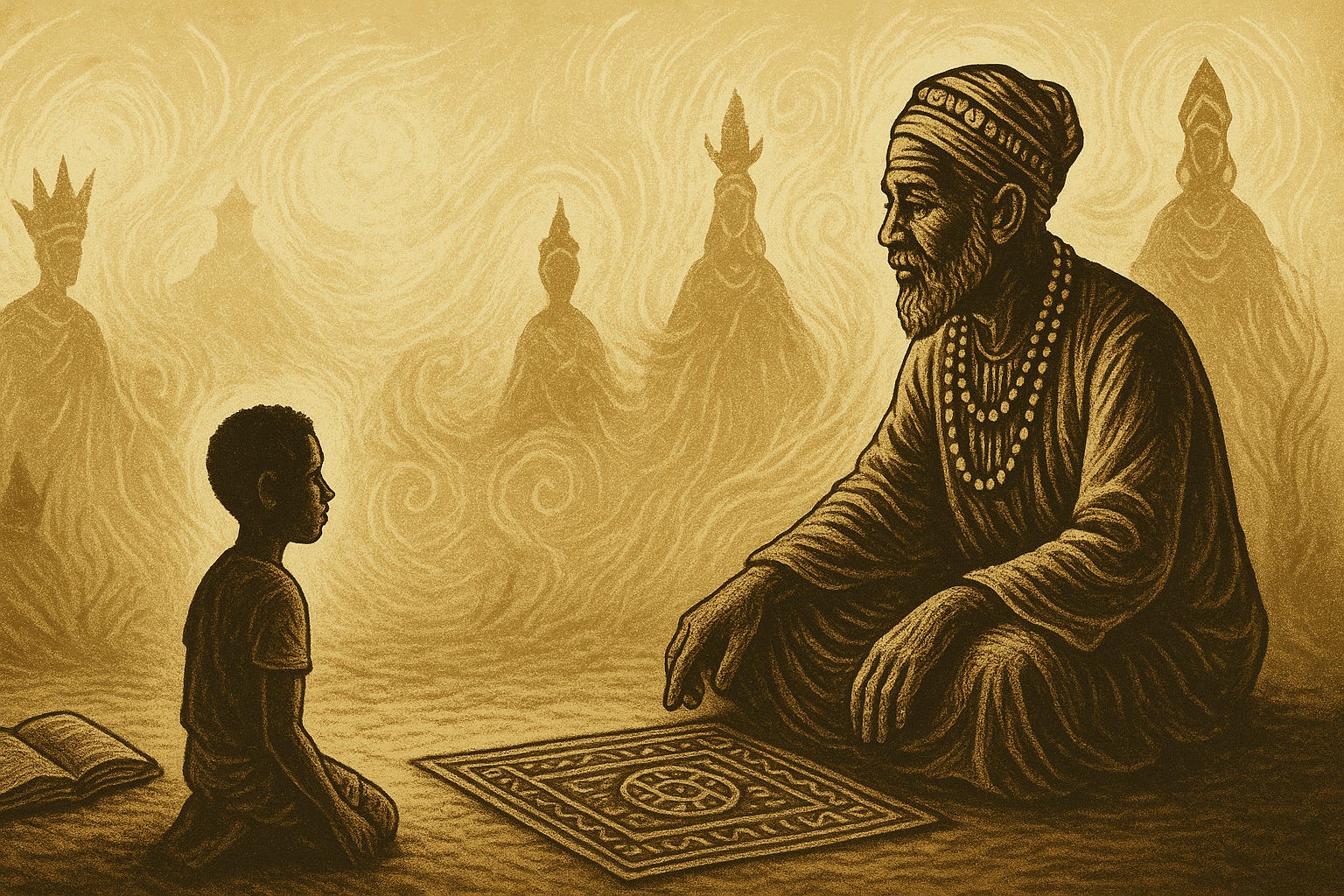
From the feet of the elders to the ears of the awakened,
Under the watchful gaze of the Iroko tree, where spirits and stories entwine, we gather again—not just to receive knowledge, but to remember that education, at its root, is a sacred relationship. It is not hierarchy. It is not submission. It is, first and foremost, asè shared in trust, humility, and mutual growth.
The Wisdom Hidden in Relationship
Our Yoruba traditions teach us that learning is not individualistic; it is collective, rooted in respect, intimacy, and community. A child learns through imitation, through presence, through the subtle rhythm of the elder’s life. Not just what is said, but how it is lived. Not just what is taught, but who is teaching it—and how they carry themselves.
This is echoed in the proverb of Odu Oyeku Meji:
"Bi omode ba mọ ohun ti o yẹ ko mọ, a fi ọwọ́ ọ̀rẹ́ kọ́ ọ."
"When a child knows what they should know, it is through the hand of friendship they are taught."
This wisdom calls us to a different model of education—not top-down, not cold or transactional, but relational and transformative. When we see education as a web of relationships, we begin to heal not only ignorance, but disconnection.
When Orunmila Sat Beside the Child
Let us remember the myth from Odu Oyeku Meji: the tale of the stubborn child born into a family of diviners. This boy, intelligent but resistant, would not learn through lectures or punishments. The elders, frustrated, tried force. Nothing worked.
Then Orunmila came—not as a judge, but as a companion. He sat quietly beside the boy, saying nothing. He showed presence without pressure. Slowly, the boy began to open—not out of obligation, but curiosity, trust. Orunmila answered with stories, not commands. Proverbs, not punishments.
And in time, that same child became the lineage's greatest awo.
This story teaches us that education begins when power kneels before presence.
The Complexities Within Our Spiritual Houses
Let us now speak plainly. Many of our spiritual communities—whether Candomblé, Umbanda, Santería, Ifá, or Vodou—have inherited complex legacies. Our traditions are resilient survivors of trauma: colonization, slavery, displacement. They carry ancestral pain and profound medicine. Yet too often, the model of education within our terreiros and houses becomes one of control rather than growth.
There is a fine line between authority and authoritarianism. Between discipline and domination.
And so many of us—initiated, committed, sincere—find ourselves asking: What does it mean to teach without harming? To guide without silencing? To lead without reproducing the very systems of oppression our traditions were born resisting?
This is especially poignant for those of us who come from outside that ancestral wound—as I do, as a white Babalorixá. I do not carry the generational trauma of slavery in my blood, but I carry a commitment: to honor that legacy with humility, to refuse to replicate colonial dynamics in how I teach, lead, or initiate.
My role is not to replace one power system with another. It is to create space for transformation—for others and for myself.
Good Leaders Create Leaders
A fundamental measure of good leadership is not how many followers one gathers, but how many leaders one creates. A true educator does not seek to build disciples, but to awaken masters.
In the wisdom of Odu Obara Meji, we hear:
"Ẹni tí ó kọ́ ọmọ rẹ̀ dáadáa, yóò gba àlàáfíà ọjọ́ ogbó."
"One who raises their child well will find peace in old age."
The goal is not to make carbon copies of ourselves, but to raise those who will surpass us. The highest act of devotion is to teach in such a way that the student becomes greater than the teacher. This is not a threat to the elder—it is their legacy.
Imagine the spiritual house where each initiate is empowered to shine, not just to follow. Where learning becomes liberation, not limitation. That is what our ancestors, even in bondage, dreamed of. That is the power of reimagined education.
Education as a Devotional Act
We forget sometimes that teaching is a sacred act. It is a ritual. To educate is to initiate—not just into knowledge, but into relationship, into accountability, into remembering.
In Odu Irosun Iwori, we hear:
"Ọ̀rọ̀ ọ̀kan ni ń bẹ nílẹ̀, Ọ̀rọ̀ èkejì ló ń jẹ kó mọ̀."
"One voice rests in the earth, another reveals its meaning."
No one teaches alone. Wisdom is co-created. A teacher brings only half the message; the learner brings the rest.
Towards a New Educational Paradigm
Let us now imagine:
A terreiro where correction uplifts rather than shames.
A temple where hierarchy serves growth, not ego.
A priesthood that celebrates when the student outshines the master.
That is the future our traditions deserve. And it begins with how we teach.
Whether you are a priestess guiding an initiate, an elder mentoring youth, or a layperson sharing knowledge—you are an educator. The question is: what kind of relationship are you building through your teaching?
Let this be your offering:
Teach with listening ears.
Lead with a bowed head.
Correct with love, not fear.
Create safety, not silence.
Celebrate those who surpass you.
A Blessing on the Path
May your words be seeds.
May your presence be rain.
May your leadership nourish, not dominate.
May your students become teachers, and your teachings outlive you.
And may Orunmila whisper beside you—not to command, but to remind you that learning is sacred, and sacredness lives in connection.
Àṣẹ.
Babá Tilo de Àjàgùnnà
DAILY IFÁ
Preview DAILY IFÁ - Coming June 21st
"Reliability is a Spiritual Contract: How Ifá Teaches Us to Keep Our Word"
In the Odu Ìwòrì Méjì, a village collapses not from violence — but from broken promises. Ọ̀rúnmìlà shows them how even small delays distort destiny.
In our next edition, we’ll explore how being late, inconsistent, or vague weakens not just trust — but spiritual alignment. We’ll uncover Ifá’s teachings on how to rebuild rhythm, restore self-respect, and lead others through quiet, steady integrity.
Members will receive a ritual to repair your energetic timing and a 3-step framework for aligning with the Orisha through your word
Next Week on DAILY IFÁ ACADEMY - Coming June 22nd
Have you ever felt unseen, cast aside, or cloaked in shame?
In our next issue, we journey into the sacred mist with Yewá, the veiled Orisha of exile, silence, and ancestral healing.
Discover how this guardian of the forgotten transforms emotional wounds into spiritual strength—and how you can call on her to cloak your spirit in protection, especially during times of heartbreak, invisibility, or transition.
A must-read for those carrying ancestral grief, queer stories, or hidden power.
Coming soon—stay close to the mist.
Não tinha momento melhor para este texto, me emocionei tbm. Também sempre muito conectado com os direcionamentos dos guias. ❤️
Alafia, This brought me to tears..