


Dear seekers of wisdom and lovers of sacred memory,
Before the altar is built, before the beads are tied, before the name of an Òrìṣà is spoken aloud with reverence, something is already moving. The river is already carrying memory. Fire is already teaching transformation. The wind is already testing what can stand and what must give way. The sea is already holding what the heart cannot yet explain. Long before theology becomes explanation, the world has already become a language. And in that language, the Òrìṣà have always been speaking.
Why Story Still Matters in Orisha Spirituality
This is why story matters.
Many people imagine myth as something distant, a sacred inheritance from another age, beautiful but far away from the pressures of ordinary life. But myth is not only an archive of holy memory. It is also a living current. It does not simply tell us who the Òrìṣà are. It begins, if we stay with it long enough, to tell us who we are.
When I wrote The Orisha Chronicles, my intention was not merely to explain the Òrìṣà through lists, attributes, or theological categories. I wanted them to breathe again in narrative form. I wanted readers to encounter them not as flattened summaries, but as living presences with atmosphere, movement, beauty, contradiction, tenderness, and force. That book was written as a narrative offering, a path back into sacred relationship through storytelling.
But sacred story, when approached with patience, always opens a second door.
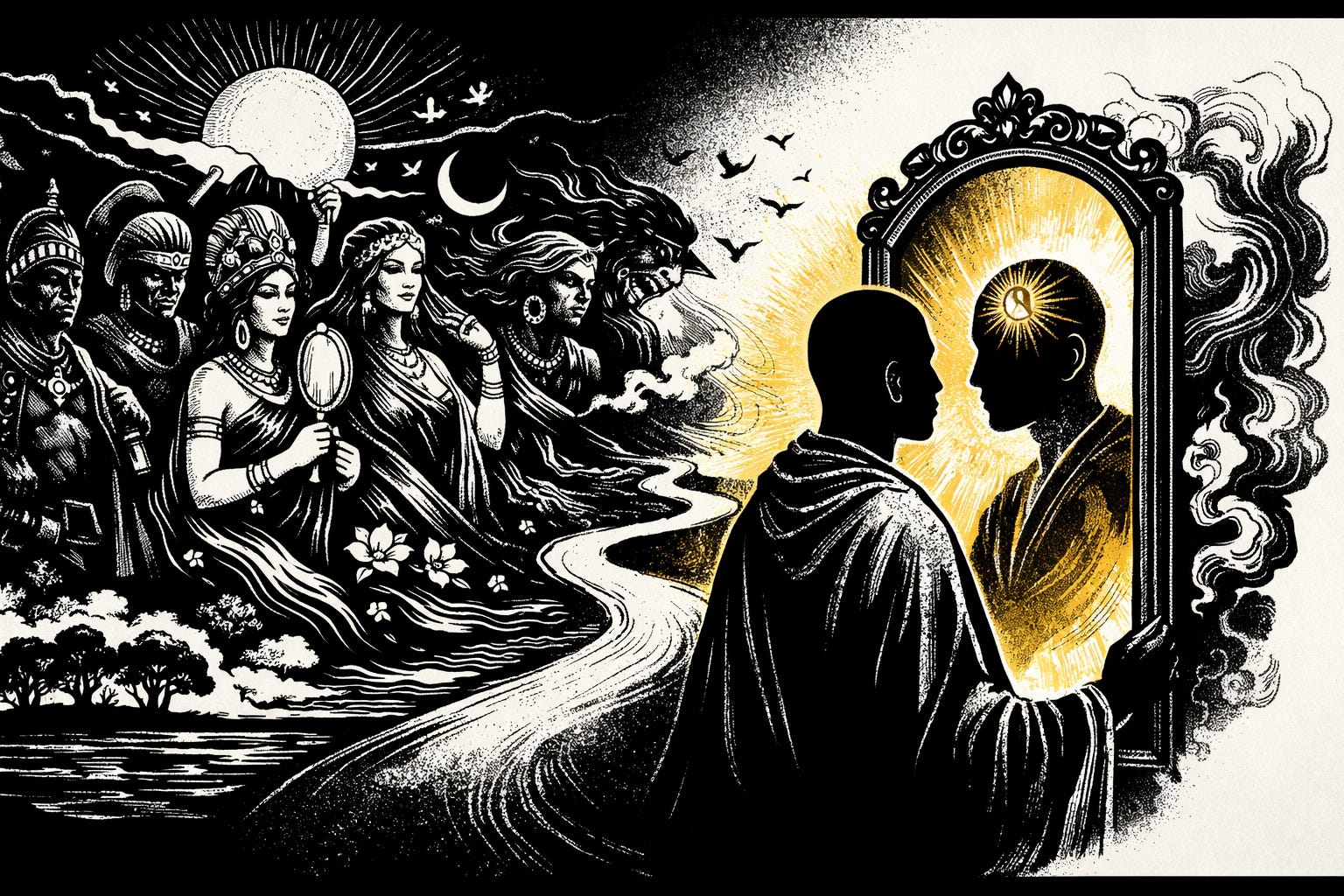
When Myth Becomes a Mirror
After sitting with these myths for years, another question began pressing itself forward: if the Òrìṣà are alive in story, ritual, nature, memory, and lineage, what do they reveal about the human soul?
Not the soul as decoration. Not the soul as vague inspiration. I mean the deeper interior life — the place where destiny wrestles with fear, where gifts stand beside wounds, where longing seeks form, where shadow hides inside charm, and where a person slowly learns the demanding work of becoming who they truly are.
This is the movement that gave birth to my new release,
The Orishas and the Human Soul: Myth, Archetype, and Spiritual Psychology in Ifá and Yorùbá Tradition.
The book follows the breath of myth inward. And for readers across languages, it is also available in Brazilian Portuguese and German.
If The Orisha Chronicles was the doorway of story, this new book is the deeper room of reflection. It asks what the Òrìṣà reveal about destiny, consciousness, moral struggle, healing, relationship, and the inner architecture of becoming. That movement is already built into the new manuscript itself: from myth to meaning, from image to interpretation, from sacred form to human resonance.
The Òrìṣà Are Not Personality Types
This must be said carefully.
To read the Òrìṣà archetypally is not to reduce them to psychology. They are not spiritual personality tests. They are not decorative symbols for the ego. They are not merely divine characters “out there,” but neither are they merely patterns “inside us.” They remain sacred presences, disclosed through myth, ritual, destiny, lineage, environment, and lived relationship. Archetypal reading can illuminate them, but it can never exhaust them.
That distinction matters deeply today, especially in an age that wants everything quickly translated into self-help language. The Òrìṣà do not ask to be simplified. They ask to be approached reverently enough that reflection becomes possible without mystery being destroyed.
In other words, the goal is not to explain the Òrìṣà away. The goal is to listen long enough that their stories begin to illuminate the patterns of human life with greater clarity.
Èṣù and the Crossroads Within
Take Èṣù.
We know Èṣù as keeper of the crossroads, opener of roads, messenger, trickster, provocateur, and guardian of consequence. But inwardly, Èṣù also reveals something about consciousness itself. He appears wherever a life reaches a threshold. He appears in the difficult place where speech can either heal or distort, where choice can either align us with destiny or bend us away from it.
The crossroads is not only a place on the road. It is also a condition of the soul.
We meet Èṣù whenever we are tempted to betray what we know, whenever we hide inside cleverness, whenever ambiguity tests our character, and whenever the next step requires truth instead of performance. In this way, myth becomes more than sacred memory. It becomes moral recognition.
Ògún and the Fire of Becoming
Then there is Ògún.
We know Ògún through iron, labor, warfare, cutting force, wilderness, invention, and the forge. Yet in human life, Ògún also reveals the painful necessity of shaping. Some things in us do not become useful until they have passed through fire. Some paths do not open until something false is cut away.
Ògún appears when a person must become more exact. He appears in discipline, in courage, in the willingness to stop living vaguely. He belongs to those moments when a life must be cleared of dead obligation, confusion, passivity, or self-deception. Yet even here the teaching is double-edged. Force can build, but it can also wound. The same iron that opens a road can harm the one who carries it without wisdom. Myth reveals not only power, but the moral responsibility of power.
Ọ̀ṣun and the Wound Around Beauty
Ọ̀ṣun is one of the most misunderstood Òrìṣà precisely because people stop too soon at sweetness.
Yes, she is beauty, adornment, pleasure, charm, elegance, fertility, diplomacy, and the river’s luminous grace. But she also reveals one of the soul’s most intimate wounds: the pain of being undervalued, mishandled, unseen, or reduced to surface while one’s wisdom is ignored.
Inwardly, Ọ̀ṣun teaches that tenderness is not weakness. Beauty is not trivial. Sweetness is not the opposite of power. She belongs wherever a person must recover dignity after humiliation, grace after betrayal, or self-worth after being treated as ornamental rather than sacred. Like the river, she teaches us how to continue flowing even after injury.
Yemọja, Ọya, and the Depths of Transformation
Yemọja reveals another interior truth: the soul’s capacity to hold what consciousness cannot yet name. She is the vastness of maternal shelter, ancestral memory, emotional depth, and the grief that exceeds ordinary speech. She reminds us that some burdens are carried in silence long before they are understood in language. Myth here is not fantasy. It is a map of emotional reality.
And then comes Ọya, who refuses stagnation. Ọya does not ask whether we enjoy change. She asks whether the life we are living can still contain who we are becoming. She tears open what false peace has sealed shut. She belongs to the storms that arrive not to destroy meaning, but to expose where life has become too narrow, too obedient to fear, too confined by yesterday’s arrangement. Inwardly, she is the force of necessary upheaval.
Why Orí Stands at the Center
At the center of all of this stands Orí.
If there is one principle that gives coherence to the inward reading of the Òrìṣà, it is Orí — the inward crown, the bearer of destiny, the intimate ground of personhood. A person may admire many spiritual powers, feel drawn to many beautiful symbols, or move through many phases of seeking, and still remain far from themselves. Orí brings the question home.
It asks: what is your life truly trying to become? What are you still betraying? What have you mistaken for destiny simply because it was familiar? What kind of alignment has your soul been asking of you all along?
This is why Orí must remain central in any serious conversation about archetype, myth, and spiritual psychology in Ifá and Yorùbá tradition. The deepest human question is not simply which sacred energy fascinates us. It is whether we are living in right relationship with the life we were actually given to live.
Why This Matters for Modern Readers
The modern world is full of information, but starved for orientation.
Many people today are spiritually curious but symbolically undernourished. They have language for stress, trauma, and desire, but not always for destiny, sacred pattern, moral atmosphere, or the mysterious ways in which a life reveals itself over time. This is where the Òrìṣà still speak powerfully. Their myths do not merely entertain or inspire. They reveal structure. They stage tensions. They make visible the consequences of action, the demands of character, and the long work of becoming aligned with one’s deeper truth.
That is why this inquiry matters beyond religion in the narrow sense. It belongs not only to ritual specialists or scholars, but also to the serious person standing somewhere between worlds — the devotee seeking a deeper symbolic language, the spiritually hungry reader who first met the Òrìṣà through beauty or dream, and the reflective soul who senses that myth is not fantasy, but a form of truth.
A Gentle Introduction to My New Release
This is the space from which The Orishas and the Human Soul was written.
It is not a ritual manual, and it is not an attempt to collapse sacred tradition into modern categories. It is a bridge: between reverence and reflection, between myth and self-knowledge, between sacred presence and the inward labor of becoming. It asks what the Òrìṣà reveal about desire, vocation, suffering, beauty, transformation, grief, character, and destiny — while keeping reverence intact.
For those who have already walked with me through The Orisha Chronicles, this new release continues the journey in a more inward direction. It complements the earlier book naturally: the first invites the reader to meet the Òrìṣà through story, while this one explores what those same sacred presences disclose about the hidden architecture of the soul. And for readers in different linguistic homes, the book is also available in Brazilian Portuguese and German.
The Real Invitation
But even beyond the book itself, let this truth remain.
We do not only read the myths of the Òrìṣà. If we are attentive enough, the myths begin to read us.
They read our defenses. They read our hidden gifts. They read our fear, our longing, our vanity, our tenderness, our inherited grief, and our unfinished becoming.
They do not do this to shame us. They do it so that relationship can become more truthful.
The Òrìṣà are not asking us to collect sacred images or spiritual identities. They are asking whether our sweetness has dignity, whether our strength has discipline, whether our change has purpose, whether our devotion has depth, and whether our lives are aligned with the head we carry.
Story was the doorway. Soul is the deeper room.
And perhaps one of the most urgent tasks of our time is not only to remember the old stories, but to become the kind of people who can hear what those stories are asking of us now.
May your Orí remain clear enough to recognize what is yours. May your heart remain soft enough to receive what is holy. May your path remain honest enough to refuse what diminishes your becoming. And may the Òrìṣà continue to speak to you not only in ritual, but in the quiet, demanding, beautiful chambers of your own life.
Stay blessed, and may your inner crown walk in peace.
Babá Tilo de Àjàgùnnà
DAILY IFÁ
ASE000..another Tremendous Read. I shall purchase both books...as i write in Spoken Word..The Orishas are revealed and as I look into previous song writing and spoke Word i find them present...as my journey and path is enlighten in experiences in IFA..I realized My Orishas have always remain with my now and then..since my Aggrement with Oludumare..My Orishas have never abandoned me..EYE Am Tremendously thankful for Reads as the Daily IFA..My Baba 's Integrity in IFA and what we as an ILE experiencing in experience and practice..ritual..ceremony..as i stated before I In Joy sharing then having a discussion on the daily IFA...
ASE000 Baba Tilo
Love this