


Beloved readers,
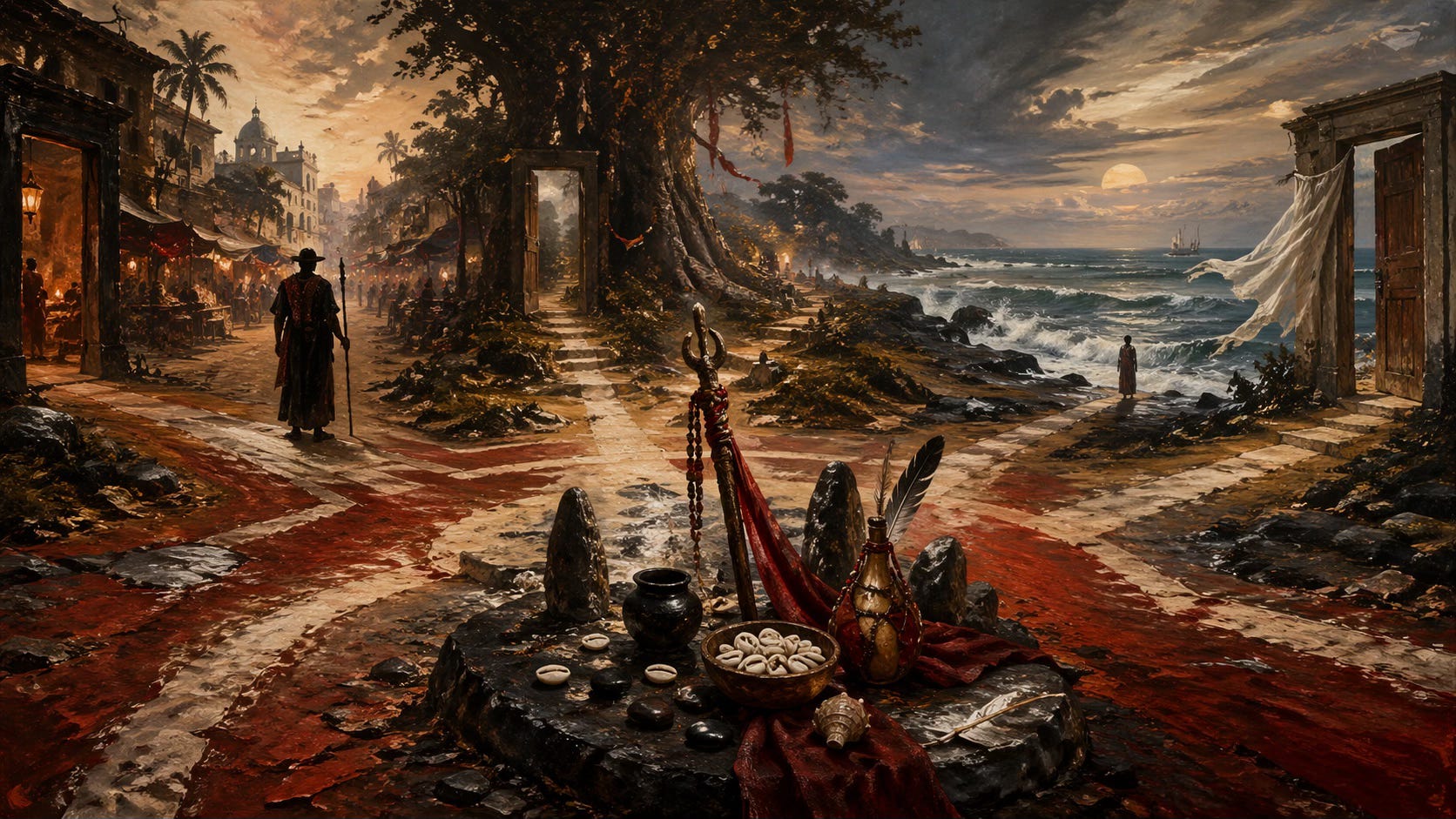
Before Eshu was feared, he was felt. He was felt in the tongue before speech, in the feet before the journey, in the body before the mind could explain what was happening. He was felt in desire, in restlessness, in appetite, in that strange moment when a closed life suddenly remembers it still has a door. And this is where I want to begin—not with accusation, but with intimacy, because too many conversations about Eshu start in public controversy when they should begin much closer to the skin.
Why Esu Bara Is the Right Place to Begin
For many of us, the most meaningful doorway into Eshu is not the public image at all, but Esu Bara. In several Brazilian understandings shaped by Yorùbá and Candomblé thought, Esu Bara is described as the individualized Eshu of each person, the “inhabitant of the body” and the “king of the body,” the force that gives movement, vitality, strength, and energetic coherence to the human being. Bara is the guardian of embodiment, the intimate intermediary between the person and their Òrìṣà, and because of that he is not merely some distant figure waiting at a mythic crossroads. He is already close. He is the motion within us, the quiet insistence that life must move, respond, desire, speak, and become.
That changes the whole conversation, because once Eshu is restored to the body, he becomes much harder to reduce to a caricature. He is no longer only the frightening figure onto whom inherited fear has been projected, but once again recognizable as a sacred principle of movement, exchange, appetite, vitality, reciprocity, and becoming. In that sense, Bara gives us a better beginning than scandal ever could. He reminds us that Eshu is not first an abstraction or a controversy; he is part of the grammar of lived existence itself. Some traditional descriptions even suggest that without Eshu’s presence, dynamism, and drive, existence itself would lose its force of motion.
There is a Yorùbá saying that feels especially right here:
Òwe l’ẹṣin ọ̀rọ̀; bí ọ̀rọ̀ bá sọnù, òwe ni a fi ń wá a.
Proverbs are the horses of speech; when speech is lost, we use proverbs to find it.
That line has been preserved in scholarship on Yorùbá proverbial knowledge, and it feels almost like an instruction for approaching Eshu at all. When language around a sacred name has been injured, flattened, or frightened, one does not repair it by shouting louder. One repairs it by speaking more carefully, by restoring nuance, and by allowing meaning to return the way water returns to a riverbed after drought. (journals.sagepub.com)
Eshu Is Not the Devil
This must still be said plainly, though it need not be said harshly: Eshu is not the devil. In many traditional understandings, Eshu is not the enemy of Olorun, not the antithesis of creation, and not a cosmic rebel who exists in order to destroy divine order. He appears instead as mediator between Ọ̀run and Ayé, between humans and Òrìṣà, and even among the divine powers themselves. He may provoke, unsettle, expose vanity, stir consequence, or force movement where stagnation has set in, but that is not the same thing as being the Christian adversary of God.
What makes this especially painful is that for many families across the African diaspora, the wound did not remain at the level of rumor. It entered the language itself. Scholarship on Yorùbá Bible history shows that in the legacy of Samuel Ajayi Crowther’s translation tradition, Èṣù was used as a rendering for Satan, and that decision became one of the major engines of later confusion. The issue is still visible in contemporary Yorùbá Bible usage: in the BibleGateway rendering of Matthew 4, verse 8 uses èṣù for the tempter, while verse 10 uses Satani in the same scene, making the instability of the language impossible to miss. (ajobit.brainfa.org)
I do not want to write this in a spirit of condemnation. Too many of our ancestors already lived under condemnation, and another sermon—only now in reverse—would heal very little. It seems truer, and more useful, to say something quieter: a sacred name was covered in someone else’s fear, and many of us are now learning how to uncover it without bitterness, without haste, and without forgetting what that covering cost.
What Eshu Actually Governs
If Eshu is not the devil, then who is he?
Traditional descriptions across the Yorùbá and Afro-Atlantic world answer that question with remarkable breadth. Eshu appears as messenger, mediator, keeper of roads, master of communication, guardian of thresholds, carrier of offerings, regulator of reciprocity, lord of movement, and force of consequence. He is associated with language, trade, sexuality, earth, fire, power, and change; he is linked with roads, markets, houses, and all those places where contact, negotiation, risk, and exchange become unavoidable. He is not simple, but sacred things rarely are, and perhaps one reason he continues to disturb people is that he resists all the moral simplifications by which human beings try to make themselves comfortable.
That resistance to simplification is part of his power. Some traditional explanations describe him as dual, ambiguous, capable of both generosity and disruption, quick to reciprocate gratitude and equally quick to expose neglect, vanity, or imbalance. He does not merely “cause chaos” in some cartoonish sense; more often, he reveals the chaos human beings had hidden inside polished surfaces and pious language.
Why the Meaning Changes Across Traditions
Because of time, region, migration, and lineage, the ideas and understandings surrounding Eshu vary—sometimes subtly, sometimes profoundly. They vary by house, by language, by nation, by ritual inheritance, and by the different forms of survival each community had to practice. So this essay can only be a small overview, not a final map, and it is better to say that clearly than to pretend one short article can settle a question that has crossed oceans and centuries.
Even so, the overview matters. In some Brazil-based lineages, Eshu is called Aluvaiá or Pambu Njila in Angola-oriented Candomblé and Legbá in Jeje Candomblé. In Cuban and Lucumí-related settings, we encounter Eleguá, Elegguá, and other closely related threshold and messenger functions. Atlantic scholarship broadly supports that we are looking at a family of sacred powers associated with roads, mediation, language, and thresholds, even though the ritual worlds they inhabit are not identical and should not be flattened into one interchangeable being. (cambridge.org)
That last point matters more than many people realize. Similarity is not sameness. Kinship is not identity. A name can travel faster than a theology, and a function can remain recognizable even while the being, the ritual obligations, and the cosmological framing around it shift from one tradition to another. To say “Eshu is not Eshu” is not to deny relationship; it is to protect complexity from being flattened into the kind of neat equation that usually serves outsiders more than practitioners.
Exu, Bara, Umbanda, and the Brazilian Knot
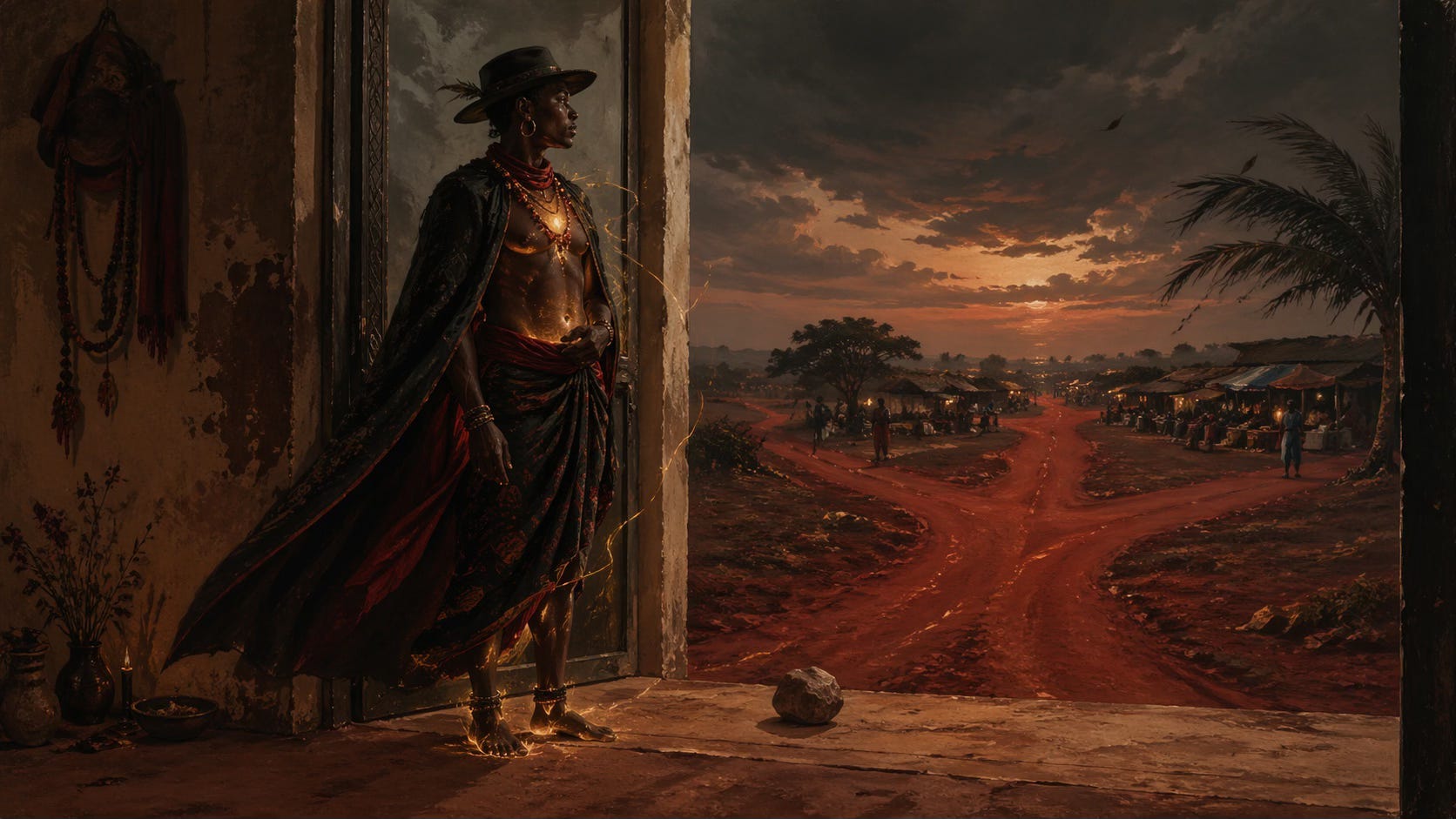
Brazil makes this especially clear, because there the same word may move through several religious worlds at once. Distinctions are often made between the Òrìṣà Eshu, the personal Bara of the individual, and the Exus and Pombagiras of Umbanda-related frameworks, and those distinctions matter. For many readers, the confusion begins exactly there, because the vocabulary overlaps while the spiritual levels, ritual contexts, and theological assumptions do not necessarily match.
This is why precision here is not coldness; it is reverence. In Brazil, one may hear Exu and think immediately of the Òrìṣà, yet in another house or context the same word may refer to spirit entities working within Umbanda or Quimbanda, and in yet another conversation Bará may point to the individualized, body-near companion of the devotee. These are not trivial differences, and they are not best handled by forcing them into sameness for the sake of convenience. They are better handled with respect for region, lineage, and religious language as it is actually lived.
Elegbara, Odara, and the Many Faces of Eshu
Confusion also multiplies because Eshu is not always addressed through the same face of his own nature. Traditional names and qualities include Elégbára as lord of power and change, Odára as a favorable and beautiful current, Larin-otá as lord of language, Akesan as linked to commerce and divination, and Ojixebó as the one who carries offerings and requests into the spiritual realm. These are not ornamental titles attached to a static figure; they show us that Eshu is encountered through different emphases, different roads, different moods of force, and different dimensions of sacred labor.
That is why reducing him to one modern label such as “trickster” never quite works. Yes, he provokes. Yes, he disrupts. Yes, he can deceive, unsettle, and expose. But he also translates, carries, guards, mediates, opens, disciplines, reconciles, and reveals. To call him only a trickster is like calling fire only dangerous or water only wet. The word captures a feature, but it does not come close to containing the force itself.
A Small Overview, Not a Final Word
If there is one thing I hope this essay leaves behind, it is gentleness with complexity. Not every crossroads power is the same. Not every Legba is simply “the same as Eshu.” Not every Exu in Brazil is the Òrìṣà Eshu. Not every inherited fear around his name came from malice; some came through translation, some through missionary pressure, some through survival, some through the practical need to hide, and some simply through the distance that time places between people and their older languages of devotion.
So let this remain what it is: a small beginning, a partial lantern, a careful doorway.
Perhaps Eshu was never asking to be defended as much as he was asking to be recognized—not as a devil, not as a caricature, and not as one fixed concept across every shore, but as a sacred force of language, embodiment, reciprocity, threshold, and consequence, one who has worn many names across time, region, and lineage and still knows how to knock from inside the body first.
In reverence,
Babá Tilo de Àjàgùnnà
DAILY IFÁ
May the road meet you with kindness.
Before the paywall, I want to tell my supporting members what waits on the other side of it. In the extended section below, I go deeper into why Esu Bara changes the conversation so radically, why the translation of Èṣù into Satan left such a lasting scar on family memory and religious language, and why the Brazilian tangle of Òrìṣà Eshu, personal Bara, Exus, and Pombagiras asks for far more careful language than it usually receives. If the first half of this piece opened the door, the second half steps into the room behind it.
For Supporting Members - The deeper waters beneath the name
Why Esu Bara Changes Everything
If the first part of this essay was a threshold, let this be the room behind it. I did not want the extended section to become a list of rituals or a catalogue of correspondences, because what seems more useful here is a deeper excavation of the misunderstanding itself. The real mystery is not simply that Eshu has many names, but that one of the oldest sacred powers in the Yorùbá world became, for so many descendants, a name spoken with hesitation, embarrassment, or fear.