


Dear Readers;
Some of the questions you ask me return in different forms, week after week:
What does my Odù mean for the life I am living?
How can I better understand my relationship with the Òrìṣà?
How do teachings inherited from another place and time speak to the decisions, relationships, and responsibilities before me today?
These questions deserve time. They also deserve an accessible place in which to study them.
I am therefore expanding DAILY IFÁ ACADEMY into a structured video teaching library, bringing together introductions to all 256 Odù Ifá and more than 50 Òrìṣà and related sacred figures.
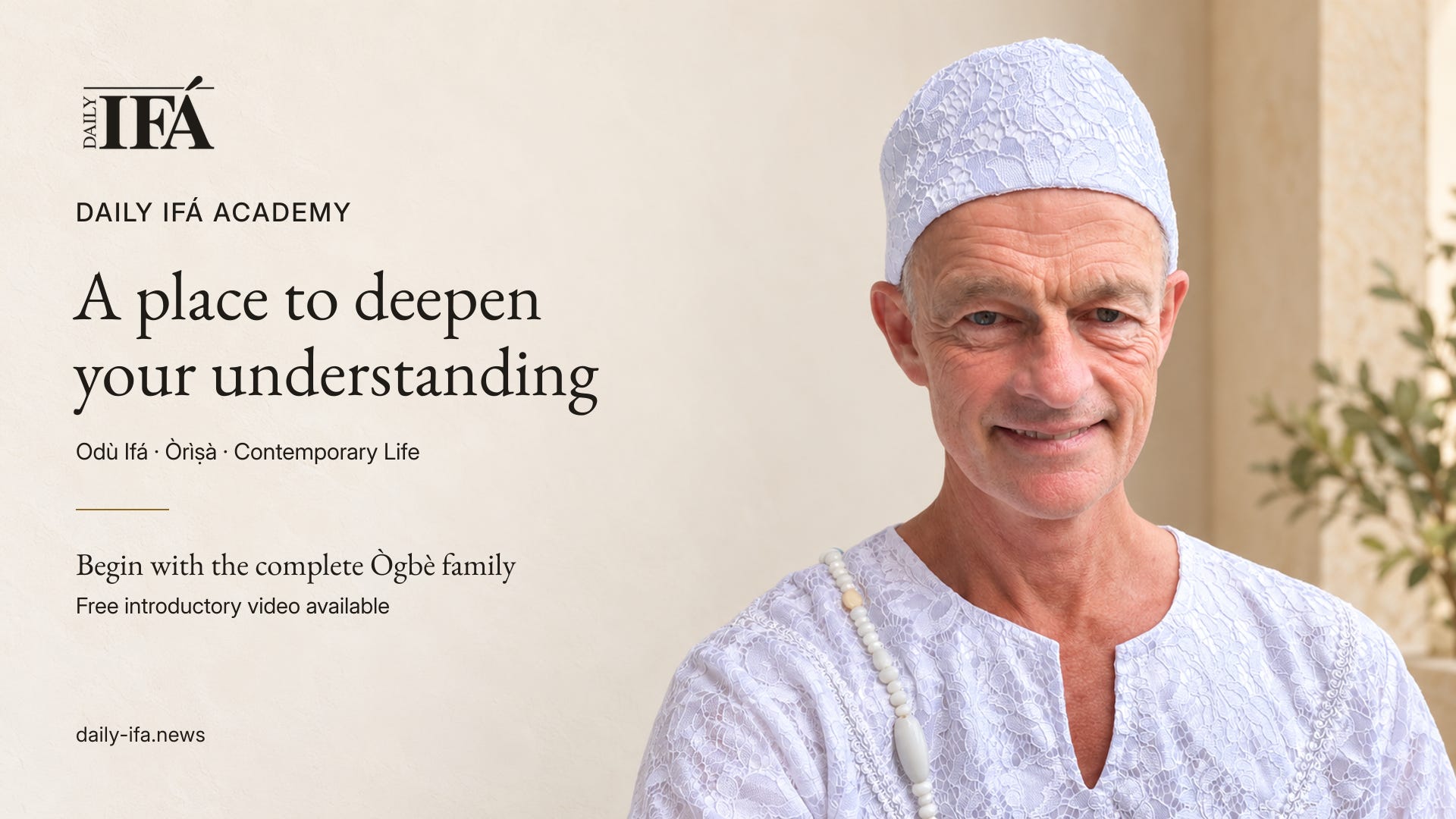
You can already begin. All 16 Odù of the Ògbè family have been completed and are available in the Academy. A free introductory video is also available to everyone, offering a starting point before you enter the individual teachings.
This is the next stage of work that has occupied much of my life for the past fifteen years. I would like to explain what I am building, how it relates to the books and newsletters you already know, and what I hope it will make possible for our community.
Begin with the Ògbè Family
The first complete part of the programme is ready: Ògbè Méjì and the fifteen combinations that belong to the Ògbè family.
These sixteen episodes allow you to explore how the teachings change as Ògbè enters into relationship with each of the other principal Odù. They also offer a manageable way to begin studying a body of knowledge that can otherwise feel overwhelming.
The introductory video is freely accessible. The individual Academy teachings form part of the offering for supporting subscribers.
You will find them in the ACADEMY section of daily-ifa.news. If you are new to this work, I recommend beginning with the introduction and then exploring the Ògbè episodes at your own pace.
You do not need to understand the entire system before beginning. What matters is giving an individual teaching enough attention to recognize its questions, follow its stories, and consider its relevance to your own circumstances.
Why Odù and Òrìṣà Matter to Our Lives
Many readers approach these traditions through a personal relationship with particular Òrìṣà or through an Odù revealed in initiation or consultation. The significance of these relationships, and how they are established, differs among lineages.
For me, these questions meet in our relationship with Orí, the inner head associated with personal destiny and the direction of a life.
Odù offer narratives through which we can examine possibilities, recurring difficulties, responsibilities, and the consequences of conduct. The Òrìṣà open further dimensions of understanding through their histories, relationships, qualities, and fields of action.
Neither should become a label that contains the whole person.
An Odù deserves more attention than a prediction of what must happen. A relationship with an Òrìṣà deserves more depth than a personality description. Both ask us to consider how we live, what we cultivate, and how we respond to the circumstances before us.
That is the approach I want the Academy to make accessible.
A Place to Learn, Wherever You Are Starting
Some of you belong to established houses and have elders with whom you can study. Others live far from such communities or are still finding a trustworthy place within them. Some are already initiated practitioners who want to broaden their resources. Others are encountering Ifá and Òrìṣà traditions for the first time.
You arrive with different experiences, but often with the same desire: to understand more clearly.
As a Babaláwo and Babalórìṣà, I see the transmission of knowledge as an important part of my responsibility. Oral teaching, apprenticeship, and the relationships through which ritual knowledge is entrusted remain essential to our traditions. A digital library has a different purpose: it can provide context, introduce sources, and help people ask better questions.
For readers who already have a house, I hope these teachings will enrich the conversations you have there. For those without that access, I hope they will offer a thoughtful foundation for further study.
The Academy is an educational resource. Its value lies in making serious learning more accessible while respecting the forms of knowledge that depend on direct transmission.
Fifteen Years Behind the Teaching
Over the past fifteen years, I have devoted considerable time and personal resources to gathering written material on Odù Ifá, Òrìṣà, and related African and Afro-diasporic traditions.
I have searched university collections, libraries, antiquarian catalogues, and private sources. I have bought books, borrowed material, and obtained copies of works that are difficult to find. Some discoveries were immediately useful; others took years of further reading before I could understand their terminology or context.
My working archive now contains more than 30,000 mythological narratives and variants, alongside extensive collections of teachings, ritual references, prohibitions, interpretations, and other material.
The collection brings together sources in several languages, including English, French, German, Portuguese, and Spanish, as well as Yorùbá terminology and material from Fon/Ewe and Bantu cultural contexts. Cuban and Brazilian sources introduce further layers of language, transmission, and interpretation.
These differences matter. Similar names do not always indicate identical understandings. A practice described in one tradition cannot automatically be transferred into another.
Much of the work therefore consists of establishing context: identifying which source is speaking, what its terms mean, and where versions agree or diverge. Old scans, incomplete translations, inconsistent spellings, and specialized ritual vocabulary make that process demanding.
Historical material also requires judgment. Age alone does not guarantee accuracy. A source may preserve valuable testimony while carrying misunderstandings, omissions, or the assumptions of its author.
The task is to make this material more readable while preserving the distinctions that give it meaning.
Bringing Inherited Wisdom into Contemporary Life
The questions guiding this work are often very practical.
How should a person living in a European city understand a myth shaped by agricultural life in West Africa? What changes when a teaching travels from Africa to Brazil or Cuba? How do we distinguish an enduring ethical insight from a recommendation tied to a particular historical situation?
A prohibition may require knowledge of its ritual setting. A myth may contain several levels of meaning. An apparent contradiction may reveal that two sources are speaking from different lineages.
These are precisely the places where teaching becomes necessary.
My interest also extends to how these narratives can deepen self-understanding and spiritual care: how they help us examine grief, ambition, conflict, belonging, or the difficulty of making a decision.
The Academy will approach such questions through the sources and through my own perspective as a contemporary practitioner. Where I offer an interpretation, I want readers to understand it as an interpretation and to have enough context to think alongside me.
What You Will Find in the Videos
Each episode is designed to take approximately fifteen to twenty minutes. It introduces an Odù or an Òrìṣà through selected stories and explores what those teachings may mean within a human life.
A myth may become the starting point for discussing character, partnership, authority, patience, prosperity, or the responsibilities attached to a particular gift.
The emphasis is on understanding relationships and consequences. Rather than presenting a long sequence of disconnected prescriptions, I want to explain why a teaching matters and what questions it asks of us.
The Òrìṣà episodes follow the same principle. They explore mythology, history, spiritual meaning, and contemporary relevance, with attention to differences among regions and traditions. Where the programme includes related sacred figures, their place will be identified clearly.
My aim is for each episode to leave you with a stronger sense of the subject and a useful basis for further reflection.
How the Videos and Books Work Together
A short teaching video cannot contain the material of a detailed volume running to several hundred pages.
The books provide the wider record: more narratives, more source material, and the depth needed for extended study. The videos offer an accessible point of entry, helping you identify central questions before moving into greater detail.
The newsletters retain another important role. They are where I can take a contemporary subject—doubt, identity, family life, leadership, or another question you bring—and explore it through Ifá.
These formats will therefore continue alongside one another. You may watch an episode to become familiar with an Odù, read a newsletter to explore one of its implications, and turn to a book when you want to study the material more extensively.
The book project continues, with English and Brazilian Portuguese editions remaining central to my plans.
Why I Am Building This Here
The research and production process has reached a point where I can prepare material more efficiently than before. Publication and distribution, however, introduce constraints of their own.
Amazon KDP currently allows up to two new title creations and two new title submissions per book format each week. Those limits apply separately to eBooks, paperbacks, and hardcovers. For a project comprising 256 Odù in two languages, the scale is substantial: 512 language editions within a single format would occupy roughly five years of release slots at two per week.
That calculation illustrates why a publication schedule can become much longer than the preparation of the material itself. Other books, interruptions, and the practical work of publishing also need to be accommodated.
Visibility creates another difficulty. In my experience, reaching readers interested in these traditions requires sustained effort, including paid advertising. Broad categories and search results often struggle to convey the distinctions that matter within our field.
I find this frustrating, especially when the material is ready and readers are asking for access. I have raised these difficulties with the relevant platforms, but I also need a way to continue the work under the conditions that exist.
As a child of Àjàgùnnà, I am inclined to look for a way forward.
Making daily-ifa.news the main home for this teaching programme gives me a more direct relationship with you. Substack requires some compromises, but it allows us to build an organized body of teaching around the community already gathered here.
What Comes Next
The Ògbè family is available now. The programme will expand through the remaining Odù families and the Òrìṣà teachings.
My working goal is to make the complete introductory video library available by the end of 2026. That is an ambitious target, and I will announce new material as it becomes available.
As the collection grows, I intend to improve its navigation, with clearer routes into the Odù and Òrìṣà material. Finding the teaching you need should become easier as the library develops.
I am also exploring further ways to make the books available digitally, including the possibility of reading editions linked beneath the relevant videos. These formats still need testing, with attention to readability, reliable access, and the protection of the work.
For now, the immediate invitation is simple: begin with what is already there.
How I Use AI in This Work
I want to be transparent about the tools involved.
The teaching rests on the historical authors and documented collections I have gathered, principally from the nineteenth and twentieth centuries. I do not build its source base from internet summaries or treat AI-generated statements as evidence about the tradition.
AI assists with parts of the editorial and production process, including translation, language revision, work on imperfect source texts, and audiovisual preparation. It can be especially useful when material exists across several languages or survives in difficult scans.
It also makes mistakes. Specialized terminology, names, and ritual language require particular attention.
I determine the focus of the teaching, select the narratives, and take responsibility for the interpretation and editorial decisions. The tools help me carry out the work; the responsibility remains mine.
The videos use synthetic narration to offer clear, consistent English. For a readership spread across more than thirty countries, I hope this makes listening easier and supports the use of transcription and translation tools. Digital tools also assist with aspects of the imagery and music.
For personal reflections and possible live conversations, I intend to use my own voice. I would like to explore occasional sessions in which you can hear more directly how I approach a question or interpret a teaching. I do not yet have dates to announce.
I also want to preserve enough time and quiet for the study on which this work depends. The project needs a thoughtful rhythm if it is to remain useful.
What Your Supporting Subscription Makes Possible
Much of DAILY IFÁ will remain freely accessible, including the introductory Academy video. The more extensive teaching library forms part of the offering for supporting subscribers.
I am fortunate to be financially independent and able to devote substantial personal resources to this work. I do not depend on the project for my livelihood.
Nevertheless, acquiring sources, preparing texts, producing videos, maintaining the tools, protecting the work, and helping readers find it all involve costs. Supporting subscriptions contribute toward those expenses and make it easier to continue developing the library.
Your participation also helps me understand which subjects deserve further attention. Reading figures and viewing patterns provide some guidance, while your thoughtful questions often reveal needs that numbers cannot show.
I value both forms of feedback. They help me decide where the next investment of time will be most useful.
A Note About the Reader Tools
Some of you also use the supporting AI guides, including Voice of Orisha and Wisdom of Ifá.
Those tools require maintenance as their underlying platform changes. I am reviewing how best to migrate or rebuild them so that they can continue to serve readers. During that process, access may temporarily change or be interrupted.
I will share clearer instructions and updated access information as the arrangements are confirmed. Thank you for your patience with this less visible part of the project.
How We Can Help This Work Reach Others
Your questions, suggestions, and corrections remain valuable to me. I cannot implement every idea, but I read them as part of an ongoing conversation about what this community needs.
If you find the teaching worthwhile, telling an interested friend is another meaningful form of support. Many people are looking for serious, accessible material on these traditions without knowing where to begin.
A personal recommendation can help someone find the free introduction, explore the newsletter, and decide whether further study is right for them.
That is how I hope the Academy will grow: through useful teaching, careful attention, and relationships built over time.
An Invitation to Begin
Fifteen years of gathering material have convinced me that access is only the beginning. A reader also needs orientation: enough language, context, and explanation to understand what is before them.
This is what I want DAILY IFÁ ACADEMY to provide.
The books will continue to deepen the record. The newsletters will continue to explore the questions of contemporary life. The videos will offer a structured way into the teachings, one Odù and one Òrìṣà at a time.
You can take the first step today.
Visit DAILY IFÁ ACADEMY, watch the free introduction, and explore the complete sixteen-part Ògbè family.
May your Orí guide your learning, and may what you discover deepen your understanding of the life you are here to live.
Baba Tilo de Àjàgùnnà
DAILY IFÁ