


Dear readers,
A foot begins to move under the table. Nothing has been decided. A shoulder follows, almost reluctantly, and a moment later we discover that we have been listening with more than our ears.
Music can reach us before we have prepared an explanation for it. For people whose days are filled with words, that can be a welcome interruption. We spend so much time describing what we feel, defending what we think, and arranging what comes next. A rhythm asks for another kind of participation: enough attention to find our place within something already moving.
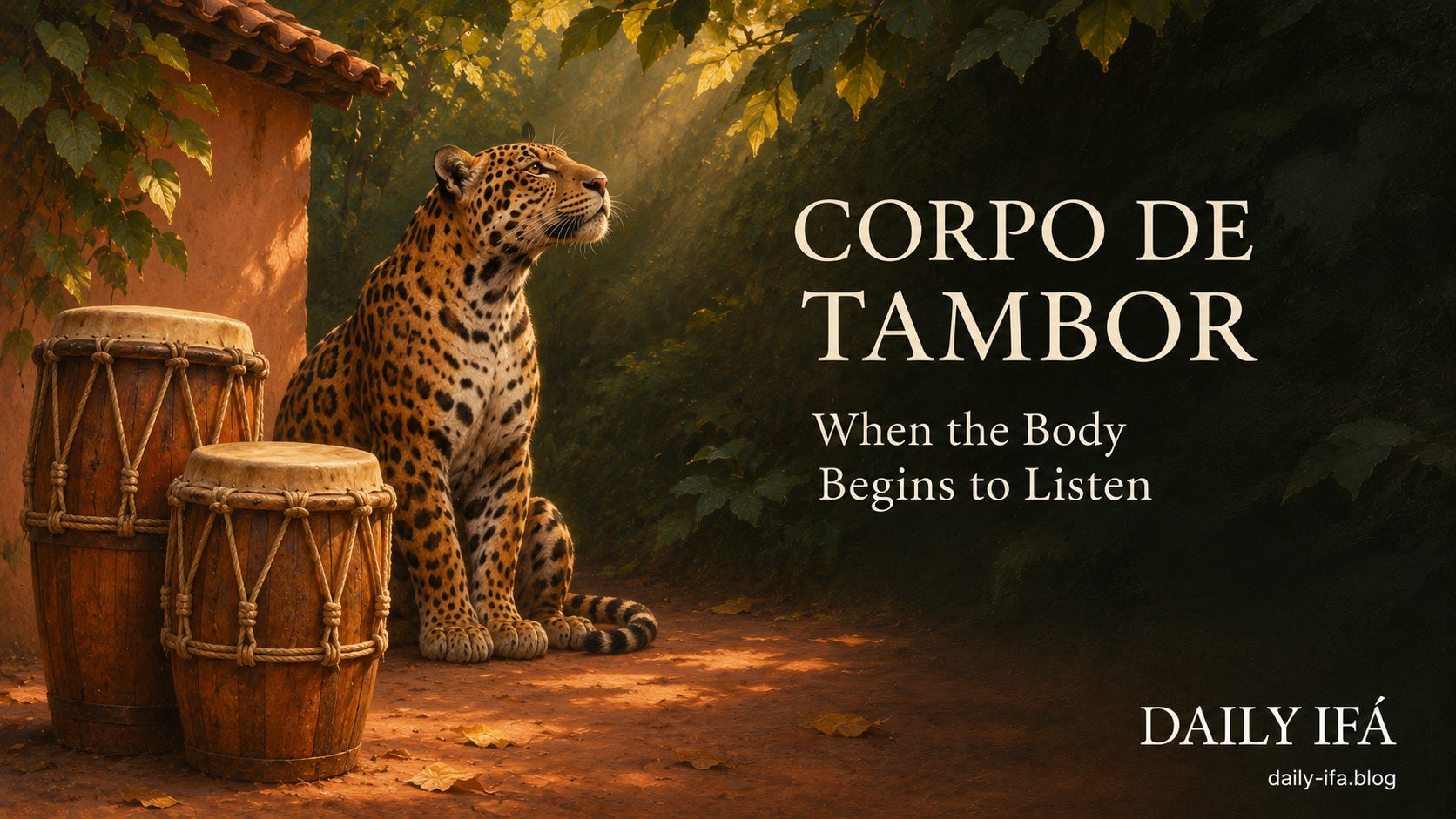
That is the invitation I want to make with CORPO DE TAMBOR — Ritmos Afro-Brasileiros: a collection of 27 contemporary tracks, with Yorùbá vocals and a visual journey that gives each piece room to breathe. Within this artistic project, each rhythm has been associated with an Òrìṣà. These relationships offer a way into listening, reflection, and personal devotion.
A first encounter with CORPO DE TAMBOR
Take 75 seconds to enter the music and images. Then join me in exploring the histories and spiritual relationships behind this collection.
A history carried by people
The expression “African rhythm” can sound as though an entire continent had one musical voice. Brazil helps us hear how inadequate that idea is.
Enslaved Africans brought different languages, religious knowledge, musical practices, and memories across the Atlantic under conditions of extreme violence. Their descendants preserved and transformed those inheritances in Brazil. The history includes Yorùbá-speaking and Gbe-speaking West African peoples, as well as the many Bantu-speaking societies of West Central Africa. It also includes encounters with Indigenous peoples and European cultural forms, shaped by relationships that were rarely equal.
Those histories remain audible in distinct settings. Ijexá connects Candomblé, afoxé processions, and popular music. Jongo belongs to particular Black communities in southeastern Brazil and has deep Bantu connections. Tambor de Crioula carries the communal life of Maranhão. Samba de roda developed in Bahia’s Recôncavo through music, poetry, and movement shared in a circle.
These names do more than identify a beat. They lead toward people who teach, remember, organize, and keep making music together. Enjoyment can be the beginning of learning their names and histories.
I have prepared a separate guide to the origins and meanings of Afro-Brazilian rhythms for readers who would like to follow those connections more closely.
Repetition that makes room
There is a kind of repetition that exhausts us: the unresolved argument, the thought returning at three in the morning, the habit we recognize a second too late. Many people arrive at spiritual practice hoping to escape repetition altogether.
A musical cycle suggests another possibility. Return can create a place in which something changes. Once the ear recognizes a pattern, attention has room to notice the voice entering, the accent shifting, the space left by a pause. The repetition supports discovery.
For me, this offers a useful way to think about spiritual attention. We often expect an important encounter to announce itself dramatically. We may overlook the quieter work of becoming available: returning, hearing more carefully, allowing what we already know to acquire another depth.
Consider listening to the same piece twice. During the first hearing, you may follow the strongest pulse. During the second, a quieter part becomes clear. The recording has remained the same; your participation has changed. That small experience can make the work of attention surprisingly tangible.
The study of Àyàngalú, the sacred and ancestral field of Yorùbá drumming, explores how musical knowledge grows through language, disciplined practice, and relationships with teachers. It reminds us that being moved by a sound and understanding everything it carries are different stages of an encounter. Both can matter. One can lead toward the other.
The Òrìṣà as an address
An association with an Òrìṣà gives listening a direction. A song can become something addressed: praise, gratitude, remembrance, a wish to draw nearer. It can also open a symbolic question that accompanies us after the sound ends.
In this collection, those associations are artistic choices. Some resonate with well-known traditional relationships; others belong to the composition’s particular arrangement and intention. They are not a universal chart assigning every Brazilian rhythm to one deity. Actual repertoires belong to houses, nations, occasions, and the people who carry them.
The distinction allows the work to be enjoyed honestly. CORPO DE TAMBOR is a contemporary creation made with AI-assisted visuals and vocals under my creative direction. Its songs use Yorùbá texts; it is not a field recording of a terreiro ceremony or a complete lesson in its musical practice.
For someone who already has a devotional relationship with an Òrìṣà, a track may become a welcome accompaniment to quiet attention. For another listener, it may begin with a question: who is being addressed, and what would it mean to learn more? Neither person needs to manufacture a revelation to make the encounter worthwhile.
I also want to leave room for the person who simply enjoys the music. Curiosity does not need to arrive wearing religious certainty. An honest first encounter can begin with pleasure, then grow into respect and study.
A body that does not have to perform
Much of contemporary life trains us to watch ourselves from the outside. We imagine how we appear while speaking, working, resting, even while trying to be spontaneous. The body becomes something to manage and evaluate.
Listening offers a modest alternative. You can notice a movement without judging whether it looks convincing. You can remain seated. You can close your eyes if that feels comfortable, or watch the visual world of the films. No one needs to perform a spiritual identity for an audience.
This is where I find the project’s recurring image especially meaningful: the jaguar, the onça. A onça escuta. The jaguar listens.
Its size and presence suggest strength, but the invitation is to attention. The image belongs to the artistic language of these films; I am not presenting it as a universal traditional symbol for the Òrìṣà. What interests me is the meeting of force and receptivity. We can be fully present without immediately taking charge of what we encounter.
That thought reaches beyond music. How often do we enter a conversation already preparing our answer? How much of another person’s reality becomes audible when we allow the first response to wait? A track cannot resolve those questions for us. It can give them a few uninterrupted minutes.
Can this be a form of meditation?
Yes, if meditation here means making time for attentive listening, reflection, or devotion. You might choose one track, sit comfortably, and let your attention return to the music when it wanders. Someone else may prefer gentle movement or a quiet walk. There is no need to turn an invitation into a prescribed ritual.
I would begin with one piece rather than a demand to complete the collection. Listen once without asking it to produce anything. Then notice what remained: a sense of steadiness, an impatience, a line of melody, a wish to learn who is being praised. On another day, the same piece may meet you differently.
If you already practice within a house or lineage, its guidance remains the context for your religious life. A recording does not establish an initiation, identify your personal Òrìṣà, or guarantee trance or healing. There is also no obligation to experience unusual sensations. A few minutes of sincere attention are sufficient in themselves.
For me, the more interesting question comes afterward: has listening made me a little more able to meet the life waiting outside it? More attentive to another person, less hurried in a decision, more willing to remain with a feeling before naming it? Those are possibilities for reflection, not promises made by an album.
Finding your way through the collection
The trailer gives a first impression of the music and images. The track playlist lets you return to individual pieces, including Ijexá, Congo de Ouro, Jongo Caxambu, Alujá, Opanijé, and Igbin. The full album film offers the uninterrupted journey, with chapters for finding a particular track again.
The collection has also been submitted for distribution to Spotify and other streaming services. Those releases are awaiting confirmation, so YouTube is the available listening destination for now. Look for Corpo de Tambor — Ritmos Afro-Brasileiros under Tilo Plöger de Àjàgùnnà as the services make it available.
I hope the music will encourage a second movement as well: from the recording toward the traditions that inspired it. Read about the rhythm that stays with you. Listen to the communities and musicians who carry its history. Let a contemporary work open a door to a larger world.
There is something generous about a rhythm we can return to. It continues without demanding that we have finished understanding it. We can arrive with our attention divided and gradually hear how the parts belong together.
Perhaps that is a good place to begin today: with enough time for one piece, and enough curiosity to let it remain more than a pleasant background.
May your listening bring care to what you meet.
Babá Tilo de Àjàgùnnà
DAILY IFÁ
Que lindo! Como posso ter acesso à agenda de seus trabalhos da Alemanha ou, se possível, na França? Boa viagem!!!
Olá,Tilo,
Muito grata pela sua devoção, dedicação e competência! 👏🏾👏🏾👏🏾