


Dear friends,
Imagine a person sitting at a kitchen table after everyone else has gone to bed. There are several tabs open on the screen. One explains an attachment pattern. Another offers a spiritual interpretation of a difficult relationship. A third promises to identify the one thing that has been missing all along.
The person is intelligent. Much of what they are reading is useful. Yet each answer produces another search. By midnight, they know more and feel no closer to speaking honestly to the person sleeping in the next room.
There is a kind of knowledge we seek because we want to encounter life more fully. There is also a kind we seek because we hope it will protect us from having to encounter life at all.
The difference interests me deeply. It is one reason I want to bring a less familiar sacred presence into our conversation: Agué, approached here in the Jeje tradition of forest and leaves.
Readers who know the Yorùbá Òrìṣà Òsanyìn will recognize a neighboring field of meaning. The relationship deserves care. Agué is a vodun in the Jeje setting discussed here, with a history and religious context of his own. Similar associations with plants do not make two sacred beings interchangeable. Nor is this Agué simply the Haitian sea lwa Agwe. Our reference study on Agué keeps these distinctions visible.
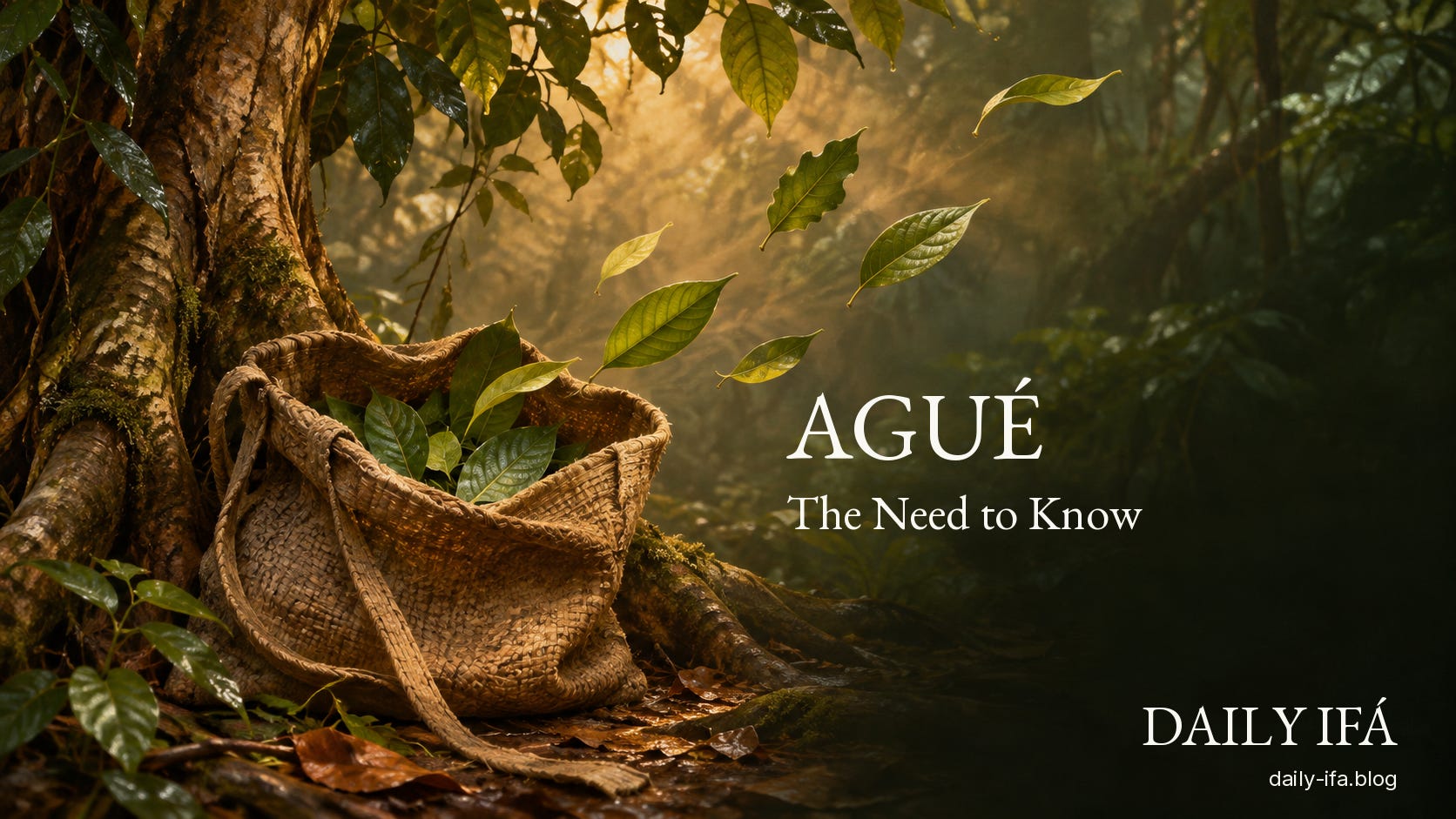
For this letter, I want to remain with a bag of leaves—and with what happens when its contents become available to everyone.
The leaves leave the bag
In a Jeje account told by Everaldo Duarte and recorded by Maria Alice Pereira da Silva in her research on Pedra de Xangô, Mawu entrusts the sacred leaves to Agué. The other voduns have none. Their dissatisfaction reaches Sogbo, who devises a way to redistribute the leaves without openly overturning Mawu’s decision.
Agué sleeps after lunch, his bag open. Yansã (Oyá) raises a powerful wind. The leaves scatter, and the other voduns gather them. Possession has changed. Yet the secrets remain with Agué.
This is a particular telling, with a named narrator, recorded in a particular Brazilian context. Its quiet surprise is enough for me: the leaves can travel without taking all their knowledge with them.
At first the story seems to concern a monopoly. Then it opens a more difficult question. What exactly have the others acquired?
They can hold the leaves. They can see their shapes and carry them away. The visible object is now theirs. Something essential, however, has resisted the transfer.
I read that gap as a challenge to one of our most persistent wishes: that having access to the right thing will spare us the slow work of becoming capable of using it.
When knowledge promises protection
The wish is understandable. An uncertain world can make information feel like shelter. If I understand every possible response, perhaps I will never be surprised. If I learn the correct spiritual vocabulary, perhaps I will never feel lost. If I can explain my grief elegantly, perhaps I will not have to experience its disorder.
In psychoanalytic language, intellectualization offers a useful lens here: thought can become a way of keeping painful feeling at a manageable distance. I use the term as an interpretive possibility, not a diagnosis of every devoted reader or serious student. Thinking is also a pleasure, a discipline, and an expression of love.
The question is what our thinking allows us to do next.
At the kitchen table, another explanation may help a person recognize something important. It may also postpone a sentence they already know they need to say: I am lonely beside you. I was hurt. I am afraid you will refuse me.
Those sentences are exposed. They cannot control the answer. A theory can be revised privately; a request introduces another person’s freedom into the room.
For me, the forest around Agué helps us notice this difference. A living place keeps answering in ways we did not arrange. It has seasons, dependencies, and inhabitants whose purposes exceed our own. To learn there requires adjustment. The learner must become available to something that will not obey merely because it has been named.
Understanding begins to deepen when it can change our conduct. Otherwise, the leaves accumulate while the relationship remains untouched.
The hurt beneath envy
The other voduns’ dissatisfaction matters, too. I do not want to dismiss it with a moral instruction to stop being envious. Unequal access can be real. A community may reasonably ask who receives knowledge, who carries its burdens, and who is kept outside.
Alongside that ethical question sits a more intimate one. Someone else knows something I need. For a moment, they possess a capacity I cannot produce by wishing. I must ask, wait, or learn.
That can be painful when our self-respect depends on being the person who already knows.
Envy then does more than desire the other person’s skill. It may try to diminish the value of that skill. The teacher is overrated. The process is unnecessary. The tradition is only hiding a simple trick. If the other person’s knowledge becomes worthless, my dependence on it becomes less humiliating.
Sometimes criticism is justified. Authorities do exaggerate their importance, and institutions can use complexity to protect privilege. The work is to distinguish an accurate criticism from the relief we feel when we no longer have to admit that someone can teach us.
Agué’s scattered leaves give that distinction a material form. Taking possession does not automatically resolve the painful feeling of needing another person. The object is in my hand; the relationship I wanted to escape is still there.
I find a certain mercy in this. Dependence need not mean inferiority. It can be a temporary, specific fact: in this matter, at this point in my life, someone else can help me become more capable.
There is dignity in naming that fact accurately. A student does not become smaller by learning. A teacher does not become less valuable when a student eventually stands more independently.
The forest is allowed to remain outside us
We often speak of archetypes as though every sacred figure were waiting to become an explanation of our personalities. Agué can become “the herbalist,” “the wise recluse,” or “the person who knows.” Such descriptions may offer an entry point. They can also become another act of collecting.
I prefer to ask what kind of relationship a figure brings into view.
Here, the relationship is with a world that has knowledge we do not yet possess, and with people who have learned to attend to it. Its psychological force lies partly in frustrating the fantasy of complete self-sufficiency.
That does not mean the forest is merely our unconscious in green clothing. Its soil, trees, communities, and histories have lives beyond the metaphor. A spiritual reading becomes poorer if everything outside us must disappear into an account of what is happening inside us.
We can let the forest illuminate the psyche while allowing the forest to remain real.
The same courtesy changes human relationships. Imagine a parent who knows a grown child’s preferences, educational history, and likely objections, yet cannot hear that the child wants a different life. The parent has assembled an extensive account of the child. But the account has become so complete that the living person has difficulty entering it.
Or imagine a partner who can explain every disagreement through the other person’s childhood. The explanation may contain truth. It may also prevent a much simpler admission: I did something that hurt you today.
In both cases, knowledge risks becoming a claim of ownership. I know you, therefore I can decide what your words really mean.
The relational alternative begins when our understanding leaves room for correction. Another person may have something to tell us that our existing account cannot contain. Listening then carries a cost: we may have to become less certain before we can become more truthful.
A teacher must also be able to let go
As a Babá, I cannot place all the difficulty on the learner. The story also puts pressure on the person who holds knowledge.
There are sound reasons for boundaries. Some teaching requires preparation, a relationship, responsibilities, or an initiatory context. Public availability does not make every practice safe or every interpretation competent.
But a boundary can serve different purposes. It can protect the integrity of a teaching. It can also protect the teacher from the anxiety of becoming less indispensable.
The distinction may be difficult to see from outside. It becomes clearer in the direction a relationship takes. Does learning gradually increase the student’s capacity to understand and act responsibly? Can a reasonable question receive a reasonable answer? Can the teacher acknowledge a limit without treating the questioner as disloyal?
A person can honor tradition and still ask these questions. Indeed, responsible transmission requires them.
I would not turn Agué’s continuing knowledge into a license for permanent dependency. The myth does not provide a modern training policy. My concern is with the uses we make of it. If we invoke sacred secrecy whenever our own authority feels uncomfortable, we have stopped listening to the story and begun recruiting it.
The mature teacher must tolerate another version of the same lesson: what I know has value even when it no longer makes me the center of every room.
A different ending to the evening
Return to the kitchen table. The person closes one of the tabs. Nothing dramatic happens. They do not reject psychology, stop reading, or decide that knowledge is the enemy.
They recognize that tonight’s next step cannot be downloaded.
Perhaps they write down what they want to say in the morning. Perhaps they discover that their anger is concealing a request. Perhaps they decide to seek help because they cannot yet have the conversation without turning it into a contest.
There is still work to do. But knowledge has begun to serve contact.
This is the possibility I find in Agué: a form of intelligence that can live without possessing everything it touches. It can study patiently, ask precisely, and remain open to correction. It can accept that another person, a tradition, or a forest has something to offer that will not arrive on command.
We need enough confidence to learn, and enough humility to let learning matter.
If there is a question to carry from this letter, mine is this: What am I trying to know so completely that I will never have to feel dependent, surprised, or changed?
The answer may tell us why the bag has become so heavy.
May the leaves remind us to approach living knowledge with care.
Àṣẹ,
Babá Tilo de Àjàgùnnà
DAILY IFÁ
If this letter reached you through a friend, subscribe to DAILY IFÁ for weekly reflections on Ifá, the Òrìṣà, and contemporary life.
When being needed becomes a form of control
There is a second bag in this reading of Agué. It belongs to the person who is always helping.