


Dear readers,
Before the city wakes, let me tell you something … The wind has been teasing me for a while.
Not the polite kind that cools a hot afternoon—the kind that rearranges your papers, interrupts your certainty, and makes you look up from your desk like someone just called your name from the street. The kind that belongs to Ọ̀yá, when she decides your “usual format” has become too tight.
Many of you have asked me—more than once, and with that very specific tone that means you’re serious—“Babá, could you write something lighter? More urban? Something I can gift to someone who isn’t ready for 400 pages of Odù logic… but who still wants the medicine?”
And for a long time, I resisted.
Not because I don’t love storytelling—I do—but because my hands are trained for “rational” work: structure, canon, analysis, translation, the discipline of source and citation. That’s my iron. That’s my Ògún mode (I am from Àjàgùnnà so faith & iron embedded in my Ori). It’s safe. It’s precise. It’s the kind of writing where nobody can accuse me of drifting into fantasy when I’m actually building bridges of knowledge.
But Ifá has its own humor: the same tradition that teaches order also teaches movement. A system that maps 256 paths does not want you trapped on one road forever.
So I opened a new door. I wrote a novel.
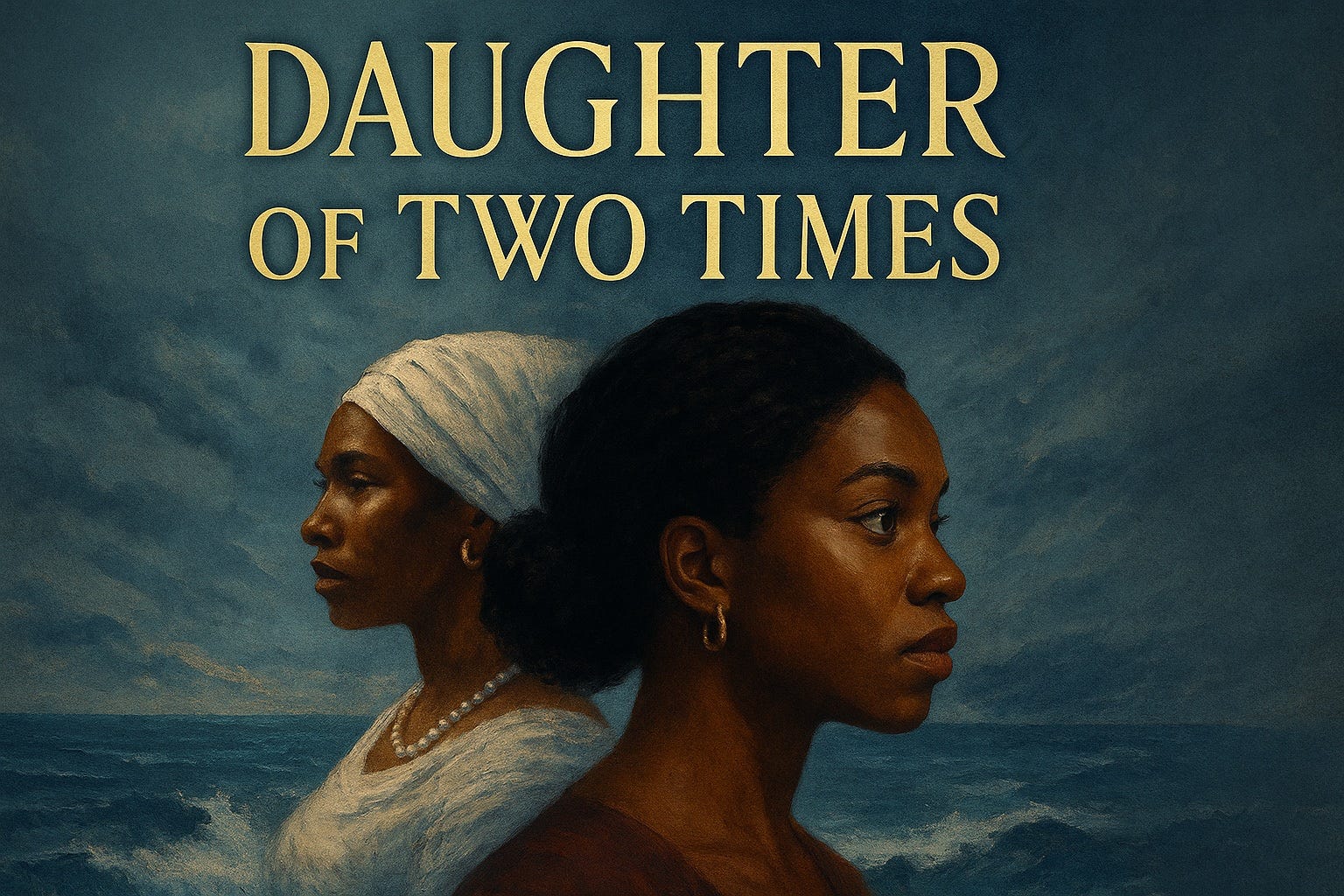
Not a “religious novel.” Not a sermon disguised as fiction. A real story—cinematic, human, emotional—set between nineteenth-century Bahia and today’s urban Brazil, carried by two women in two centuries whose lives echo each other like wave and wind. One is an ancestor who crosses the Atlantic in chains and learns how survival becomes dignity, and dignity becomes foundation. The other is her descendant in São Paulo, who retells that story while her own life transforms in parallel—race, belonging, ambition, motherhood, spiritual memory, all meeting in the same corridor.
The book is called:
DAUGHTER OF TWO TIMES
The Woman Who Crossed, the Woman Who Remembered
Why this title? Because it’s honest. That’s what Ifá does at its best: it tells you you’re never “just” in the present. You are carrying time. You are being carried by time. And the moment you accept that, your daily life changes—how you love, how you choose, how you stand up when the world wants you to shrink.
Structurally, I dared something very “Ifá”: the novel moves through sixteen gates, inspired by the Sixteen Major Odù, from Òg̀bè (first light) to Òfún (white cloth—completion that becomes a beginning). But don’t worry: you do not need to know the tradition to enjoy the story. I built it so that readers can simply read—and feel the pattern working underneath, like a drum you don’t have to understand to recognize.
Now comes the real test: your resonance.
Some of you will love this format because it’s giftable, readable, and it brings the tradition into daily life without requiring initiation into vocabulary. Some of you may dislike it because you prefer me in my “rational” role—clean, technical, exact. I can live with both responses. In fact, I need them. Because this is a trial door. If the door opens into a real house, we build. If it opens into wind only, we learn and return.
One more important note: this novel is available in Brazilian Portuguese as well. The story belongs in the language of the streets that shaped it. Here is the link for FILHAS DE DOIS TEMPOS on Amazon Brazil (but available in USA and Europe a well).
If you read it, tell me—honestly—what it does to you. Does it carry the tradition with dignity? Does it feel accessible without becoming superficial? Does it make you want more of this kind of work, or should I keep my focus on the existing formats of knowledge?
Either way, I’m grateful for the journey—and I’m curious what your Orí will say when you walk through this door.
Until the next gate opens,
Babá Tilo de Àjàgùnnà
DAILY IFÁ
—still with iron in one hand, and a little wind in the other.